Table of contents
IPRoyal and Webshare show up on almost every shortlist for people who want good proxies without an enterprise contract. Both are self-service, both cover residential, ISP and datacenter IPs, and both are popular with developers, solo operators and small teams. But they win for very different reasons. IPRoyal's headline policy is residential traffic that never expires. Webshare's is a genuinely free plan and a plan builder that lets you pay for exactly the proxy count, bandwidth and threads you need.
This comparison walks through how the two providers differ on network, proxy types, billing model, targeting, protocols, tooling and support, and then maps those differences to real workloads. We keep specific prices out of the prose because both providers change plans regularly; the live cards below pull current starting prices and details from our directory.
IPRoyal vs Webshare at a glance
If you only have a minute, here is the short version. Webshare is the easier place to start: you can sign up, get a handful of free datacenter proxies and be sending requests within minutes, then scale with a custom plan. IPRoyal is the easier place to stay if your residential usage is bursty, because the gigabytes you buy sit on your account until you use them instead of vanishing at the end of a billing cycle.
| Factor | IPRoyal | Webshare |
|---|---|---|
| Signature strength | Non-expiring residential traffic, true pay-as-you-go | Forever-free plan and a custom plan builder |
| Strongest product | Residential (rotating and sticky) | Datacenter proxies |
| Residential pool (as listed) | 32M+ IPs across 195 countries | Part of an 80M+ total IP network; residential covers 195 countries |
| Other proxy types | Datacenter, ISP (static residential), mobile, sneaker | Datacenter, static residential (ISP) |
| Protocols | HTTP and SOCKS5 across products | HTTP; confirm SOCKS5 support for your plan in its docs |
| Targeting | Country and city on residential | Country-level focus; geo granularity is more limited |
| Free option | No free trial listed | Free plan with 10 datacenter proxies |
| Best for | Intermittent residential use, SOCKS5 tools, mobile or sneaker needs | Developers, high-volume datacenter work, trying before buying |
IPRoyal
IPRoyal is the pick when you want residential IPs on your own schedule. Buying traffic that never expires removes the "use it or lose it" pressure that subscription plans create, and SOCKS5 support across the range makes it friendly to tools that insist on it.

IPRoyal
IPRoyal is the best pure pay-as-you-go deal in proxies. Non-expiring traffic is a genuinely customer-friendly policy that no major rival matches — buy what you need, use it whenever, lose nothing. The pool is smaller than the premium networks and success rates can soften on the most heavily defended targets, so high-volume enterprise scraping is not its strength. The dashboard is also fairly basic. For intermittent scraping, account work, and sneaker copping on a predictable budget, IPRoyal is an easy recommendation and one of the best value picks for occasional users.
Webshare
Webshare is the pick when you want to start for free, scale datacenter capacity cheaply and manage everything through a clean dashboard and API without ever talking to sales.

Webshare
Webshare is the developer's self-service favorite. Instant activation, a free tier that is actually free, and the cheapest fast datacenter proxies in the market make it the easiest provider to just start using. The custom plan builder — pick your IP count, bandwidth, and threads — is a genuinely good model that lets you avoid paying for capacity you do not need. The residential pool is newer and less battle-tested than specialists, and support is thin on the lower tiers. For datacenter proxies, API-driven workflows, and anyone who wants to try before paying, Webshare is one of the best-value options around.
IPRoyal
Proxy
Webshare
Proxy
Editor score
User rating
Starting price
Founded
Network size and IP sourcing
Pool size numbers are the least useful figure in proxy marketing, but they still tell you something about how each company is positioned. IPRoyal lists a residential network of more than 32 million IPs across 195 countries. Webshare lists more than 80 million IPs in total, but that figure spans datacenter, residential and static residential addresses, so it is not a like-for-like residential comparison.
What matters more in practice is how many usable IPs you get in the locations you actually target, and how clean they are. A pool of tens of millions is more than enough for most small and mid-sized workloads; the difference shows up on heavily defended sites, where both providers are generally considered a step behind the premium networks. Our own listing notes that IPRoyal's success rates can soften on the hardest targets, and that Webshare's residential pool is newer and smaller than its datacenter network.
Pool size is not success rate
Two providers with similar pool sizes can perform very differently on the same target. Always run a short test against your real target list before committing budget. Our guide on how to choose a proxy provider covers what to measure.
Both providers state that their residential IPs are ethically sourced and that they are GDPR compliant. IPRoyal also lists KYC checks for sensitive use cases, which is a reasonable signal that the company polices how its network is used.
Proxy types compared
This is where the two diverge most clearly. IPRoyal sells a broader catalogue; Webshare goes deep on a narrower one.
Residential proxies
IPRoyal's residential product is its centre of gravity. You get rotating and sticky sessions, country and city targeting, and traffic that stays on your account until you use it. Webshare also sells rotating residential proxies, but its own positioning, and our editors' verdict, treat residential as the newer, secondary line next to its datacenter business.
Datacenter proxies
Here the roles flip. Webshare's datacenter network is the product it is best known for, and it is widely regarded as one of the cheapest and fastest options in its class. You choose the number of IPs, the bandwidth and the thread count, so you are not paying for capacity you will not use. IPRoyal also sells datacenter proxies, but they are not the reason most people choose it.
ISP (static residential) proxies
Both providers sell static residential IPs, which are addresses registered to consumer ISPs but hosted on fast server infrastructure. These are useful when you need a stable identity that also looks residential, such as long-lived accounts. If you are unsure which type you need, our explainer on datacenter proxies and our roundup of the best ISP proxies lay out the trade-offs.
Mobile and sneaker proxies
IPRoyal lists mobile proxies and dedicated sneaker proxies; Webshare does not list either in our directory. If you need carrier IPs for social or app workflows, or proxies tuned for retail drops, that alone may settle the decision. For a wider field of mobile options, see our list of the best mobile proxies.
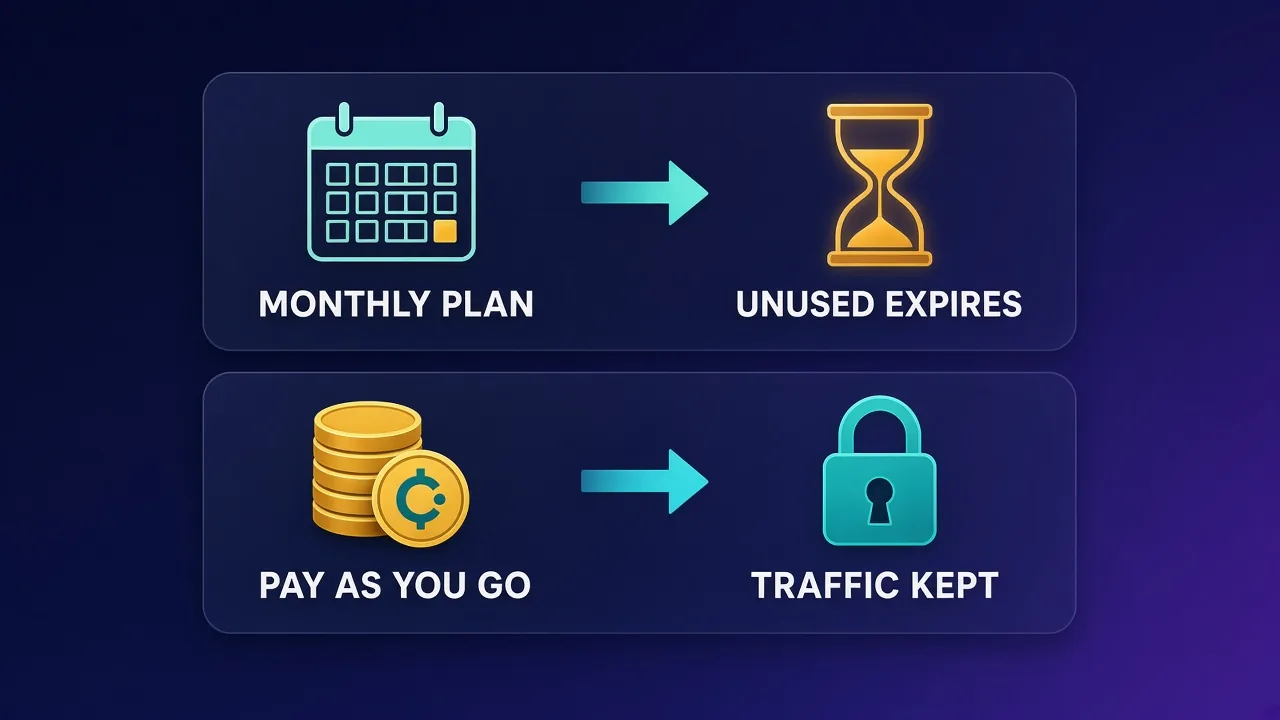
Pricing models: non-expiring traffic vs a custom plan builder
Price per gigabyte or per IP is only half the story. How you are billed shapes what you actually spend.
How IPRoyal bills
IPRoyal sells residential traffic pay-as-you-go. You buy a bundle of gigabytes, and that traffic does not expire. There is no monthly subscription you have to keep alive. For anyone whose usage comes in bursts, such as a monthly price check, a quarterly research project or an occasional account task, this is a real saving, because nothing you paid for gets wiped at the end of the month.
The trade-off is that pay-as-you-go pricing is typically not the lowest per-gigabyte rate at high volume. Teams pushing large, steady traffic through residential IPs may find committed plans elsewhere cheaper per unit.
How Webshare bills
Webshare runs subscription plans, but they are unusually configurable. You choose the proxy type, the number of IPs, the monthly bandwidth and the number of concurrent threads, and the price adjusts to match. There is also a free plan with 10 datacenter proxies and a small monthly bandwidth allowance, with no card required, which makes it easy to test the platform end to end.
The trade-off is the usual subscription one: if you buy more bandwidth than you use in a cycle, that headroom is gone. For steady datacenter workloads that is rarely a problem, because you can size the plan to your real usage.
Check the current plan pages before you buy
Both providers adjust prices, minimums and bundle sizes over time. We deliberately avoid quoting numbers in this article; the cards above show the current starting price from our directory, and you should confirm the exact tier on the provider's own pricing page. Our Webshare pricing explainer breaks down how its plan builder works.
Targeting and session control
For residential work, IPRoyal lists country and city targeting, plus both rotating and sticky sessions. That makes it a better fit when location accuracy matters, for example checking localized search results or prices in specific cities.
Webshare's own limitations, as listed in our directory, include more limited geo-targeting granularity. For many datacenter use cases this does not matter, because you are choosing a country-level pool and rotating through it. If you need city-level residential targeting on a budget, IPRoyal is the safer starting point of the two.
Sticky sessions deserve a quick note. When you log into accounts or work through multi-step flows, changing IP mid-session is a red flag for the target. Both providers let you hold an IP for a period; if session length is critical to you, read our guide to sticky sessions before choosing.
Protocols, authentication and integrations
IPRoyal supports HTTP and SOCKS5 across its product range. That matters more than it sounds: some antidetect browsers, desktop apps and custom scripts only behave correctly over SOCKS5, and having it everywhere removes a common setup headache.
Webshare supports both IP whitelisting and username and password authentication, and its listing highlights a clean REST API, sub-user management and a browser extension. It also lists ready integrations with Puppeteer, Playwright, Selenium, Scrapy, a Python SDK and cURL. IPRoyal lists integrations with Puppeteer, Selenium, Scrapy, cURL and antidetect browsers such as Multilogin and GoLogin.
In short, both will work with mainstream scraping and automation stacks. Webshare's tooling is more developer-polished; IPRoyal's protocol coverage is more consistent.
Dashboard, API and support
Webshare is designed to be fully self-service, with instant activation and a dashboard and API that our editors describe as clean and modern. The downside, according to its listing, is that live chat and phone support are limited on entry plans, so you are expected to help yourself through documentation.
IPRoyal's dashboard is functional but its usage analytics are basic compared with premium providers. If you need detailed per-target success reporting, neither of these budget providers will match the enterprise platforms, and you may want to build your own logging.
Log your own metrics
Whichever provider you choose, record status codes, block pages and response times per target in your own code. Provider dashboards show traffic used, not whether your requests actually succeeded.
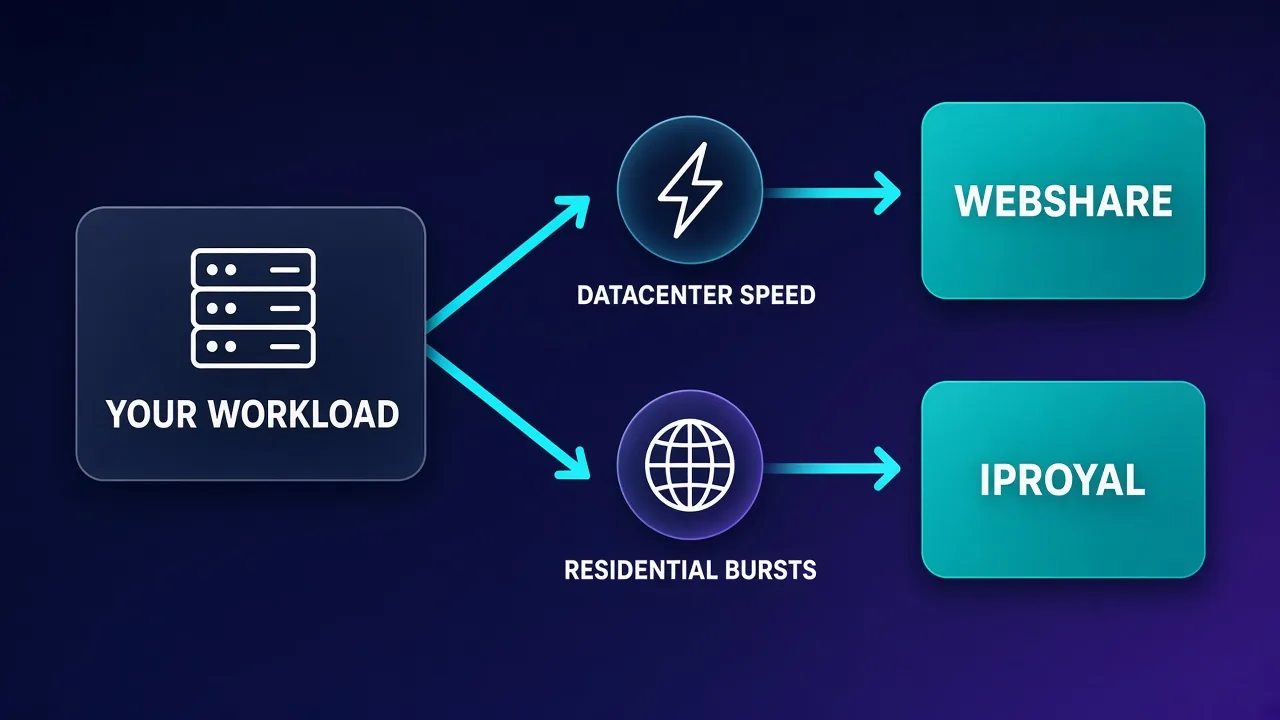
Which one fits your use case?
Web scraping
For easy and moderately protected targets, Webshare's datacenter proxies are hard to beat on value and speed, and the plan builder lets you scale threads as your crawler grows. When a target starts blocking datacenter ranges, IPRoyal's residential pool is a natural step up. For heavily defended sites, consider a premium network or an unblocker product instead; our roundup of the best proxies for web scraping covers those.
Price monitoring and SEO checks
Location-sensitive checks favour IPRoyal because of its city targeting. If your checks run on a schedule but not constantly, non-expiring traffic means you are not paying for idle months.
Account management and antidetect browsers
Long-lived accounts need stable, residential-looking IPs. IPRoyal's ISP and sticky residential options plus SOCKS5 make it the stronger fit here. Webshare's static residential product can work too, but it is not where the company focuses.
Development, testing and learning
Webshare's free plan is the obvious choice for prototyping a scraper, testing proxy rotation logic or learning how proxies work, because you can do all of it without paying. If you are just getting started in code, our guide on using proxies with Python Requests pairs well with a free Webshare account.
Sneakers and mobile
Only IPRoyal lists dedicated sneaker and mobile proxies, so for these workloads it is the only one of the two worth considering.
Pros and cons summary
IPRoyal
- Pros: residential traffic never expires; true pay-as-you-go with no subscription; SOCKS5 across products; country and city targeting; mobile and sneaker options.
- Cons: smaller pool than premium rivals; success rates can dip on the hardest targets; basic dashboard analytics; no free trial listed.
Webshare
- Pros: forever-free plan; among the cheapest and fastest datacenter proxies; highly customizable plans; instant self-service activation; clean dashboard and API.
- Cons: residential pool is newer and smaller; limited geo-targeting granularity; limited live support on entry plans.
How to test both before committing
The cheapest mistake is the one you catch in a test. A sensible process looks like this:
- Pick 20 to 50 real target URLs that represent your workload, including at least a few of the hardest pages you need.
- Start with Webshare's free plan for datacenter tests and a small IPRoyal residential bundle, which will not expire if you stop testing halfway.
- Measure success rate, latency and block pages per provider and per target, not just whether a request returned a 200.
- Check location accuracy if geo matters, by comparing the exit IP's reported country and city with what you requested.
- Estimate real monthly cost from the traffic or IP count your test implies, then compare billing models, not just headline rates.
Our step-by-step guide on how to test a proxy covers speed, anonymity and leak checks in more detail.
Common mistakes when choosing between them
- Comparing total IP counts directly. Webshare's headline number includes datacenter IPs; IPRoyal's is residential. They are not measuring the same thing.
- Buying residential for jobs datacenter can do. If a target does not block datacenter ranges, residential bandwidth is an expensive way to get the same result.
- Over-buying a subscription for occasional use. If you only need proxies a few days a month, non-expiring traffic usually wins.
- Ignoring protocol needs. Confirm your tool's SOCKS5 or HTTP requirements before you pick a plan.
- Skipping a real-target test. Reviews, including this one, cannot predict how a specific site treats a specific pool on a given week.
Verdict: IPRoyal or Webshare?
Choose Webshare if your work is mostly datacenter-friendly, you want to start free, and you value a polished self-service dashboard and API. It is the best way in this pair to get fast, cheap capacity and scale it precisely.
Choose IPRoyal if you mainly need residential IPs, your usage is irregular, you rely on SOCKS5, or you need mobile or sneaker proxies. Non-expiring traffic is a genuinely customer-friendly policy, and it changes the maths for anyone who does not burn bandwidth every day.
Plenty of teams end up using both: Webshare datacenter proxies for bulk, low-risk requests and an IPRoyal residential bundle held in reserve for the targets that push back. If neither fits, browse our list of the best cheap residential proxies or see how Webshare stacks up against an enterprise network in Webshare vs Bright Data.
Frequently asked questions
It depends on how you use proxies. Webshare is usually the cheaper route for datacenter proxies and steady usage, and it has a free plan. IPRoyal can work out cheaper for irregular residential use because the traffic you buy never expires, so you never pay for bandwidth you lose at the end of a month.
Yes, according to IPRoyal's own policy, purchased residential traffic stays on your account until you use it. There is no monthly subscription you have to keep active. Always confirm the current terms on IPRoyal's site before buying.
Yes. Webshare offers a free plan with 10 datacenter proxies and a small monthly bandwidth allowance, and no credit card is required. It is a practical way to test the dashboard, API and proxy setup before paying.
For easy to moderately protected sites, Webshare's fast, inexpensive datacenter proxies are usually the better value. When a target blocks datacenter IP ranges, IPRoyal's residential proxies are the better option of the two. For heavily defended sites, a premium network or unblocker may be needed.
IPRoyal lists SOCKS5 support across its product range. Webshare supports standard HTTP proxies and lists IP whitelisting and username and password authentication; check its documentation for SOCKS5 availability on the plan you choose.
IPRoyal is generally the stronger fit because it offers static ISP proxies, sticky residential sessions, mobile proxies and SOCKS5, which pair well with antidetect browsers. Webshare's static residential product can work, but it is not the company's main focus.
IPRoyal lists country and city targeting on its residential proxies. Webshare's geo-targeting is more limited in granularity, so if city-level location matters, IPRoyal is the safer choice of the two.
Many teams do. A common setup is Webshare datacenter proxies for bulk, low-risk requests and a reserve of IPRoyal residential traffic for targets that block datacenter IPs. Because IPRoyal traffic does not expire, keeping a reserve costs nothing extra over time.