Table of contents
Decodo and IPRoyal are two of the names that come up most often when a buyer wants residential proxies without signing an enterprise contract. Both sell self-service residential, ISP, datacenter and mobile proxies from one dashboard, both cover 195+ locations, and both bill residential traffic by the gigabyte. The differences show up in the details: how the per-GB rate falls as you buy more, whether unused traffic expires, how long a sticky session can last, what the refund rules look like, and how each provider talks about where its IPs come from.
This comparison puts the two side by side on the things that actually change your bill and your success rate. Every price below was read from Decodo's and IPRoyal's own pricing pages on 11 November 2026. Proxy prices move often, so treat the figures as a dated snapshot and confirm the total at checkout. For the full plan-by-plan breakdowns, see Decodo Pricing Explained and IPRoyal Pricing Explained.
The short answer
For steady monthly residential usage from a few GB up to about 1 TB, Decodo's list prices are lower at every public tier we could compare. IPRoyal makes more sense when your usage is irregular and you want traffic that never expires, when you need sticky sessions longer than Decodo's, or when you want to rent ISP or dedicated mobile proxies for a day at a time.
Decodo vs IPRoyal at a glance
Here is how the two providers line up on the points most buyers ask about first. The figures come from each provider's pricing and product pages as they appeared on 11 November 2026.
| Feature | Decodo | IPRoyal |
|---|---|---|
| Advertised residential pool | 115M+ IPs, 195+ locations | 64M+ IPs, 195+ countries |
| Smallest residential plan | 3 GB at $3.75/GB ($11.25 a month) | 1 GB at $7.00/GB (subscription) or $7.35/GB (pay as you go) |
| 10 GB residential | $3.50/GB ($35 a month) | $5.25/GB on subscription |
| Lowest advertised residential rate | $2/GB at 1,000 GB (Enterprise tab) | $1.75/GB from 10 TB (custom plan) |
| Pay as you go | $4/GB, bought one GB at a time through the Wallet | From $7.35/GB at 1 GB, traffic never expires |
| Targeting | Continent, country, state, city, ZIP and ASN | Country, state and city |
| Sticky sessions | Up to 30 minutes, per the pricing page FAQ | Up to 7 days |
| Protocols | HTTP(S) and SOCKS5 | HTTP(S) and SOCKS5 |
| Trial | 3-day trial with 100 MB on residential | Limited trial mentioned in the terms, subject to eligibility |
| Refunds | 14-day money-back on the first purchase, with usage limits | Full refund only if the service is defective in the first 24 hours; otherwise discretionary |
Neither column is a clean win. Decodo is cheaper per GB at the sizes most small and mid-sized teams buy, and it offers finer targeting. IPRoyal trades a higher small-plan rate for traffic that does not expire, longer sticky sessions and short ISP rentals.
Residential proxy pricing compared
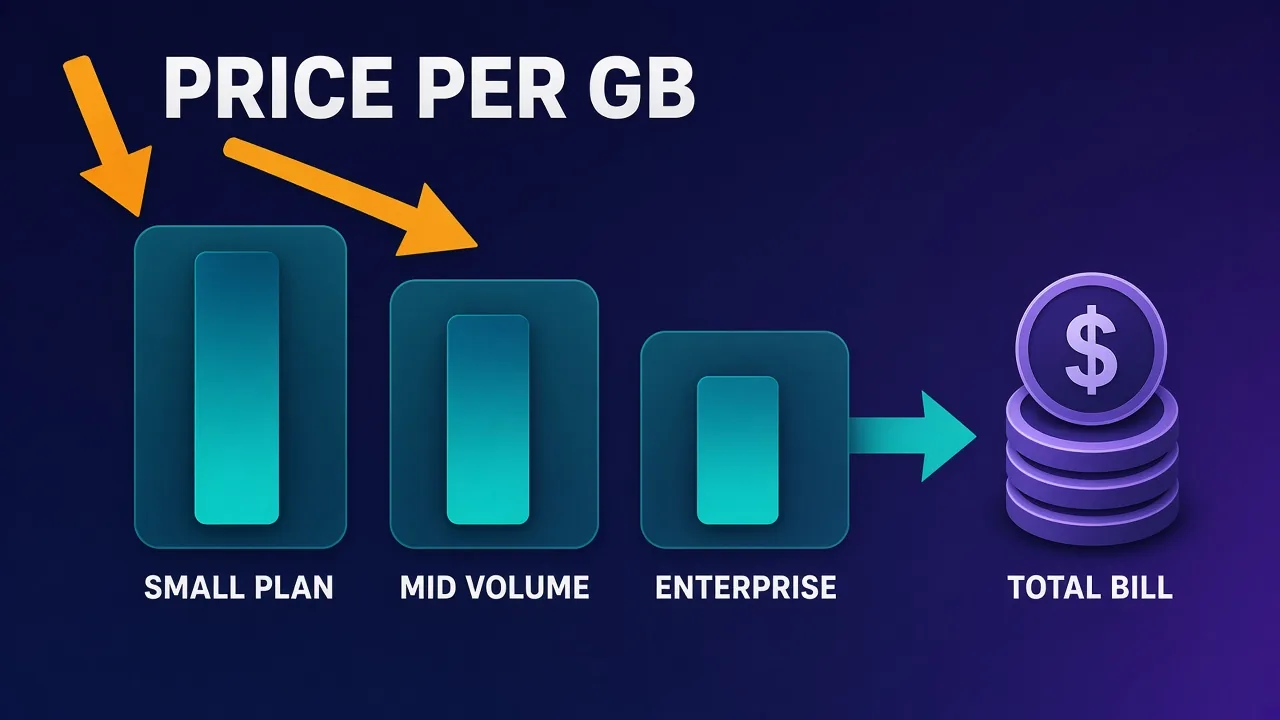
Residential proxies are the product most people mean when they compare these two, so this is where the money decision usually happens. Both meter residential traffic per GB, but the shape of the price ladder is very different.
Decodo's residential tiers
Decodo publishes a full ladder of monthly subscriptions. On the Regular tab, plans run from 3 GB at $3.75/GB ($11.25 a month) through 10 GB at $3.50/GB ($35), 25 GB at $3.25/GB ($81.25), 50 GB at $3/GB ($150) and 100 GB at $2.75/GB ($275). The Enterprise tab continues with 250 GB at $2.50/GB ($625) and 1,000 GB at $2/GB ($2,000). All of these prices are shown before VAT, and orders are processed by Paddle as the merchant of record, so the amount you are charged can differ by country.
Pay As You Go is $4/GB. It runs through Decodo's Wallet: you top up credits, then buy one GB at a time. Decodo states that you cannot hold a monthly residential subscription and Pay As You Go at the same time.
IPRoyal's residential tiers
IPRoyal's page has two tabs. On the subscription tab (5% off), the public packages are 1 GB at $7.00/GB, 2 GB at $5.95/GB and 10 GB at $5.25/GB. On the pay-as-you-go tab, 1 GB is $7.35/GB and 2 GB is $6.25/GB. Above that, the next step on the page is a custom plan: $1.75/GB on subscription or $1.84/GB on pay as you go, both available only from 10 TB (10,000 GB).
That 10 TB condition matters. IPRoyal's headline "from $1.75/GB" is real, but it starts at a purchase of roughly $17,500. Between 10 GB and 10 TB the public page lists no intermediate prices, so buyers in that range need to ask IPRoyal's sales team for a quote.
What a month actually costs
The table below uses list prices only. For IPRoyal sizes that fall between public packages, we show the cost of buying the 10 GB subscription package repeatedly, which is the most you would pay at list. A sales quote could come in lower, so treat those cells as an upper bound.
| Monthly residential need | Decodo (list) | IPRoyal (list) |
|---|---|---|
| 1 to 3 GB test | $11.25 for the 3 GB plan, or $4 per GB on Pay As You Go | $7.00 to $7.35 for 1 GB |
| 10 GB | $35 | $52.50 (subscription) |
| 50 GB | $150 | Up to $262.50 at the 10 GB rate, or a custom quote |
| 100 GB | $275 | Up to $525 at the 10 GB rate, or a custom quote |
| 1,000 GB | $2,000 (Enterprise tab) | Custom quote |
| 10 TB | Contact sales | $17,500 (subscription) or $18,400 (pay as you go) |
On public list prices, Decodo is cheaper at every size from 3 GB to 1 TB. The only place IPRoyal publishes a lower rate is at 10 TB, where Decodo asks you to contact sales, so that comparison cannot be made from the pricing pages alone.
Compare the tier you will actually buy
Both providers advertise their deepest volume rate in the headline: "from $2/GB" for Decodo and "from $1.75/GB" for IPRoyal. Line up the plan size that matches your real monthly usage, then add VAT or any checkout fee, before you decide.
Never-expiring traffic vs monthly plan tiers
Price per GB is only half of the cost picture. The other half is how much of what you buy you actually use, and here the two providers take opposite approaches.
Decodo's residential plans are monthly subscriptions. Upgrades, downgrades and cancellations take effect from the next billing cycle, and the plan you already paid for stays yours until that cycle ends. That works well when usage is steady: pick the tier that matches last month, and adjust if it changes.
IPRoyal leans on flexibility. Its pricing page highlights "never expiring traffic" on pay as you go: the gigabytes you buy stay on your account until you use them. On the subscription side, the terms we reviewed for our IPRoyal pricing guide say unused data accumulates from month to month instead of disappearing, as long as the account stays active.
That difference changes the math for irregular workloads. If you scrape heavily one month and barely at all the next two, an IPRoyal pay-as-you-go balance can absorb the swings without waste, while a Decodo subscription sized for your busy month would leave paid traffic unused in the quiet months. On the other hand, if you use about the same amount every month, Decodo's lower per-GB rate wins and the expiry rule rarely costs you anything.
A simple way to decide
- If your monthly usage varies by more than about half from one month to the next, price IPRoyal pay as you go against Decodo's smallest tier plus Pay As You Go top-ups.
- If your usage is steady and above 10 GB a month, Decodo's subscription ladder is usually the cheaper route at list price.
- If you are not sure yet, run a small test on both before committing to a plan size.
Pool size, targeting and rotation
Decodo advertises 115M+ residential IPs across 195+ locations, with continent, country, state, city, ZIP code and ASN-level targeting included in every residential plan. ZIP and ASN targeting are useful for local SEO checks, ad verification and any job where the specific carrier or neighbourhood matters.
IPRoyal advertises 64M+ residential IPs in 195+ countries with city-level targeting. Its residential features include an instant IP change from the dashboard or by API, timed auto-rotation every 1, 10 or 30 minutes, sticky sessions of up to 7 days and unlimited concurrent sessions.
Advertised pool sizes are marketing figures, and neither number tells you how many IPs are online in a particular city at the moment you need them. What matters more is whether each provider has enough fresh IPs on your specific targets and locations. A short trial against your real target list will tell you more than either headline.
Sticky sessions
Session length is one of the clearest practical differences. Decodo's residential pricing FAQ describes rotating IPs per request or keeping one IP for up to 30 minutes. IPRoyal lets a sticky residential session last up to 7 days. If you run logged-in workflows that must keep the same residential address for hours, IPRoyal's longer sessions are a real advantage. If you need an address for days or weeks, both providers would point you to ISP proxies instead.
ISP, datacenter and mobile proxies
Both providers sell more than residential traffic, and the static products are priced in quite different ways.
Decodo sells ISP (static residential) proxies three ways: dedicated IPs, shared IPs billed per GB, and shared IPs billed per IP. The dedicated tab on 11 November 2026 ran from 3 IPs at $3.33/IP ($9.99 a month) down to 2,000 IPs at $2/IP, with the page listing shared options from $1.30/GB and from $0.27/IP. All three are monthly subscriptions. Decodo also notes that cryptocurrency is not accepted for ISP proxies.
IPRoyal rents ISP proxies per IP for a fixed period, starting from $1.80 for 24 hours, with a 60-day rental listed at $2.55. Its page says the ISP product covers 31+ countries with state and city targeting and both HTTP(S) and SOCKS5. The 24-hour option is handy for short tests or one-off tasks where a monthly commitment would be wasted.
For datacenter and mobile proxies the pattern is similar. Decodo sells shared and dedicated datacenter proxies plus per-GB mobile plans. IPRoyal rents dedicated datacenter IPs for 30, 60 or 90 days and sells mobile proxies both per GB and as dedicated devices by the day or month. Check each live pricing page before you buy, because static proxy prices vary by country and quantity.
Tools, integrations and support
Both dashboards cover the basics: username and password or IP whitelisting for authentication, usage statistics, and a proxy generator for endpoints. Decodo includes a Chrome extension and Firefox add-on with residential subscriptions and publishes setup guides for common browsers, extensions and tools. It also lets you create sub-users with traffic limits, which helps agencies keep one client from draining a shared plan.
IPRoyal's dashboard focuses on self-service control of orders, usage insights and IP whitelisting, and it also offers browser extensions. Both providers advertise round-the-clock support. If you plan to wire proxies into a scraper, either one works with the usual HTTP client libraries and frameworks.
Trials, refunds and billing rules
The refund rules are where the two differ most, and they are worth reading before you pay.
Decodo offers a 3-day free trial on residential proxies with 100 MB of traffic for new users. Its 14-day money-back option applies only to the first purchase, only if you did not use the free trial, and only if you used no more than 20% of a regular residential plan's traffic (10% on Enterprise). You have to choose between the trial and the refund route.
IPRoyal's terms describe paid fees as non-refundable by default. You are entitled to a full refund if a service is inactive or defective in the first 24 hours and IPRoyal cannot fix it in that window. Beyond that, refunds are at its discretion, and crypto payments are never refundable. A service fee can also be added at checkout depending on the product and payment method.
Test small on both
Use Decodo's trial or its smallest plan, and IPRoyal's 1 GB pay-as-you-go package, against your real targets on the same day. With IPRoyal, report any problem within 24 hours, since that is the window its terms protect.
How IPRoyal sources its residential IPs (and the abuse reports)
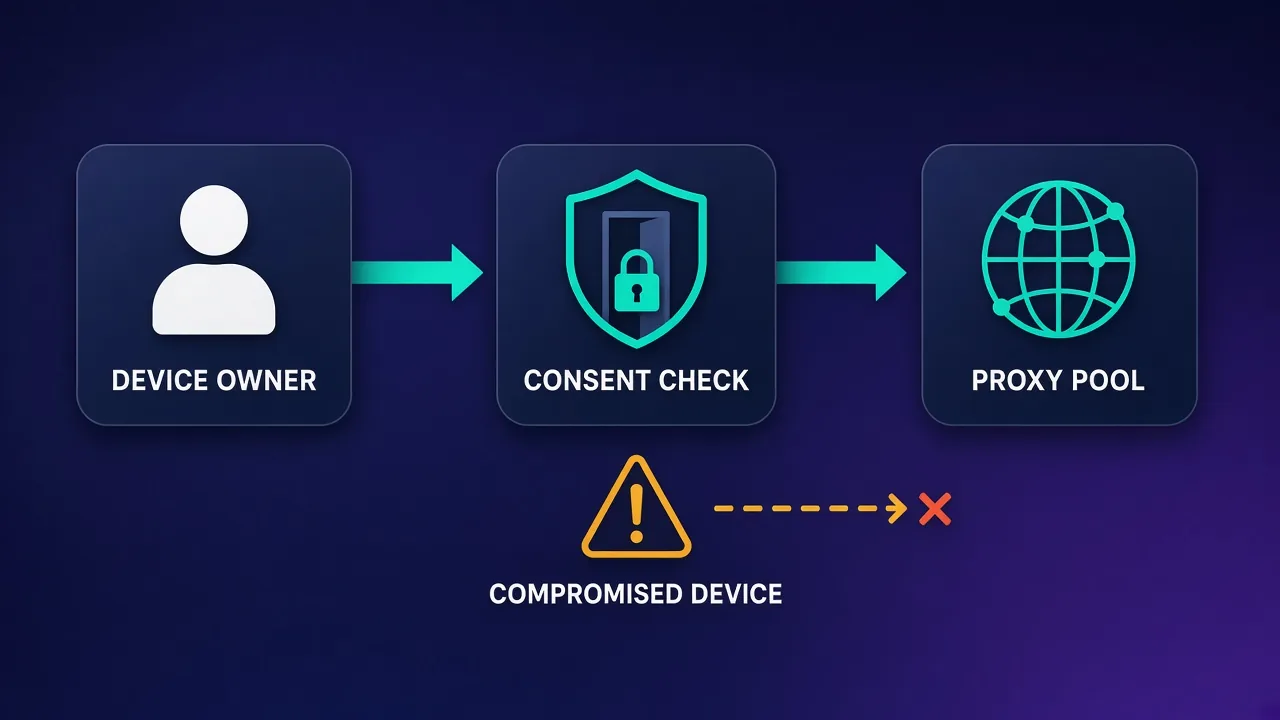
Residential IPs come from real home connections. IPRoyal's pool relies in part on people sharing bandwidth through an app. Security firm GreyNoise describes Pawns.app as a "direct partner" of IPRoyal that supplies proxy nodes, and says it appears to be a rebrand of "IPRoyal Pawns."
That software has been found on devices whose owners never agreed to run it. In October 2026, GreyNoise reported an actor it tracks as skynox7 that compromised at least 143 edge devices in 34 countries and installed Pawns.app on them under the attacker's own payout account. AhnLab's ASEC team has documented similar cases, including adware droppers that installed IPRoyal Pawns without permission and attacks on poorly managed MS-SQL servers that installed it alongside other proxyware.
None of these reports shows that IPRoyal installed the software itself. In the reported cases, attackers ran it on devices they did not own and collected the payouts. IPRoyal's transparency statement says suppliers must show that device owners gave informed consent, and that it checks its pool against public abuse databases. We cover the details in our IPRoyal pricing guide.
Decodo describes its residential IPs as ethically sourced, and we have not seen comparable public reports tying Decodo's network to compromised devices. That is not proof that any app-based pool is free of abuse, though. For any residential provider, ask how it proves consent before you sign up for a large plan, and use residential IPs only for legitimate work. Our roundup of residential proxy network takedowns explains why sourcing has become a buying question.

Decodo
Proxy

IPRoyal
Proxy
Editor score
User rating
Starting price
Founded
Which one should you choose?
Most buyers fall into one of a few situations.
Choose Decodo if
- You use a predictable amount of residential traffic each month, from a few GB up to around 1 TB, and want the lower list price.
- You need ZIP code or ASN targeting for local or carrier-specific checks.
- You want a free trial and a money-back window on your first purchase.
- You manage several projects or clients and want sub-users with traffic limits.
Decodo
Decodo offers the best price-to-performance ratio in the industry. It delivers roughly 90% of what the enterprise leaders provide — high success rates, a large clean pool, sticky sessions, an unblocker — at a fraction of their cost. The dashboard is the friendliest of any major provider, the 14-day money-back guarantee removes the risk of trying it, and support actually responds. The main gaps are enterprise-grade compliance tooling and the very deepest targeting, neither of which most teams need. For startups, solo developers, and any team that wants professional results without enterprise pricing, Decodo is our top value pick and an easy recommendation.
Choose IPRoyal if
- Your usage is irregular and you want pay-as-you-go traffic that never expires.
- You need sticky residential sessions longer than 30 minutes, up to 7 days.
- You want to rent ISP proxies for 24 hours, or dedicated mobile proxies by the day.
- You are buying at 10 TB or more and want a published per-GB rate to compare against quotes.
IPRoyal
IPRoyal is the best pure pay-as-you-go deal in proxies. Non-expiring traffic is a genuinely customer-friendly policy that no major rival matches — buy what you need, use it whenever, lose nothing. The pool is smaller than the premium networks and success rates can soften on the most heavily defended targets, so high-volume enterprise scraping is not its strength. The dashboard is also fairly basic. For intermittent scraping, account work, and sneaker copping on a predictable budget, IPRoyal is an easy recommendation and one of the best value picks for occasional users.
If neither fits, our list of Decodo alternatives covers other mid-market providers worth pricing on the same worksheet.
Common mistakes when comparing the two
- Comparing headline rates. "From $2/GB" and "from $1.75/GB" apply at 1 TB and 10 TB respectively. Compare the plan size you will really buy.
- Ignoring waste. Every image, script and retry is billed on a per-GB plan. Blocking unneeded assets often saves more than switching providers.
- Forgetting the refund window. IPRoyal protects you for 24 hours, while Decodo's money-back route is lost once you start the free trial.
- Skipping taxes and fees. Decodo's prices are shown before VAT, and IPRoyal may add a service fee at checkout.
- Judging pools by size. Test success rates on your own targets and locations rather than trusting advertised IP counts.
The bottom line
On public list prices, Decodo is the cheaper residential option for most buyers, with a full ladder of monthly tiers, finer targeting, a free trial and a clearer first-purchase refund. IPRoyal costs more per GB below 10 TB, but it gives you traffic that never expires on pay as you go, rollover data on subscriptions, sticky sessions of up to 7 days and short ISP rentals. If you go with IPRoyal, read the sourcing reports above and ask how it proves consent before a large commitment. Whichever you lean towards, run a small test on both against your real targets, then compare cost per successful request rather than cost per GB.
Frequently asked questions
On public list prices checked on 11 November 2026, yes for most plan sizes. Decodo's 10 GB plan is $3.50/GB ($35 a month), while IPRoyal's 10 GB subscription is $5.25/GB. IPRoyal only publishes a lower rate ($1.75/GB) from 10 TB, where Decodo asks you to contact sales.
IPRoyal says pay-as-you-go residential traffic never expires, so the gigabytes stay on your account until you use them. Its subscription terms also let unused data accumulate from month to month while the account is active. Decodo's residential plans are monthly subscriptions, with changes applied from the next billing cycle.
IPRoyal allows sticky residential sessions of up to 7 days. Decodo's residential pricing FAQ describes keeping one IP for up to 30 minutes. For identities that must stay on one address for days or weeks, both providers offer ISP proxies instead.
Decodo offers new users a 3-day residential trial with 100 MB of traffic, but using it removes the 14-day money-back option. IPRoyal's terms mention a limited free trial for evaluation subject to eligibility checks, so check its site or support before counting on one.
Decodo offers a 14-day money-back option on the first purchase only, if you skipped the free trial and used no more than 20% of a regular residential plan (10% on Enterprise). IPRoyal refunds in full if a service is defective in the first 24 hours and can't be fixed; otherwise refunds are discretionary and crypto payments are never refunded.
Decodo includes continent, country, state, city, ZIP code and ASN-level targeting on residential plans. IPRoyal offers country, state and city targeting. If you need ZIP or carrier-level precision, Decodo covers more options out of the box.
Researchers at GreyNoise and AhnLab found IPRoyal's Pawns bandwidth-sharing software installed on compromised devices by attackers, though the reports don't show IPRoyal installed it. IPRoyal says suppliers must prove informed owner consent and that it checks its pool against abuse databases. Use residential IPs only for legitimate work and ask any provider how it verifies consent.
IPRoyal rents ISP proxies from $1.80 for 24 hours, which suits short tests and one-off tasks. Decodo sells ISP proxies as monthly subscriptions, either dedicated per IP, shared per GB or shared per IP.