Table of contents
For years, the main question proxy buyers asked was "how fast and how cheap?" In 2026 a new question pushed its way to the front: where do these IPs actually come from? Two large enforcement actions, Google's disruption of the IPIDEA network in January and the FBI's seizure of NetNut domains on 2 July, showed that the sourcing behind a residential pool can become a legal, operational and reputational problem for everyone who rents it, including customers who never heard the upstream brand's name.
This explainer walks through what happened in both cases, what is and is not established, why sourcing became the core risk in the residential proxy market, and a practical due-diligence checklist you can run on any vendor before you send it traffic. We attribute every claim to its source. A domain seizure is a law-enforcement action, not a court finding, and nothing here should be read as a verdict on any company.
The short version
Both takedowns targeted networks that researchers say grew by putting proxy code on consumer devices, often without meaningful owner consent. Both networks were widely resold under other brand names. If your provider bought capacity from an affected pool, your scrapers and accounts could break overnight, and your traffic may have been riding on compromised devices.
What happened to IPIDEA in January 2026
On 28 January 2026, the Google Threat Intelligence Group (GTIG) published details of an action against IPIDEA, which it described as one of the largest residential proxy networks in the world. Google said the operation had three parts: legal action to take down domains used to control devices and route proxy traffic, sharing technical intelligence about IPIDEA's software development kits (SDKs) with platforms, law enforcement and researchers, and making Google Play Protect warn users about, remove and block apps known to contain IPIDEA SDKs.
Google said the action reduced the pool of devices available to the operators "by millions". It also reported that in a single seven-day period in January 2026 it saw more than 550 distinct threat groups using IP addresses it tracked as IPIDEA exit nodes, including groups from China, North Korea, Iran and Russia. Reporting by CyberScoop quoted Lumen's Black Lotus Labs saying initial data suggested the network shrank by about 40%, while roughly 5 million bots were still talking to IPIDEA's command servers afterwards. CNA, citing Google, reported that IPIDEA operated at least 13 residential proxy brands that were taken offline.
It did not stay down
The most useful lesson for buyers came months later. On 4 September 2026, Team Cymru Research posted an intel brief saying it had watched the IPIDEA operators rebuild "from near-zero starting in April 2026" to near-full operation by August, tracking 1,021,627 IP addresses tied to the network and more than 6,713 active tier-2 controllers against about 7,400 before the disruption. In other words, a takedown can remove infrastructure without removing the business, and the brands reselling a pool can reappear on fresh hostnames.
What happened to NetNut in July 2026
On 2 July 2026, KrebsOnSecurity reported that the FBI had worked with industry partners to seize hundreds of domains associated with NetNut, a residential proxy service run by Alarum Technologies, an Israeli company listed on Nasdaq. NetNut's homepage was replaced with a seizure notice from the FBI and IRS Criminal Investigation that thanked Google, Lumen, Shadowserver and other partners. Krebs noted that about two weeks earlier, several security firms had published findings linking NetNut to a botnet tracked as Popa.
The same day, Google's GTIG said it had acted against "the NetNut residential proxy network, also known as Popa", building on the IPIDEA disruption. Google estimated the network at "at least 2 million devices", said NetNut populated it by distributing SDKs for devices such as smart TVs and streaming boxes, and said it observed 316 distinct threat clusters using suspected NetNut exit nodes in a single week of June 2026. Google also stated it had "high confidence that many popular residential proxy brands are in fact whitelabeling the NetNut botnet."
What Alarum has said
Alarum's public statements are an important part of the record. In a 2 July statement it said it had become aware of the seizure, takes the matter seriously and "will fully cooperate with law enforcement to ensure any misuse of its infrastructure is thoroughly investigated." In a 3 July update it said more NetNut domains had been seized, that it was experiencing disruptions to part of its services, that neither it nor NetNut had been formally contacted by the FBI or another authority at that time, and that it was investigating whether third parties had misused its network.
As far as public reporting shows, no criminal charges against NetNut or Alarum have been announced. When we checked on 31 October 2026, netnut.io still displayed the "Seized by the Federal Bureau of Investigation" page.
Seizure is not a conviction
A domain seizure is an investigative step. The botnet descriptions above are Google's and independent researchers', and they have not been tested in court. We report them because they are credible, specific and directly relevant to buyers, not because a court has ruled.
Why sourcing became the risk
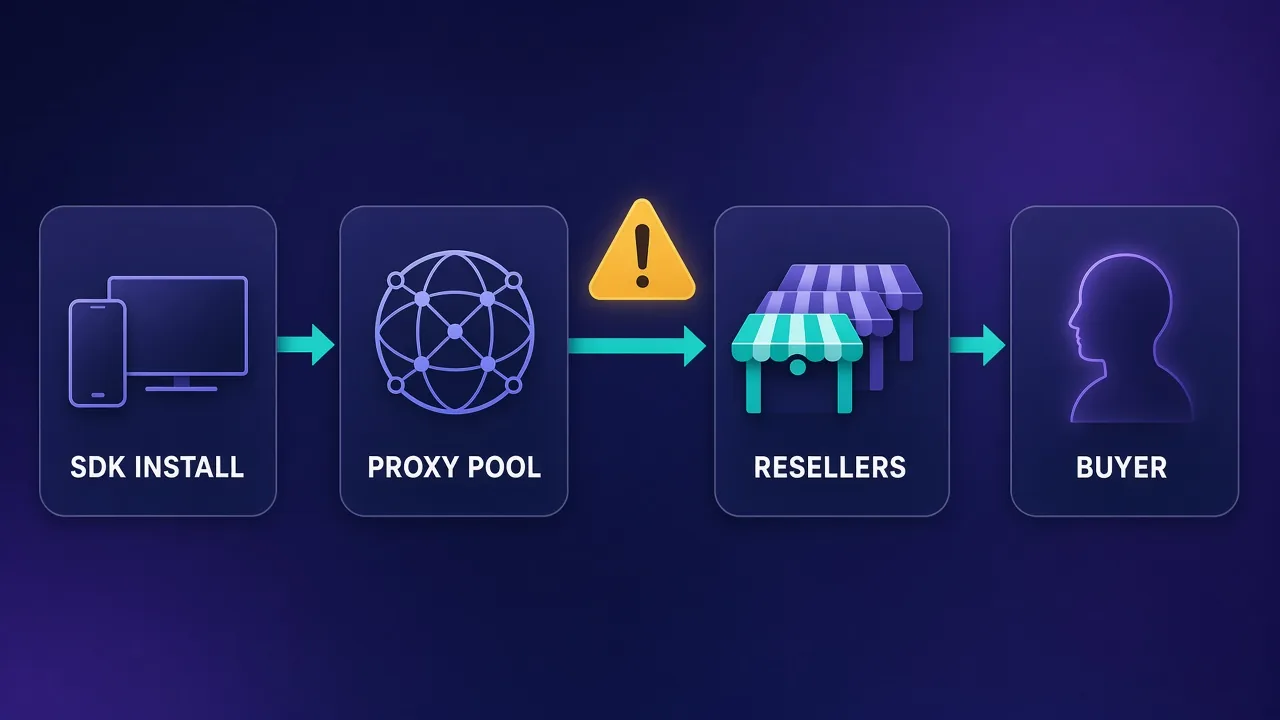
A residential proxy is valuable because its traffic exits through a real consumer internet connection, which websites trust more than a data-centre IP. To sell millions of those exits, a provider needs software running on millions of consumer devices. There are broadly three ways to get it there:
- Explicit opt-in. A user knowingly installs a bandwidth-sharing app, understands what it does and is paid or rewarded, and can leave whenever they want.
- Bundled SDKs. A developer embeds a proxy SDK in a free app or game. Consent depends on how clearly the app explains it, and Google's reports describe SDKs that "surreptitiously enroll user devices".
- Pre-installed or malicious code. Cheap streaming boxes or TVs ship with, or later receive, proxy components. Google tied both IPIDEA and NetNut to botnets such as BadBox 2.0, where owners had little or no say.
The first model can be legitimate. The second and third are where the takedowns landed. The problem for a buyer is that you usually cannot see which model sits behind the gateway you are paying for.
The white-label problem
Both Google posts stress the same point: residential proxy pools are resold. Google said IPIDEA controlled a cluster of seemingly independent proxy and VPN brands, and that NetNut ran "a robust reseller program that allows whitelabeling of its network." It also observed that when an operator's own network is degraded, it may start buying capacity from competitors, effectively becoming a reseller itself.
That means the logo on your invoice does not tell you whose devices carry your traffic. A small brand with a slick dashboard can be a thin layer over a much larger upstream pool. When that upstream is seized, the downstream brand can go dark with no warning, or quietly switch to another source you know nothing about.
| Question | IPIDEA (Jan 2026) | NetNut (Jul 2026) |
|---|---|---|
| Who acted | Google GTIG with Cloudflare, Lumen Black Lotus Labs and Spur | FBI and IRS-CI, with Google, Lumen, Shadowserver and others |
| Main action | Legal action against control and marketing domains, SDK intelligence sharing, Play Protect removals | Seizure of hundreds of domains, disabled Google accounts used for C2, Play Protect removals |
| Reported scale | Pool reduced "by millions" (Google); about 40% cut, roughly 5 million bots still active (Lumen via CyberScoop) | At least 2 million devices (Google estimate); pool reduced "by millions" |
| Reported abuse | 550+ threat groups in one week (Google) | 316 threat clusters in one week (Google) |
| Reselling | Cluster of seemingly independent brands; at least 13 brands taken offline (CNA, citing Google) | Reseller and white-label program; Google believes many brands resold it |
| Aftermath | Rebuilt to near-full operation by August (Team Cymru) | Domains still showing the seizure page on 31 October 2026; no public charges reported |
What these takedowns mean for proxy buyers
Operational risk
When an upstream pool is disrupted, success rates collapse, gateways stop resolving and sticky sessions die mid-task. Alarum itself said, in a press release in early July, that it had decided to temporarily pause traffic through the relevant network services for several days. If your price monitoring, ad verification or QA pipeline depended on that pool through a reseller, you found out the hard way.
Security risk
Google warned that when a consumer device becomes an exit node, unauthorized traffic passes through it and other devices on the same home network can be exposed. Turned around, it also means your requests are passing through hardware nobody is maintaining or securing. Sensitive logins and session cookies have no business crossing that path.
Legal and reputational risk
Using a proxy is generally legal, as we cover in Are Proxies Legal?, but knowingly benefiting from compromised devices is a different matter, and the FBI seizure notice, as transcribed by ProxyPicker, says the action was taken "against the NetNut residential proxy platform, its administrators, and its subscribers". For companies, the more immediate cost is usually reputational: a customer, partner or auditor asking why your traffic came from a botnet named in a Google threat report.
Data and account risk
Networks that attract hundreds of threat groups also attract heavy blocking. IP reputation services flag those exits, so your accounts and scrapers inherit the reputation of whoever used the same IP an hour earlier.
Red flags that a pool may be badly sourced
- Prices far below the market for "ethically sourced" residential traffic, with no explanation of how the economics work.
- No public page describing how devices join the network, or a vague line about "millions of real users" and nothing else.
- Heavy pools of exits on smart TVs, Android TV boxes or other device types consumers rarely install bandwidth-sharing apps on.
- No know-your-customer (KYC) process at all, or marketing aimed at use cases like credential stuffing or "unblock anything, no questions asked".
- A brand that cannot say whether it runs its own network or resells someone else's.
- A company with no named legal entity, address or responsible leadership.
A due-diligence checklist for any proxy vendor
We go deeper on this in What Makes a Proxy Provider Trustworthy?. Here is the condensed version tuned to the lessons of 2026.
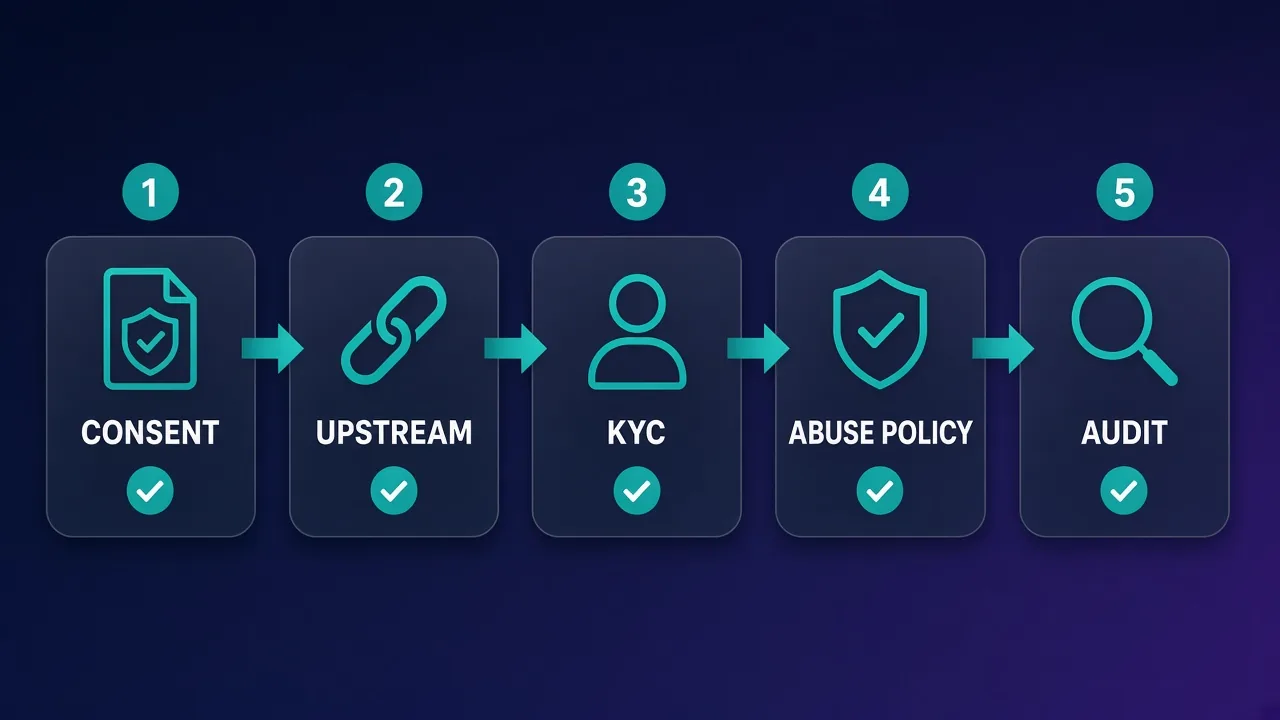
- Ask how devices join the pool. You want a named app or SDK, a plain-language consent screen, a way for participants to opt out, and clear compensation. Ask to see the consent flow.
- Ask who the upstream is. Get a written answer to "do you operate your own network, resell another, or both?" If they resell, ask which networks and whether they audit them.
- Check the SDK partners. Providers that embed SDKs in third-party apps should be able to describe the review they run on those apps and how they handle an app that hides the proxy feature.
- Check device mix. Ask what share of the pool is phones, desktops and TV-type devices. A pool dominated by cheap streaming boxes deserves extra questions given what Google reported.
- Look for KYC and an abuse desk. A provider that verifies customers and blocks abusive use is less likely to attract the kind of traffic that gets a network targeted.
- Look for independent checks. Third-party audits, certifications or published transparency reports are not proof, but a provider with none at all is asking for blind trust.
- Read the contract. Check warranties about lawful sourcing, notice obligations if the network is disrupted, and refund terms if service stops.
- Test what you are buying. Run the checks in How to Test a Proxy and compare exit IPs against reputation and proxy-detection services. Heavy flagging is a signal worth acting on.
Reduce single-pool exposure
Keep a second vetted provider configured and tested so you can fail over within hours. The teams that weathered July were the ones who could swap a gateway in their config instead of rebuilding their pipeline.
What to do if you used an affected service
- Stop sending sensitive traffic such as logins, payment pages or internal tools through that pool.
- Rotate credentials for any accounts accessed through it, and review sessions for unfamiliar activity.
- Ask your reseller in writing which upstream network they used and what they have moved to since.
- Document your decisions so you can show a partner or auditor that you acted once the reports were public.
- Re-vet the replacement with the checklist above rather than picking the next cheapest gateway.
Our view: what this means for the market
Residential proxies have real, legitimate uses: price and ad verification, localized QA, brand protection and public-data research. Those uses do not require compromised devices, and the takedowns make it harder for the market to pretend otherwise. We expect more buyers to ask sourcing questions up front, more providers to publish consent and audit details, and more pressure on cheap pools whose economics only work if device owners are not really paying attention.
We also expect more actions like these. Google described its work as a continuing effort and said it will keep mapping how the peers of disrupted networks adapt. On Proxyaxis, we do not recommend NetNut while its domains remain seized, and we treat providers that public reporting links to IPIDEA as excluded from our recommendations.
The bottom line
The IPIDEA and NetNut cases did not ban residential proxies, but they did change what a good purchase looks like. Price per GB is now the second question. The first is whether a vendor can explain, in writing, where its IPs come from, who sits upstream and what happens to your traffic if that upstream disappears. If they cannot answer, the cheapest gateway may turn out to be the most expensive one you ever bought.
Frequently asked questions
On 2 July 2026 the FBI and IRS Criminal Investigation seized hundreds of domains associated with NetNut, and its homepage was replaced with a seizure notice. Its parent company Alarum said it was experiencing service disruptions. When we checked on 31 October 2026, netnut.io still showed the seizure page.
Public reporting we reviewed does not show any criminal charges against NetNut or Alarum. A domain seizure is an investigative step, not a court finding, and Alarum has said it will cooperate with law enforcement and is investigating possible misuse by third parties.
In January 2026 Google's Threat Intelligence Group, working with partners, took legal action against domains used to run the IPIDEA residential proxy network, shared intelligence on its SDKs and made Play Protect remove apps containing them. Google said the action reduced the network's device pool by millions.
According to a September 2026 intel brief from Team Cymru Research, IPIDEA's operators rebuilt from near zero starting in April 2026 and were close to full operation by August. That is a reminder that takedowns can remove infrastructure without ending the business behind it.
Residential IPs come from software on consumer devices, and some networks enrol devices without meaningful consent. If your provider relies on such a pool, your traffic can be cut off overnight by enforcement, flagged by reputation services, and tied to abuse you had nothing to do with.
Ask in writing whether they operate their own network, resell another, or both, and which upstream they use. Google reported that both IPIDEA and NetNut were widely white-labelled, so a brand name alone does not tell you whose devices carry your traffic.
Look for a documented consent flow for device owners, a clear answer about upstream networks, customer KYC and an abuse desk, independent audits or transparency reports, and contract terms covering lawful sourcing. Then test exit IPs against reputation and proxy-detection services before committing.
Stop routing sensitive logins or internal tools through it, rotate credentials for accounts accessed that way, and ask your provider which upstream it used and what replaced it. Keep a second vetted provider ready so you can fail over quickly.