Table of contents
Proxies are legal to use in most countries. A proxy is just a server that forwards your traffic, and businesses run them every day for security, caching, testing and privacy. What can make proxy use illegal is not the proxy itself but what you do through it, where you are, and how the proxy's IP addresses were obtained. Those three questions cover almost every real legal risk.
This guide walks through how the law treats proxies, how terms of service differ from actual law, what the main rules around web scraping and personal data say, and how to pick a provider that will not drag you into someone else's problem. It is a general overview for readers, not legal advice. Laws differ between countries and change over time, so speak to a qualified lawyer about any specific project, especially a commercial one.
Not legal advice
This article explains general principles and widely reported cases. It does not cover every jurisdiction and should not be relied on as advice for your situation.
The short answer: legality depends on use
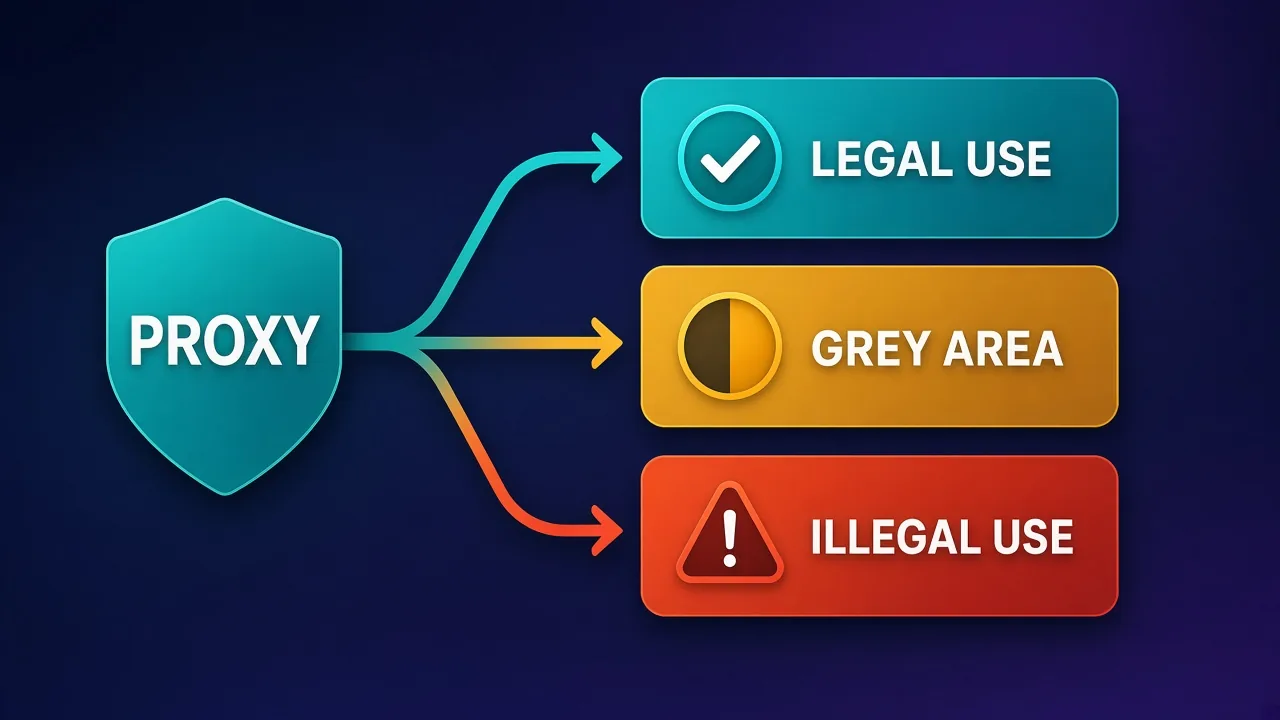
Think of a proxy the way you think of a car. Owning and driving one is legal; using it as a getaway vehicle is not. Courts and regulators generally look at the activity, not the tool. In practice, proxy use falls into three broad groups:
- Clearly fine: protecting your privacy on public Wi-Fi, testing how your own website appears in other countries, verifying ad placements, load testing your own infrastructure, and accessing corporate networks through a company proxy.
- Grey areas: collecting public data from websites whose terms forbid automated access, getting around regional content licensing, or running several accounts on a platform that limits them. These may break a contract or a site's rules without breaking criminal law, but the answer depends on the details and the jurisdiction.
- Clearly illegal: fraud, credential stuffing, breaking into systems, distributing malware, harassment, buying or selling stolen data, and evading sanctions. Routing these through a proxy does not change their legality, and it is not the shield many people assume.
Where proxies are restricted by law
In most of North America, Europe, and much of Asia and Latin America, there is no general ban on using proxies or VPNs. A small number of countries take a different view. China requires approval for VPN and similar services and blocks many unapproved ones, Russia has restricted VPN and anonymiser services that do not comply with its blocking rules, and a handful of other governments limit or ban such tools. In some places the rules focus on the use, for example treating the use of an anonymising tool to commit a crime as an aggravating factor.
If you live in, travel to or run infrastructure in a country with restrictions, check the local rules before you connect. Your provider's terms usually also list countries where they will not offer service, often because of sanctions.
Terms of service are not the same as law
Much of the confusion about proxies comes from mixing up two different things: breaking a website's terms of service and breaking the law.
- Terms of service are a contract between you and the website. If you break them, the site can usually suspend your account, block your IPs, or in some cases sue for breach of contract. That is a civil matter.
- Laws are rules set by governments. Breaking them can lead to fines, damages, or criminal charges.
Many platforms ban proxies, automation or multiple accounts in their terms. Using a proxy against those terms can get your accounts closed, but that is a different consequence from committing a crime. The line can blur, though. In some jurisdictions, deliberately getting around technical barriers after being told to stop can move an activity closer to unauthorised access under computer misuse laws. Being blocked and then working hard to evade the block is riskier than accessing public pages normally.
| Question | Terms of service | Law |
|---|---|---|
| Who sets it? | The website or platform | Legislatures and courts |
| Who enforces it? | The platform, sometimes through civil courts | Regulators, prosecutors and courts |
| Typical consequence | Account bans, IP blocks, civil claims | Fines, damages, criminal penalties |
| Does a proxy change it? | Using one may itself breach the terms | No, the underlying activity is what counts |
Web scraping and the law
Web scraping is the most common reason people ask whether proxies are legal, because scrapers often use proxy pools to spread requests across many IPs. Our explainer on how web scraping works covers the mechanics. The legal picture rests on a few separate questions.
Is the data public?
Collecting information that anyone can see without logging in is generally treated very differently from accessing data behind a login or paywall. In the United States, the long-running hiQ Labs v. LinkedIn litigation led the Ninth Circuit to conclude that scraping publicly accessible profiles was unlikely to be access "without authorization" under the Computer Fraud and Abuse Act. That did not make scraping consequence-free: the case later turned on contract claims and ended in a settlement. In 2024, a federal court in California also found in Meta v. Bright Data that Bright Data's logged-out scraping of public data did not breach Meta's terms. These rulings are specific to their facts and to US law, and they do not cover scraping behind a login.
Did you get around a technical barrier?
Laws such as the US Computer Fraud and Abuse Act and the UK Computer Misuse Act focus on unauthorised access to computers. The US Supreme Court narrowed the meaning of "exceeds authorized access" in Van Buren v. United States in 2021, but logging in with someone else's credentials, defeating access controls, or exploiting vulnerabilities remain high-risk activities.
Is the data protected in another way?
Copyright can protect the content you collect, such as articles, images and videos, even when you can access it freely. In the European Union, databases can also have their own protection. Collecting facts is usually lower risk than republishing someone's creative work wholesale.
Did you overload the site?
Sending so many requests that a site slows down or fails can create liability of its own, regardless of whether the data was public. Responsible scrapers pace requests, respect robots.txt where appropriate, and stop when asked.
Personal data, GDPR and privacy laws
Privacy law is often the bigger risk for data projects. The EU's General Data Protection Regulation applies to personal data about people in the EU, and "publicly available" is not an exemption. If you collect names, profile details, email addresses or anything else that identifies a person, you need a lawful basis for processing it, you must handle it securely, and you may have to tell people you hold it. Regulators in Europe have fined companies for scraping personal data at scale.
Other regions have their own rules, such as the California Consumer Privacy Act in the US, Brazil's LGPD and India's Digital Personal Data Protection Act. The safest approach is simple: avoid collecting personal data unless you genuinely need it, minimise what you keep, and get advice before building anything that profiles individuals.
A proxy does not anonymise your liability
Proxies hide your IP address from the website you visit, but providers keep account, payment and usage records, and reputable ones cooperate with lawful requests. If an activity is illegal, a proxy makes it harder to trace, not legal.
Ethical sourcing: the legal risk people overlook
Residential and mobile proxies route traffic through real people's devices and connections. How those IPs were obtained matters, both ethically and legally. Our guide to residential proxies explains how these networks are built. Broadly, there are two kinds of sourcing:
- Consent-based sourcing, where people knowingly share bandwidth through an app or SDK in exchange for payment, rewards or an ad-free experience, with clear opt-in and the ability to opt out.
- Malware-based sourcing, where devices are infected and turned into proxy exit nodes without their owners' knowledge. Law enforcement has taken down several such networks; the US Justice Department announced the dismantling of the 911 S5 botnet in 2024, for example.
Buying access to a botnet-based proxy service can expose you to reputational damage at best and legal problems at worst, and you are routing traffic through victims' devices. This is one reason we put so much weight on provider transparency in our checklist of what makes a proxy provider trustworthy.
How to choose a legally safer proxy provider
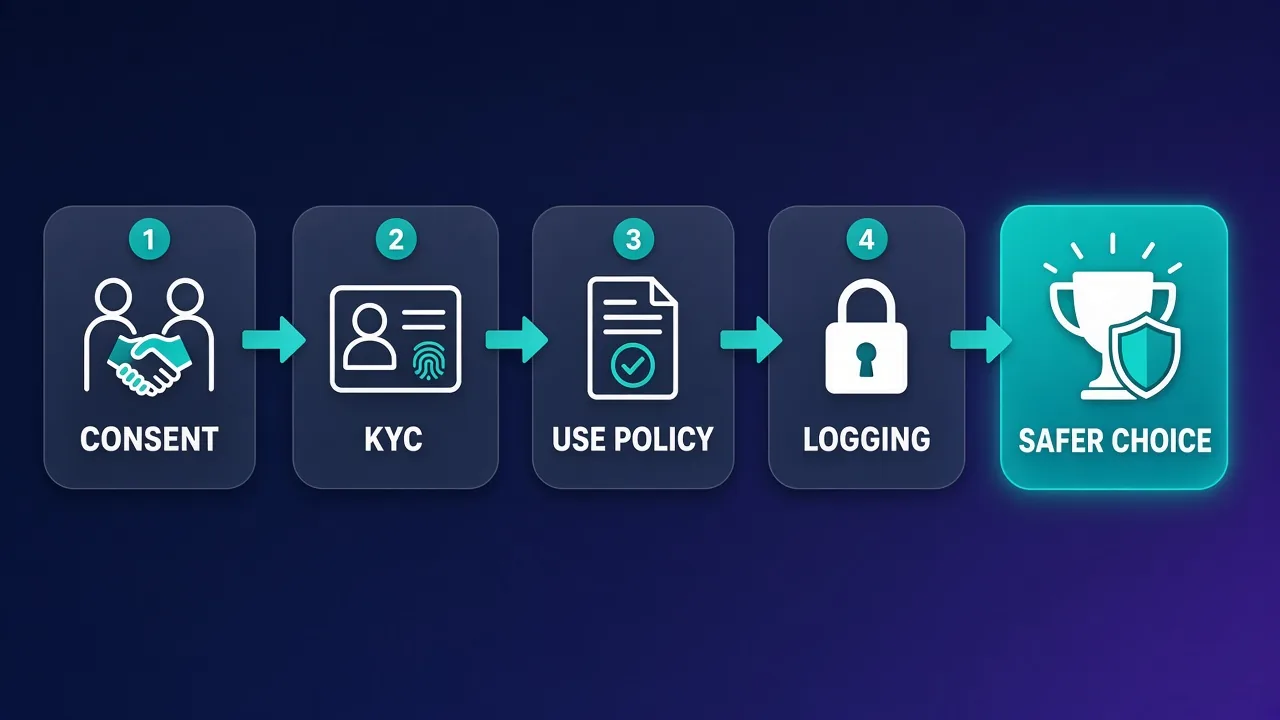
You cannot outsource your own legal responsibility, but a good provider lowers the risk considerably. Look for:
- Clear sourcing statements. The provider explains how residential and mobile IPs are obtained, ideally naming the consent mechanism.
- Know-your-customer checks. Many reputable providers verify customers before unlocking sensitive targets or large volumes. It is a sign they take abuse seriously.
- A published acceptable-use policy. It should say what is prohibited and how violations are handled.
- A clear logging and privacy policy. Know what the provider records about your traffic and for how long.
- A real company behind it. A registered business, an address and support you can reach are better than an anonymous storefront.
- Compliance commitments. GDPR or CCPA statements are a baseline for providers handling EU or Californian data.
Common legitimate uses of proxies
For balance, it is worth remembering how ordinary most proxy use is:
- Ad verification: checking that ads appear where they were paid for and are not shown next to harmful content.
- Price and market research: seeing public prices and listings as customers in different regions see them.
- SEO monitoring: tracking how search results look in different cities and countries.
- Website and app testing: confirming localisation, geo-redirects and content availability.
- Brand protection: finding counterfeit listings and unauthorised use of trademarks.
- Security research: investigating phishing sites and threats without exposing company IPs.
- Privacy: hiding your home IP on untrusted networks, although a VPN is often simpler for that; see our proxy vs VPN comparison.
What happens if you break the rules?
The consequences scale with what you did and whose rules you broke. It helps to separate the realistic outcomes:
- Platform action. The most common result of breaking a site's terms is technical: CAPTCHAs, blocked IP ranges, suspended accounts or a permanent ban. For many teams, losing access to an important platform is the most damaging outcome in practice.
- Cease-and-desist letters. Companies often send a formal demand to stop before going to court. Continuing after a clear demand can strengthen a later legal claim against you.
- Civil lawsuits. Platforms have sued scrapers and automation vendors for breach of contract, copyright infringement and related claims. These cases can be expensive even when the defendant ultimately wins.
- Regulatory fines. Privacy regulators can fine organisations that collect or process personal data unlawfully, whether or not proxies were involved.
- Criminal charges. These are reserved for activity that is itself criminal, such as fraud, unauthorised access or distributing malware. Using a proxy can be seen as evidence of intent to conceal, which does not help a defence.
Proxies at work, school and on shared networks
Employers, schools and universities often run their own proxies and filters, and their acceptable-use policies may forbid using outside proxies or VPNs to get around them. Breaking those rules is rarely a crime, but it can lead to disciplinary action or loss of network access. If you need an external proxy for legitimate work, ask your IT team first; many organisations will approve a specific tool once they understand the need.
Practical rules for staying on the right side
- Know the law where you are and where your targets and data subjects are.
- Read the terms of any site you automate, and understand the business risk of breaking them.
- Stick to public data, stay out of logged-in areas you are not entitled to, and never use other people's credentials.
- Avoid collecting personal data unless you have a lawful basis and a real need.
- Do not overload websites; pace requests and stop when asked.
- Use providers with transparent, consent-based sourcing and clear policies.
- Keep records of what you collect and why, so you can explain your project if asked.
- Get legal advice for commercial projects or anything involving sensitive data.
The bottom line
Using a proxy is legal almost everywhere. Ask instead whether the activity is legal, whether you are respecting contracts and privacy rules, and whether your provider sourced its IPs ethically.
Final thoughts
Proxies are everyday networking tools, and using one is legal in most of the world. The risk sits in three places: the activity you carry out, the rules of the country you are in, and the provenance of the IPs you rent. Treat terms of service as contracts with real business consequences, treat privacy law as a serious constraint on any data project, and choose providers that can explain where their IPs come from. Do that, and proxies become what they are meant to be: a practical way to see the web from somewhere else, safely and responsibly.
Frequently asked questions
In most countries, yes. A proxy is a standard networking tool, and using one is legal in most of North America, Europe and much of the world. What can make it illegal is the activity you carry out through it or local rules in countries that restrict such services.
It depends on what you collect and how. Collecting public data is treated very differently from accessing data behind a login, and US cases such as hiQ v. LinkedIn and Meta v. Bright Data favoured scraping of logged-out public data on their facts. Privacy, copyright and contract rules can still apply, so get advice for commercial projects.
Usually it is a contract issue rather than a crime. A site can ban your accounts, block your IPs or bring a civil claim. Deliberately defeating technical barriers after being told to stop can move closer to unauthorised access under computer misuse laws in some jurisdictions.
A small number of countries restrict them. China requires approval for VPN-type services and blocks many unapproved ones, and Russia restricts services that do not follow its blocking rules. Check local law before using a proxy in, or running one from, a country with restrictions.
No. A proxy hides your IP from the sites you visit, but providers keep account and payment records and reputable ones respond to lawful requests. An illegal activity stays illegal when routed through a proxy.
Yes, if the data identifies people in the EU. GDPR has no exemption for publicly available personal data, so you need a lawful basis, must handle the data securely and may have to inform the people involved.
It is a residential IP whose owner knowingly agreed to share bandwidth, usually through an app or SDK with clear opt-in and opt-out. The alternative, IPs from malware-infected devices, puts you in a legal and ethical grey zone at best.
Possibly, under the organisation's acceptable-use policy rather than criminal law. Getting around a company or school filter with an outside proxy can lead to disciplinary action or losing network access, so ask your IT team before using one.