Table of contents
IPv6 proxies look like a bargain on paper. Proxy-Seller lists IPv6 from $0.02 per IP, while its own IPv4 datacenter proxies start at $0.49 per IP. That is roughly a 25x gap per address. So why do most scraping teams still buy IPv4? Because a cheap IP is worthless if the site you need won't answer it, or if one ban takes out every address you bought at once.
This guide explains how IPv4 and IPv6 proxies actually differ, which targets accept IPv6, why /64 subnet bans change the maths, and when IPv6 saves you money versus when it turns into a false economy. Prices below were checked on the providers' own sites on 12 November 2026.
IPv4 vs IPv6 in one paragraph
IPv4 addresses are 32 bits long (written like 203.0.113.42), which allows about 4.3 billion addresses in total. That pool ran out years ago: the global free pool held by IANA was handed out in 2011, and the regional registries have since run dry too. New IPv4 space now mostly changes hands on a secondary market, which is why every IPv4 proxy costs real money. IPv6 addresses are 128 bits long (written like 2001:db8:85a3::8a2e:370:7334). The space is so large that providers hand out whole blocks of billions of addresses to single customers. For a proxy buyer, that one difference drives everything else: price, pool size, how sites treat the address, and how bans work.
Short answer
Buy IPv6 when your targets are large, dual-stack platforms and you need lots of unique IPs cheaply. Buy IPv4 when you need to reach any site on the internet, when your target is IPv4-only, or when you can't afford a single ban wiping out a whole subnet.
How IPv6 proxies work (and how they differ from IPv4)
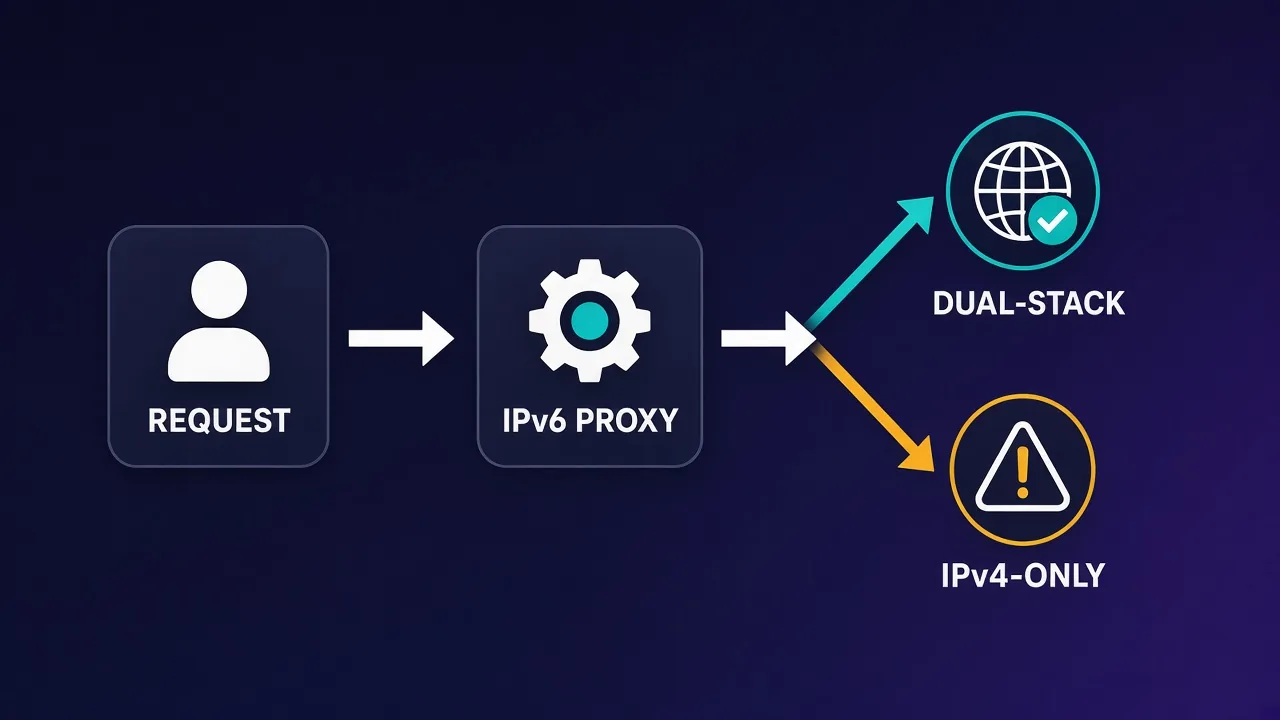
From your code's point of view, an IPv6 proxy is just another HTTP(S) or SOCKS5 endpoint. You connect to the proxy host and port with a username and password or an allowlisted IP, and the proxy makes the outbound request for you. The difference is the address the target sees. With an IPv4 proxy the site sees an IPv4 address; with an IPv6 proxy the outbound connection leaves over IPv6, so the site sees an IPv6 address.
That has three practical consequences:
- The target must accept IPv6. The proxy can only reach a site that publishes an IPv6 address (an
AAAADNS record). Proxy-Seller's own FAQ is blunt about this: its IPv6 proxies do not translate traffic to reach IPv4-only sites, so for those you need IPv4. - Your local network usually doesn't matter. You can connect to the proxy over IPv4 from your laptop or server; it's the proxy's outbound side that uses IPv6.
- Addresses come in blocks. IPv6 is normally allocated in subnets such as a /64, /56 or /48. That makes it cheap to give you many addresses, but it also gives sites an easy way to group and block them.
Comparison table: IPv4 vs IPv6 proxies
| Factor | IPv4 proxies | IPv6 proxies |
|---|---|---|
| Address supply | Scarce, traded on a secondary market | Effectively unlimited for proxy use |
| Typical price per IP | Higher (Proxy-Seller IPv4 from $0.49/IP) | Much lower (Proxy-Seller IPv6 from $0.02/IP; Rayobyte $0.20/IP/month) |
| Site compatibility | Works with virtually every public site | Only sites with IPv6 / dual-stack support |
| How bans spread | Usually per IP, sometimes per /24 or ASN | Often per /64 or wider, hitting many IPs at once |
| Reputation history | Many datacenter ranges carry years of abuse history | Less history per address, but whole ranges get flagged fast |
| Proxy types available | Datacenter, ISP, residential, mobile | Mostly datacenter; residential IPv6 is less common |
| Best for | General scraping, account work, any target | High-volume jobs on large IPv6-ready platforms |
Which sites accept IPv6?
The honest answer is: many large platforms do, and a long tail of smaller sites still doesn't. Big consumer services, major search engines, social networks and large CDNs have run dual-stack for years, so their pages are often reachable over IPv6. Plenty of mid-size shops, regional retailers, government portals, older APIs and sites on budget hosting still publish only an IPv4 address. Google publishes a running chart of the share of its users who reach it over IPv6, which is a useful sense of direction, but it says nothing about whether your target is ready.
Don't guess. Check each target before you buy:
# Does the domain publish an IPv6 (AAAA) record?
dig AAAA www.example.com +short

# Can you actually fetch it over IPv6? (run from a host with IPv6)
curl -6 -sS -o /dev/null -w '%{http_code}\n' https://www.example.com/
Two traps to watch for:
- Partial support. The homepage may be on a dual-stack CDN while the API, search endpoint or checkout lives on an IPv4-only origin. Test the exact URLs your scraper hits, not just the root domain.
- Different treatment. Some sites accept IPv6 connections but apply stricter rate limits or more challenges to IPv6 ranges, especially datacenter ones. A 200 response on one test request isn't proof the target will tolerate thousands.
Mixed target lists
If even a few of your targets are IPv4-only, you'll need IPv4 proxies for those anyway. Many teams run both pools and route each job by protocol, which Proxy-Seller itself recommends on its IPv6 page.
The /64 problem: why IPv6 bans hit harder
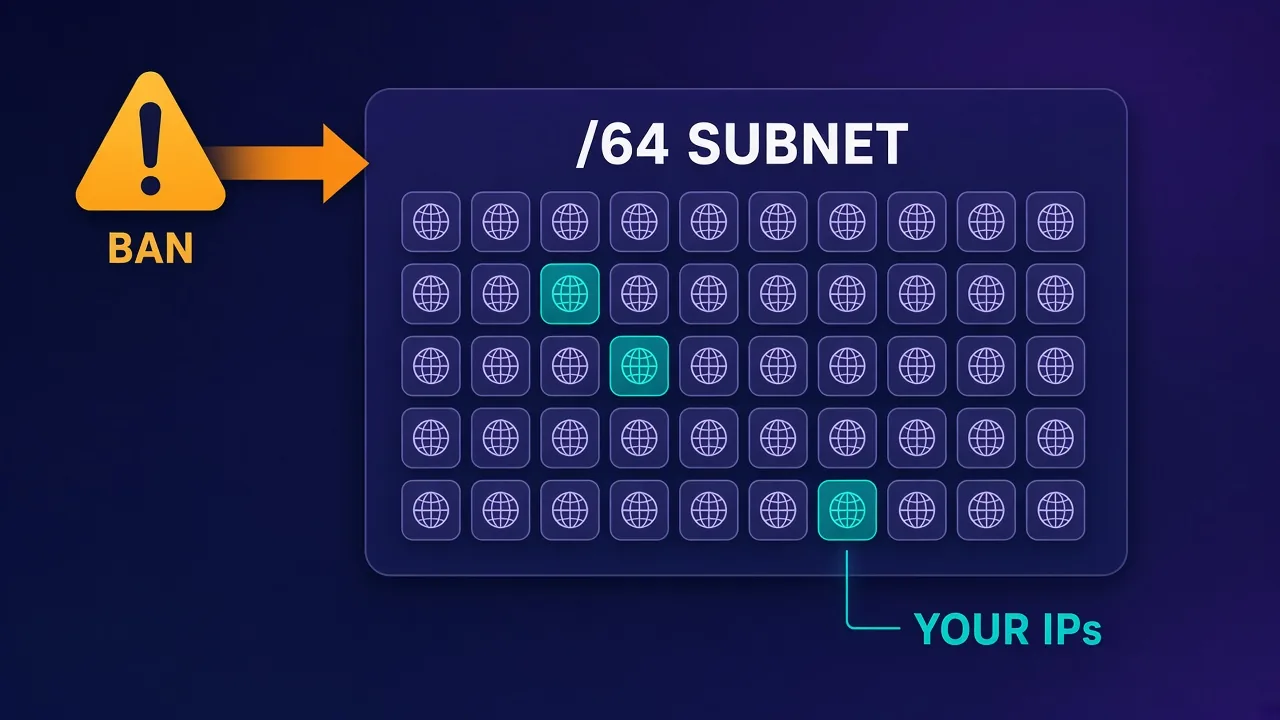
Here's the part sellers rarely put in the headline. In IPv6, a /64 is the standard size of a single network segment, and an ordinary home connection is commonly given a /64 or a larger block. Anti-bot systems know this. Blocking one IPv6 address is pointless, because the same user can pick another from the billions in their /64. So many sites and bot-management services rate-limit and ban at the /64 level or wider, treating the whole subnet as one "user".
That changes what "1,000 IPv6 proxies" means:
- If those 1,000 addresses sit inside the same /64, a site that groups by /64 sees them as one client. You've paid for 1,000 IPs and got the rotation value of one.
- If each address sits in its own /64, they behave far more like separate clients. Rayobyte's help centre, for example, says each /64 subnet you buy includes a single static IP, precisely so addresses aren't grouped this way.
- Even with one IP per /64, providers allocate from larger blocks (a /48 or /32) registered to their own network, so a site that bans by ASN or by wider prefix can still knock out the lot. Our guide to what an ASN is explains why network-level reputation matters.
Before buying, ask the provider directly: how are addresses distributed across /64s, how many /48s or /32s does the pool span, and what happens if a subnet gets flagged? If the answers are vague, assume the worst case. For more on how detection works generally, see why proxies get blocked.
Cost and pool size: where IPv6 genuinely wins
When the target supports IPv6 and doesn't punish it, the economics are hard to argue with. Here's what the three providers in this guide list today:
| Provider | IPv6 offer | IPv4 offer | Notes |
|---|---|---|---|
| Proxy-Seller | From $0.02/IP; minimum order 10 IPs and 1 week | Datacenter IPv4 from $0.49/IP | Unlimited traffic, 1 Gbps channel, HTTP(S) and SOCKS5 per its IPv6 page |
| Rayobyte | $0.20/IP/month, US only, private and static | Dedicated datacenter IPv4 and per-GB datacenter plans | Unlimited bandwidth subject to its acceptable use policy |
| Webshare | None: its help centre says all proxies currently use IPv4 | 100 shared datacenter proxies for $2.99/month; 10 free proxies | 250 GB bandwidth included on proxy server plans, unlimited as an upgrade |
Two things stand out. First, IPv6 per-IP pricing really is a fraction of dedicated IPv4. If you need tens of thousands of distinct addresses on an IPv6-ready platform, that matters. Second, look at Webshare: shared IPv4 at about three cents per proxy per month is already in the same price range as IPv6. The "IPv6 is always cheaper" argument mostly holds against dedicated IPv4, not against shared pools.
Prices change often, and quantity tiers, billing periods and locations all affect the final figure. Always confirm at checkout.
When IPv6 is a false economy
Cheap per IP doesn't mean cheap per successful request. IPv6 tends to cost you more than it saves when:
- Your target is IPv4-only or partly so. Every request to an IPv4-only endpoint fails outright, so you end up buying IPv4 anyway.
- The site bans by /64 and your addresses share subnets. Your effective pool shrinks to a handful of "users", so you get blocked as fast as with a few IPv4 addresses.
- The target scores datacenter IPv6 harshly. More CAPTCHAs and soft blocks mean more retries, more bandwidth and more engineering time spent on workarounds.
- You need residential or mobile trust. Most IPv6 proxies on sale are datacenter addresses. If a site only lets residential-looking traffic through, cheap datacenter IPv6 won't help.
- You need many countries. Some IPv6 offers are limited to a single location; Rayobyte's IPv6 is US-only, for instance.
A useful rule: work out your cost per thousand successful requests, not cost per IP. Run a small test with both protocols on your real target, count successes, retries and blocks, and compare the totals.
Don't skip the pilot
Buy the smallest IPv6 package you can (Proxy-Seller's minimum is 10 IPs for a week) and test it on your actual URLs before committing to thousands of addresses.
Use cases: which protocol fits which job
Where IPv6 fits well
- High-volume scraping of large dual-stack platforms, where you need many unique addresses and the site doesn't heavily penalise IPv6.
- Load and QA testing of your own IPv6-enabled services, where you control the target.
- SEO rank tracking on search engines that answer over IPv6, provided your request rates stay polite.
Where IPv4 is the safer pick
- Broad scraping across many unknown sites, because you can't check every target's IPv6 support in advance.
- Account management and logins, where one subnet ban could lock out many accounts together.
- Anything needing residential, ISP or mobile IPs. See our datacenter proxies explainer for how datacenter IPs compare to the alternatives.
Providers worth considering
These three cover the useful range: a cheap IPv6 specialist, a US provider with one IP per /64, and a low-cost IPv4 option to benchmark against.
Proxy-Seller: cheapest per-IP IPv6 with a short minimum
Proxy-Seller sells both IPv4 and IPv6 datacenter proxies, with IPv6 listed from $0.02 per IP, a 10-IP and one-week minimum, unlimited traffic and HTTP(S) or SOCKS5. Its page says the addresses come from local internet registry allocations and vetted data centres and are not shared between customers during the rental. It's the easiest place to run a low-cost IPv6 pilot and, if needed, add IPv4 from the same account.

Proxy-Seller
Proxy-Seller is excellent value if you want fixed, dedicated IPs instead of metered bandwidth. Per-IP pricing from $1.30 with unlimited bandwidth, flexible rental terms, and unusually cheap IPv6 make it a smart choice for account management and SEO. It is not the place for large rotating-residential workloads — the per-IP model does not scale to mass scraping that needs thousands of fresh addresses. The dashboard is also plain and functional rather than polished. But for stable, dedicated identities at a low cost, backed by 24/7 support, Proxy-Seller is one of the better dedicated-proxy specialists around.
Rayobyte: US IPv6 with one static IP per /64
Rayobyte describes its IPv6 proxies as private, single-user static proxies priced at $0.20 per IP per month, currently US-only. Its help centre says each /64 you buy includes a single IP and that the addresses sit on its own network. That design directly addresses the /64 grouping problem, though addresses still share Rayobyte's wider prefix. Bandwidth is unlimited, subject to its acceptable use policy.

Rayobyte
Rayobyte is a dependable, transparent US provider that does the basics very well. Its unlimited-bandwidth datacenter proxies are the highlight — predictable costs for heavy scraping, backed by a responsive US-based support team. The ethical residential sourcing program is a genuine plus for compliance-minded teams, even if the pool is mid-sized rather than enormous. The interface is functional rather than polished, and datacenter country coverage is narrower than some. For SEO tooling, high-volume datacenter scraping, and anyone who values support and transparency, Rayobyte is a solid, no-drama choice.
Webshare: the IPv4 benchmark
Webshare doesn't sell IPv6; its help centre says all its proxies currently use IPv4. It's here because it shows how cheap IPv4 can be: 100 shared datacenter proxies for $2.99 a month, a free 10-proxy plan, and volume discounts down to $0.0179 per proxy. If your targets are a mix of IPv4 and IPv6 sites, shared IPv4 at this price can beat IPv6 on total cost once failures are counted.

Webshare
Webshare is the developer's self-service favorite. Instant activation, a free tier that is actually free, and the cheapest fast datacenter proxies in the market make it the easiest provider to just start using. The custom plan builder — pick your IP count, bandwidth, and threads — is a genuinely good model that lets you avoid paying for capacity you do not need. The residential pool is newer and less battle-tested than specialists, and support is thin on the lower tiers. For datacenter proxies, API-driven workflows, and anyone who wants to try before paying, Webshare is one of the best-value options around.
How to choose: a quick decision checklist
- List every domain and endpoint you need. Check each for an
AAAArecord and a real IPv6 fetch. - If any are IPv4-only, plan an IPv4 pool for them regardless.
- For IPv6-ready targets, ask the provider how addresses spread across /64s and wider prefixes.
- Pilot both protocols on the real target. Measure success rate, block rate and retries.
- Compare cost per thousand successful requests, not cost per IP.
- Re-test periodically. Targets add IPv6 support, and anti-bot rules change.
Bottom line
IPv6 proxies are a genuinely good deal for one job: reaching large, IPv6-ready platforms with lots of distinct addresses at a low price. Outside that job, scarce and pricier IPv4 is still the protocol that works everywhere. The two biggest risks with IPv6 are a target that doesn't support it and a /64 ban that takes out a whole block at once. Check your targets, ask how the subnets are laid out, pilot small, and let your cost per successful request decide. If you're still weighing proxy types more broadly, our datacenter proxies guide and blocking explainer are good next reads.
Frequently asked questions
Both work the same way from your code: you connect to an HTTP(S) or SOCKS5 endpoint. The difference is the address the target sees. IPv4 addresses are scarce and cost more, while IPv6 addresses are abundant and cheap, but only sites that support IPv6 can be reached through them.
Usually, per IP. On 12 November 2026 Proxy-Seller listed IPv6 from $0.02 per IP against IPv4 datacenter from $0.49 per IP, and Rayobyte listed US IPv6 at $0.20 per IP per month. Shared IPv4 can be close in price, though: Webshare sells 100 shared IPv4 proxies for $2.99 a month.
No. An IPv6 proxy sends its outbound request over IPv6, so the target must publish an IPv6 address. Proxy-Seller states its IPv6 proxies do not translate traffic to IPv4-only sites. For those targets you need IPv4 proxies.
Look up its AAAA DNS record, for example with dig AAAA www.example.com, and then try a real request over IPv6 with curl -6 from a host that has IPv6. Test the exact endpoints your scraper uses, because an API or checkout may sit on a different, IPv4-only server.
A /64 is the standard size of a single IPv6 network segment, and one user can easily control billions of addresses inside it. Because banning a single IPv6 address is pointless, many sites block or rate-limit the whole /64. If your proxies share a /64, one ban can take all of them down together.
They can be, for high-volume scraping of large platforms that support IPv6 and don't penalise it heavily. They are a poor fit for broad scraping across many unknown sites, IPv4-only targets, or sites that only trust residential traffic. Run a small pilot and compare cost per successful request.
According to Webshare's help centre, all of its proxies currently use IPv4. It is still a useful benchmark because its shared IPv4 plans are priced low enough to compete with IPv6 on total cost for mixed target lists.
Many teams do. Route jobs on IPv6-ready targets through cheap IPv6 addresses and send everything else through IPv4. This keeps costs down without losing access to the sites that still don't support IPv6.