Table of contents
Every IP address on the internet belongs to a network, and every network that routes its own traffic has a number: an Autonomous System Number, or ASN. Most people never see it, but websites and anti-bot systems look it up on nearly every request — because an ASN reveals whether an IP comes from a home broadband provider, a mobile carrier, or a cloud data centre. For proxy users, that single lookup often decides whether traffic is trusted or blocked before any other check runs. This guide explains what an ASN is, how autonomous systems work, how sites use ASN data, and how to choose proxies with the right ASN profile.
What is an autonomous system?
The internet isn't one network; it's tens of thousands of independently run networks stitched together. An autonomous system (AS) is one of those networks: a collection of IP address ranges operated by a single organisation under a single, clearly defined routing policy. Your home broadband provider is an autonomous system. So is a mobile carrier, a university, a large company, and every major cloud provider.
The ASN is the unique number that identifies that network to the rest of the internet. When you see something like AS15169, that's Google's network; AS16509 is Amazon Web Services; AS7922 is Comcast. Each ASN announces the IP address blocks it's responsible for, so any IP address can be traced back to an ASN — and therefore to the organisation behind it.
How ASNs and BGP route the internet
Autonomous systems talk to each other using the Border Gateway Protocol (BGP). Each network announces the IP prefixes it originates ("I can deliver traffic for these address ranges"), tagged with its ASN. Neighbouring networks pass those announcements along, adding their own ASN to a list called the AS path. When your request travels to a website, routers pick a path through a chain of autonomous systems based on those announcements and each network's routing policy.
Two consequences matter for proxy users. First, because every announced prefix is tied to an origin ASN, any IP can be mapped to the network that owns it. Second, that mapping is public and cheap to look up — which is exactly why websites use it.
Who assigns ASNs?
ASNs are allocated in a hierarchy. IANA hands out blocks of numbers to the five Regional Internet Registries: ARIN (North America), RIPE NCC (Europe, the Middle East and Central Asia), APNIC (Asia-Pacific), LACNIC (Latin America and the Caribbean) and AFRINIC (Africa). Organisations then apply to their regional registry for an ASN, typically when they need to connect to more than one upstream provider or run their own routing policy.
ASNs originally used 16 bits, allowing numbers up to 65,535. As that space ran low, 32-bit ASNs were introduced, raising the ceiling to over four billion. A few ranges are reserved for private use inside networks — 64512–65534 in the 16-bit space and 4200000000–4294967294 in the 32-bit space — and never appear on the public internet.
Types of ASNs — and why sites care
From a website's point of view, the most useful thing about an ASN isn't its number but what kind of network it represents:
| ASN type | Examples | What traffic from it usually means | Typical trust |
|---|---|---|---|
| Consumer ISP ("eyeball") | Home broadband providers | Real people at home | High |
| Mobile carrier | Cellular networks | Real people on phones, often many behind one IP | Very high |
| Hosting / cloud | AWS, DigitalOcean, OVH, Hetzner | Servers, scripts and bots | Low |
| Business / enterprise | Corporate networks | Office workers | Medium to high |
| Education / government | Universities, agencies | Students, staff, public bodies | Medium to high |
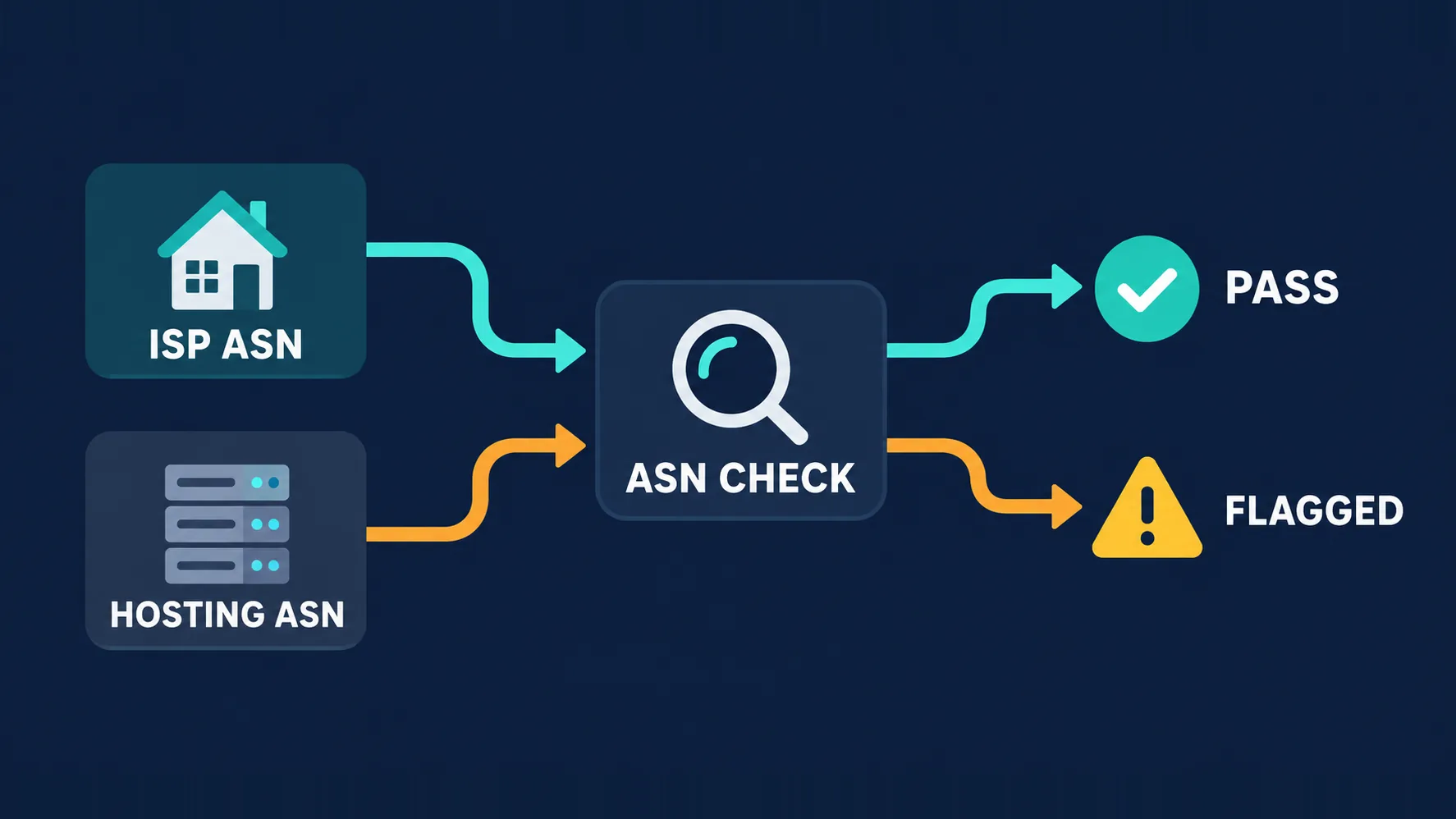
The logic is simple: ordinary people rarely browse from inside a cloud provider. So when a login, checkout or search request arrives from a hosting ASN, it's statistically far more likely to be automated.
How websites use ASN data against proxies
ASN checks are one of the cheapest and earliest layers of bot detection. A site maps the incoming IP to its ASN using a routing or IP-intelligence database, then applies rules such as:
- Blocking or challenging hosting ASNs outright on sensitive pages like login, signup and checkout.
- Scoring risk by ASN reputation, where networks with a history of abuse raise a request's bot score.
- Rate-limiting per ASN, so a surge of requests from one network gets throttled even if it's spread across many IPs.
- Checking consistency — an IP geolocated to one country but owned by an ASN that operates elsewhere is a mismatch worth flagging.
Because this happens before any fingerprinting, a proxy on the wrong kind of ASN can fail instantly no matter how carefully the rest of the setup is built. It's one layer in the wider picture covered in how websites detect bots.
ASNs by proxy type
Once you understand ASNs, the differences between proxy types become much clearer — the type largely determines which ASN your traffic appears to come from:
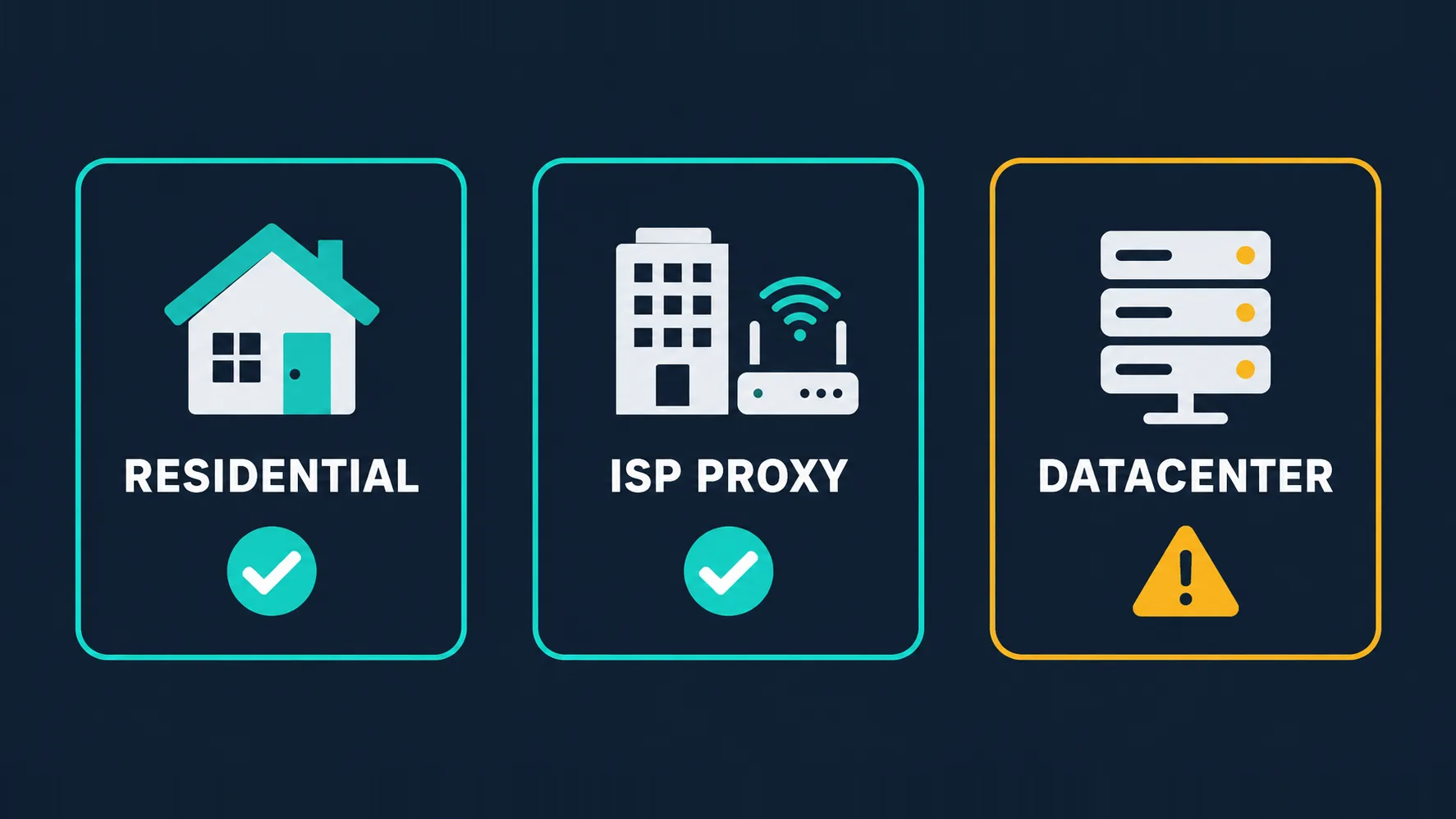
- Datacenter proxies sit in hosting ASNs. They're fast and cheap, but any site that filters by ASN can identify them immediately.
- Residential proxies route through real home connections, so they appear under consumer ISP ASNs — the same networks ordinary visitors use.
- Mobile proxies appear under mobile carrier ASNs. Carriers put many subscribers behind shared IPs, so sites are reluctant to block them. Our guide to mobile proxies covers why they cost more.
- ISP (static residential) proxies are the interesting hybrid: servers hosted in data centres, but using IP ranges registered to and announced by ISP-type ASNs. That's why they combine datacenter speed with residential-level ASN trust.
The ASN is often the whole difference
A datacenter proxy and an ISP proxy can live in the same building and run on similar hardware. What separates them in a site's eyes is the network registration behind the IP. That's why ISP proxies cost more — you're paying for the ASN, not just the server.
How to look up an IP's ASN
You can check the ASN behind any IP — including the exit IP of a proxy you're testing — in seconds. Two quick command-line options:
# Team Cymru's free IP-to-ASN whois service
whois -h whois.cymru.com " -v 8.8.8.8"

# ipinfo.io returns the ASN and organisation name
curl ipinfo.io/8.8.8.8/org
# AS15169 Google LLC

# Check your proxy's exit IP by sending the request through it
curl -x http://USER:PASS@PROXY_HOST:PORT ipinfo.io/org
The last command is the one to remember: it shows the ASN your target site will see when you connect through the proxy. If the organisation named is a cloud host and you paid for residential or ISP proxies, something's wrong.
ASN targeting: choosing a specific network
Some proxy providers let you go beyond country and city targeting and pick a specific ASN or carrier. It sounds niche, but it solves real problems:
- Ad verification and QA — confirming how ads or content render for customers of a particular ISP or mobile carrier.
- Consistency for accounts — keeping a managed account on the same kind of network it normally logs in from.
- Matching a local audience — appearing as a customer of a dominant local ISP rather than a lesser-known network.
- Carrier-specific apps — testing services that behave differently on particular mobile networks.
ASN targeting is usually a layer on top of geo-targeting. As with city targeting, the narrower you go, the smaller the available pool — so only target an ASN when you genuinely need that network.
Proxy providers with ASN or ISP-level targeting
If network-level control matters for your work, these providers support it:
Bright Data — granular ASN targeting at scale
Very large residential and mobile networks with targeting down to city and ASN, well suited to large ad-verification and data-collection projects that need specific networks.
Bright Data
Bright Data remains the most complete data-collection platform money can buy. No competitor matches its combination of network scale, targeting granularity, and compliance tooling — and for enterprise teams whose revenue depends on reliable data, that completeness justifies the premium. The trade-offs are real: it is one of the priciest providers per gigabyte, the interface overwhelms newcomers, and KYC verification adds friction before you can route a single request. Smaller projects will get better value from Decodo or IPRoyal. But if you need city-level residential targeting at scale, a managed unblocker for the hardest targets, and audit-ready compliance, Bright Data is the default — and our highest-rated proxy provider overall.
SOAX — flexible carrier and ISP filtering
Residential and mobile pools with filtering by country, city and carrier or ISP, useful for keeping sessions on a consistent, trusted network.

SOAX
SOAX is the targeting specialist. City- and ISP-level selection on every plan — not locked behind premium tiers — is genuinely rare, and the continuously cleaned pool keeps success rates high where it matters. It is not the fastest network, the interface could use a refresh, and SOCKS5 coverage is uneven. Those are real but minor gripes against a provider that nails the fundamentals of precision and reliability. For ad verification, localized market research, and social-media work that depends on appearing in an exact location, SOAX is one of the best mid-market options available.
ProxyEmpire — ISP-level targeting with rollover data
Residential, mobile and static ISP proxies with targeting down to region, city and ISP level, plus rollover data so unused bandwidth doesn't expire at month end.

ProxyEmpire
ProxyEmpire wins on flexibility. Rollover data is a genuinely rare, customer-friendly policy — unused traffic carries forward instead of evaporating at month end — and the targeting reaches city and ISP level on a network that covers 170+ countries. The pool is smaller than the market leaders and speeds are solid rather than spectacular, so very high-volume operations may want a bigger network. SOCKS5 support and sticky sessions round out a capable feature set. For individuals and mid-sized teams who want fair, flexible, ethically sourced proxies, ProxyEmpire is a strong value pick.
How to read an ASN lookup result
A typical lookup returns a handful of fields, and each tells you something different:
- AS number — the network identifier itself, such as
AS15169. - Organisation name — who operates the network. A name containing words like "hosting", "cloud", "server" or "data centre" is a strong hint the IP is not residential.
- BGP prefix — the address block the IP was announced in. Many of your proxy IPs sharing one small prefix means they will likely be judged together.
- Country and registry — where the network is registered, which may differ from where the IP geolocates.
Read the organisation name carefully. Some networks carry neutral-sounding names that don't reveal they're hosting providers, so if the name is unfamiliar, search it before assuming the IP is residential.
Judging a provider's ASN diversity
When you evaluate a proxy provider, it's worth sampling a batch of exit IPs and looking up their ASNs. A healthy residential pool should spread across many different consumer ISPs in each country rather than clustering in a handful of networks, and an ISP-proxy product should resolve to ISP organisations rather than cloud hosts. If a large share of "residential" IPs come back under hosting ASNs, or almost all of them sit in one or two networks, expect more blocks than the product description implies. A short test like this, run against the countries you actually need, is one of the most honest ways to compare providers — it's the same kind of verification we recommend in types of proxies.
Common ASN mistakes proxy users make
- Using datacenter proxies on sites that filter hosting ASNs — no amount of fingerprint work fixes a blocked network.
- Concentrating everything in one ASN. A large share of your traffic from a single network is itself a pattern sites notice; spread across networks where you can.
- Never checking the exit IP's ASN. Mislabelled or recycled IPs happen; verify before trusting a provider's product label.
- Mismatching ASN and location. An IP whose network, geolocation and browser locale disagree looks inconsistent.
- Over-targeting. Pinning a rare ASN shrinks the pool and increases IP reuse, which can burn addresses faster (see why proxies get blocked).
ASN databases aren't perfect
IP-to-ASN mapping comes from live routing data, but the classification of a network as "hosting", "ISP" or "business" comes from third-party databases that can lag or disagree. An ISP proxy may be labelled correctly by one site and flagged by another. Treat ASN trust as a strong signal, not a guarantee, and test against the specific sites you care about.
Limits of ASN-based trust
ASN checks are powerful but blunt. Blocking an entire hosting ASN can also block legitimate users — people on corporate VPNs, privacy services or cloud-hosted browsers — so many sites challenge rather than outright ban. And a trusted ASN only gets a request through the front door: browser fingerprinting, behaviour and rate limits still apply afterwards. A residential or ISP IP paired with an obviously automated browser will still be caught, just a little later in the process.
The bottom line
An ASN is the number that identifies the network behind an IP address, and it tells websites a surprising amount: whether traffic comes from a home, a phone, an office or a data centre. That's why it has become one of the first checks in bot detection — and why proxy type matters so much. Datacenter proxies sit in easily recognised hosting ASNs; residential, mobile and ISP proxies inherit the trust of consumer and carrier networks. Check the ASN of your exit IPs, choose the proxy type that matches the networks your targets trust, use ASN targeting only when you need it, and remember that the right network gets you in the door but doesn't replace the rest of a clean setup.
Frequently asked questions
ASN stands for Autonomous System Number. It is a unique number assigned to a network — such as an internet service provider, mobile carrier, cloud provider or large organisation — that manages its own IP address ranges and routing policy. Every public IP address can be traced back to the ASN that announces it.
Use a free lookup service. On the command line, whois -h whois.cymru.com " -v <IP>" or curl ipinfo.io/<IP>/org will return the ASN and organisation name, and many IP-lookup websites show it too. To see the ASN a website sees through your proxy, send the lookup request through the proxy itself.
Yes. Sites can block, challenge or rate-limit every IP belonging to a particular ASN, and it is common to do this for hosting and cloud networks on sensitive pages like login and checkout. Many sites prefer challenges to outright bans, because blocking a whole network can also catch legitimate users on corporate VPNs or privacy services.
Datacenter proxies use IP addresses owned by hosting and cloud providers, and those ASNs are publicly known. Real people rarely browse from inside a data centre, so a site can simply check the ASN of an incoming request and treat hosting networks as likely automation, before running any more expensive checks.
ISP proxies use IP ranges registered to and announced by internet service providers, so they appear under ISP-type ASNs rather than hosting ASNs, even though the servers sit in data centres. That is why they pass ASN-based checks that block datacenter proxies. Classification databases can still disagree, so it is worth testing against your target sites.
ASN targeting lets you choose proxy IPs that belong to a specific network, such as a particular ISP or mobile carrier, on top of country or city targeting. It is useful for ad verification, testing carrier-specific services and keeping accounts on a consistent network. Narrow targeting shrinks the available pool, so use it only when you need a specific network.
Not exactly. An ISP usually operates one or more ASNs, but ASNs also belong to cloud providers, content networks, universities, governments and large companies. The ASN identifies a routing network, while the ISP is a type of business; many ASNs are not ISPs, and some large ISPs run several ASNs.
Yes. When you connect through a VPN or proxy, websites see the exit IP, so they see that IP's ASN rather than your own ISP's. A VPN or datacenter proxy typically shows a hosting ASN, while residential, mobile and ISP proxies show consumer ISP or carrier ASNs, which is why proxy type matters so much for trust.