Table of contents
Decodo, the provider formerly known as Smartproxy, earned its reputation by sitting in the sweet spot between price, performance and ease of use. So why look elsewhere? Usually for a specific reason: you want traffic that never expires, finer geo-targeting on every plan, a cleaner compliance story, a free tier for testing, or a network that doesn't rely on peer-to-peer devices at all.
This guide compares six credible Decodo alternatives and, more usefully, tells you which one fits which reason. We stick to what each provider actually offers and keep prices out of the prose, because they change often; the live cards pull current details from our directory.
What Decodo does well (and why that matters)
Before switching, it helps to be clear about what you'd be giving up. Decodo has been around since 2018 and is built for startups, solo developers and growing teams who want professional-grade proxies without enterprise complexity. Its line-up covers rotating and sticky residential proxies, mobile, ISP (static residential) and datacenter IPs, with country targeting broadly available and city targeting on most plans. It also offers a Site Unblocker for protected targets, a 14-day money-back guarantee and 24/7 support.
The weaknesses are narrower than with many rivals. Our listing notes fewer enterprise compliance features than the largest providers and city-level targeting that's limited on some plans. If neither of those bothers you and your success rates are fine, switching may not be worth the migration effort. For a full picture of what you pay today, see our Decodo pricing guide.

Decodo
Decodo offers the best price-to-performance ratio in the industry. It delivers roughly 90% of what the enterprise leaders provide — high success rates, a large clean pool, sticky sessions, an unblocker — at a fraction of their cost. The dashboard is the friendliest of any major provider, the 14-day money-back guarantee removes the risk of trying it, and support actually responds. The main gaps are enterprise-grade compliance tooling and the very deepest targeting, neither of which most teams need. For startups, solo developers, and any team that wants professional results without enterprise pricing, Decodo is our top value pick and an easy recommendation.
Why people look for Decodo alternatives
In our experience, buyers start shopping around for one of a handful of reasons:
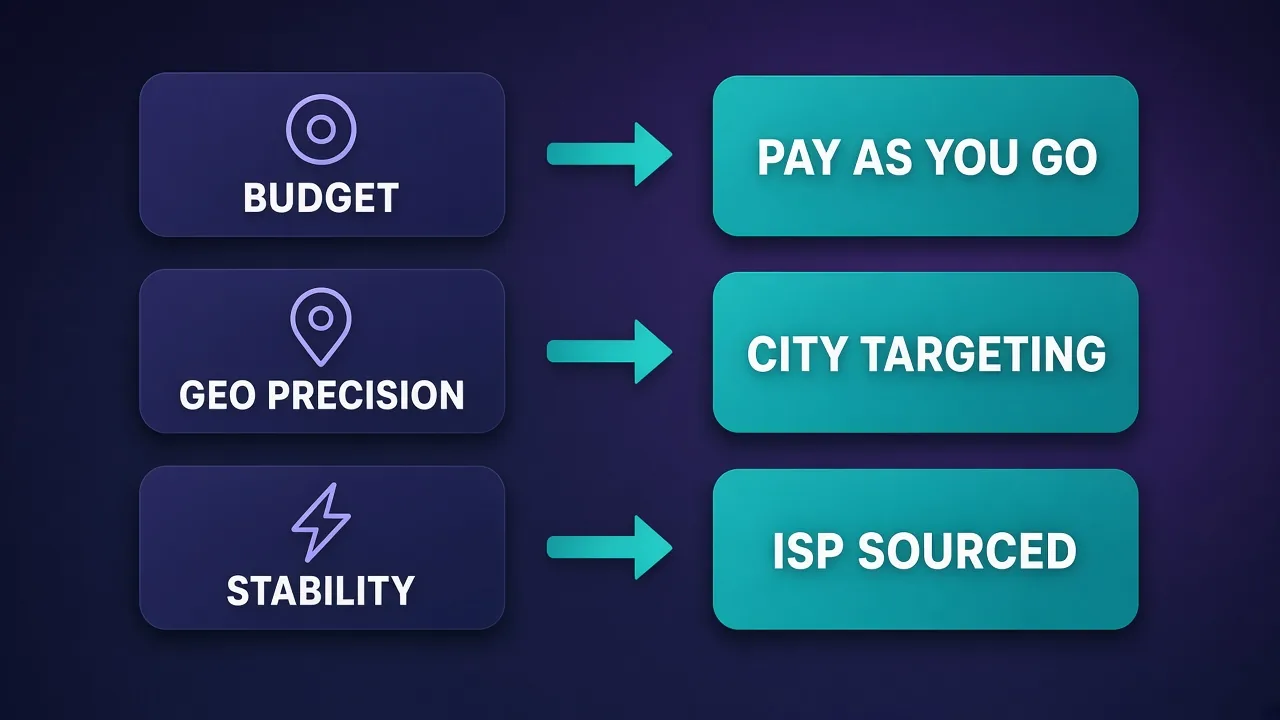
- Usage pattern. Intermittent users dislike paying for traffic that has to be used inside a billing cycle.
- Targeting precision. Teams doing local SEO, ad verification or price checks may need city or ISP-level targeting on every plan, not only some.
- Sourcing and compliance. Legal and procurement teams increasingly ask how residential IPs were obtained and want documentation.
- Network architecture. Some workloads need long, stable sessions that peer-to-peer residential pools can struggle to hold.
- Testing and budget. Developers want a free or very cheap way to prove a target works before committing.
- Specific products. A need for SOCKS5 everywhere, sneaker proxies, or a particular product line Decodo doesn't emphasise.
Each alternative below is strong on at least one of these.
How we chose these alternatives
We limited this list to providers with published, reviewed listings on Proxyaxis and checked each one's product line against our own data rather than marketing pages. We weighted five things: pricing model and flexibility, pool type and sourcing, targeting depth, support and tooling, and compliance posture. We deliberately left out enterprise-only providers whose minimums would make them a poor swap for a typical Decodo customer; if you're moving up-market, our Oxylabs vs Decodo comparison covers that path.
Decodo alternatives at a glance
| Provider | Best reason to switch | Product types | Watch out for |
|---|---|---|---|
| IPRoyal | Residential traffic that never expires, true pay-as-you-go | Residential, ISP, datacenter, mobile, sneaker | Smaller pool; success can dip on hard targets |
| SOAX | City and ISP targeting on every plan | Residential, mobile, ISP, datacenter | No SOCKS5 on some products |
| Webshare | Forever-free tier and self-service plan builder | Datacenter, ISP, residential | Residential pool newer; limited geo granularity |
| NetNut | Direct ISP connectivity, no peer-to-peer | Residential (incl. static ISP), datacenter, mobile | Higher minimums; fewer pay-as-you-go options |
| Massive | Consent-based, auditable residential sourcing | Residential (rotating and sticky) | Smaller ecosystem; fewer managed-scraping extras |
| Evomi | Budget pricing with a Swiss compliance posture | Residential, ISP, mobile, datacenter | Very young network; verify coverage per geo |
The best Decodo alternatives
1. IPRoyal: best for intermittent and pay-as-you-go users
IPRoyal's signature policy is simple and genuinely different: residential traffic you buy never expires. Combined with true pay-as-you-go pricing and no required subscription, that makes it a natural fit for freelancers, small teams and anyone whose proxy use comes in bursts. Its residential network covers 195 countries, and it also sells datacenter, ISP, mobile and dedicated sneaker proxies, with SOCKS5 supported across products.
The trade-off is that its pool is smaller than the premium leaders and success rates can dip on the hardest targets. Its dashboard analytics are basic. For moderate targets and irregular workloads, though, it removes the "use it or lose it" pressure that bothers many Decodo subscribers.

IPRoyal
IPRoyal is the best pure pay-as-you-go deal in proxies. Non-expiring traffic is a genuinely customer-friendly policy that no major rival matches — buy what you need, use it whenever, lose nothing. The pool is smaller than the premium networks and success rates can soften on the most heavily defended targets, so high-volume enterprise scraping is not its strength. The dashboard is also fairly basic. For intermittent scraping, account work, and sneaker copping on a predictable budget, IPRoyal is an easy recommendation and one of the best value picks for occasional users.
2. SOAX: best for precise geo-targeting
SOAX's defining feature is targeting precision: country, region, city and ISP-level selection are available on every plan, not just premium tiers. If city-level limits on some Decodo plans are why you're looking, SOAX addresses that directly. Its pool spans residential, mobile, ISP and datacenter types across 195 countries and is regularly cleaned to remove flagged addresses. It offers a low-cost trial and supports both whitelist and credential authentication.
On the downside, our listing notes speeds slightly behind premium providers, a dashboard that can feel dated, and no SOCKS5 on some products. If your work is local SEO, ad verification or regional price checks, the targeting usually outweighs those. We compare it against a bigger rival in SOAX vs Bright Data.

SOAX
SOAX is the targeting specialist. City- and ISP-level selection on every plan — not locked behind premium tiers — is genuinely rare, and the continuously cleaned pool keeps success rates high where it matters. It is not the fastest network, the interface could use a refresh, and SOCKS5 coverage is uneven. Those are real but minor gripes against a provider that nails the fundamentals of precision and reliability. For ad verification, localized market research, and social-media work that depends on appearing in an exact location, SOAX is one of the best mid-market options available.
3. Webshare: best for self-service testing and datacenter value
Webshare is a self-service platform built around price transparency and instant setup. Its forever-free plan gives you 10 datacenter proxies with a small monthly bandwidth allowance and no card, which makes it the easiest way on this list to check whether a target tolerates proxies before spending anything. Paid plans are unusually configurable: you choose IP count, bandwidth and thread limits.
Its datacenter network is its strongest product. The residential pool is newer and smaller than Decodo's, geo-targeting granularity is limited, and lower tiers don't include phone or live-chat support. Think of Webshare as a strong swap for datacenter-heavy workloads rather than a like-for-like residential replacement. Details are in our Webshare pricing guide.

Webshare
Webshare is the developer's self-service favorite. Instant activation, a free tier that is actually free, and the cheapest fast datacenter proxies in the market make it the easiest provider to just start using. The custom plan builder — pick your IP count, bandwidth, and threads — is a genuinely good model that lets you avoid paying for capacity you do not need. The residential pool is newer and less battle-tested than specialists, and support is thin on the lower tiers. For datacenter proxies, API-driven workflows, and anyone who wants to try before paying, Webshare is one of the best-value options around.
4. NetNut: best for stable, long sessions
NetNut takes a different architectural approach. Instead of routing through peer-to-peer consumer devices, it connects directly through ISP partners in a one-hop model, and it maintains a large static residential (ISP) pool alongside datacenter and mobile options across 195 countries. That design is aimed at stability: sessions that stay up and IPs that don't drop because a volunteer device went offline.
The catch is commercial. NetNut leans toward businesses, with higher minimum commitments and fewer pay-as-you-go options than Decodo, and our listing rates its dashboard as less intuitive than rivals. It offers a 7-day free trial for businesses. If you run brand protection, ad verification or long-lived sessions where drops are costly, it's worth a trial.

NetNut
NetNut's direct-ISP architecture is more than marketing — it genuinely delivers steadier, faster sessions than peer-to-peer networks, because it does not depend on consumer devices staying online. That makes it a standout for uptime-critical workloads like brand protection and ad verification, where a dropped session means lost data. The trade-offs are business-oriented pricing, higher minimum commitments, and a dashboard that takes some learning. If session stability is your priority and you operate at business scale, NetNut is one of the most reliable residential networks available and well worth the 7-day trial.
5. Massive: best for documented, consent-based sourcing
Massive is built around ethical sourcing and compliance. Every residential IP comes through a transparent, opt-in SDK model that it describes as auditable, and it supports KYC along with GDPR and CCPA compliance. Practically, it offers city-level targeting across 195+ countries, rotating and sticky sessions, and SOCKS5.
The trade-off is breadth: a smaller ecosystem than the major platforms and fewer managed-scraping extras such as unblockers. If your procurement or legal team is asking hard questions about where residential IPs come from, Massive gives you clear answers. Our guide to what makes a proxy provider trustworthy explains why sourcing matters.

Massive
Massive is the provider to choose when ethical sourcing is non-negotiable. Its consent-based SDK model is transparent and auditable, which matters increasingly for businesses that must defend how their data is collected. Performance is solid — high success rates, city-level targeting, SOCKS5 — even if the ecosystem and managed-scraping extras are thinner than the giant platforms. Pricing is competitive per GB. For compliance-conscious data, research, and brand-protection teams, Massive delivers trustworthy residential proxies without forcing a trade-off on performance.
6. Evomi: best budget option with a compliance angle
Evomi is a young Swiss provider, launched in 2024, that pairs some of the lowest per-GB residential rates in our directory with a compliance-forward pitch: Swiss jurisdiction, documented ethical sourcing and KYC. It sells rotating residential with country and city targeting, static ISP, mobile and datacenter lines over HTTP(S) and SOCKS5, with free trials on its main products.
The obvious caveat is maturity. The network is very new, its depth under sustained load is less proven than the others here, and coverage claims are worth checking per country before you rely on them. For cost-sensitive teams that still need a defensible supply chain, it's a compelling test candidate.

Evomi
Evomi's combination is rare: budget pricing that competes with the aggressive Asian vendors, plus Swiss-jurisdiction compliance posture and sourcing documentation that most budget rivals cannot offer at all. As a 2024 arrival, its depth is unproven — treat pool and performance claims as promising rather than established. For price-driven work that still has to answer compliance questions, it is a distinctive and welcome option; verify your geos on the free trial first.
Compare on your own targets
Pool size and country counts are only a rough guide. Two providers with similar headline numbers can perform very differently on the same site. A short trial against your real targets beats any spec sheet.
Which alternative fits your use case?
- Occasional scraping or side projects: IPRoyal, because unused traffic doesn't expire.
- Local SEO, ad verification, regional pricing: SOAX, for city and ISP targeting on every plan.
- Testing targets or heavy datacenter use: Webshare, starting from its free tier.
- Long sessions and uptime-critical work: NetNut, thanks to direct ISP routing.
- Compliance-sensitive enterprises: Massive, or Evomi if budget is tight.
- Protected targets that need unblocking: staying on Decodo's Site Unblocker, or comparing against a managed unblocker, may beat a raw-pool switch.
If you're also weighing other value-tier providers, our Decodo vs Geonode comparison covers another common head-to-head.
How to switch from Decodo without breaking things
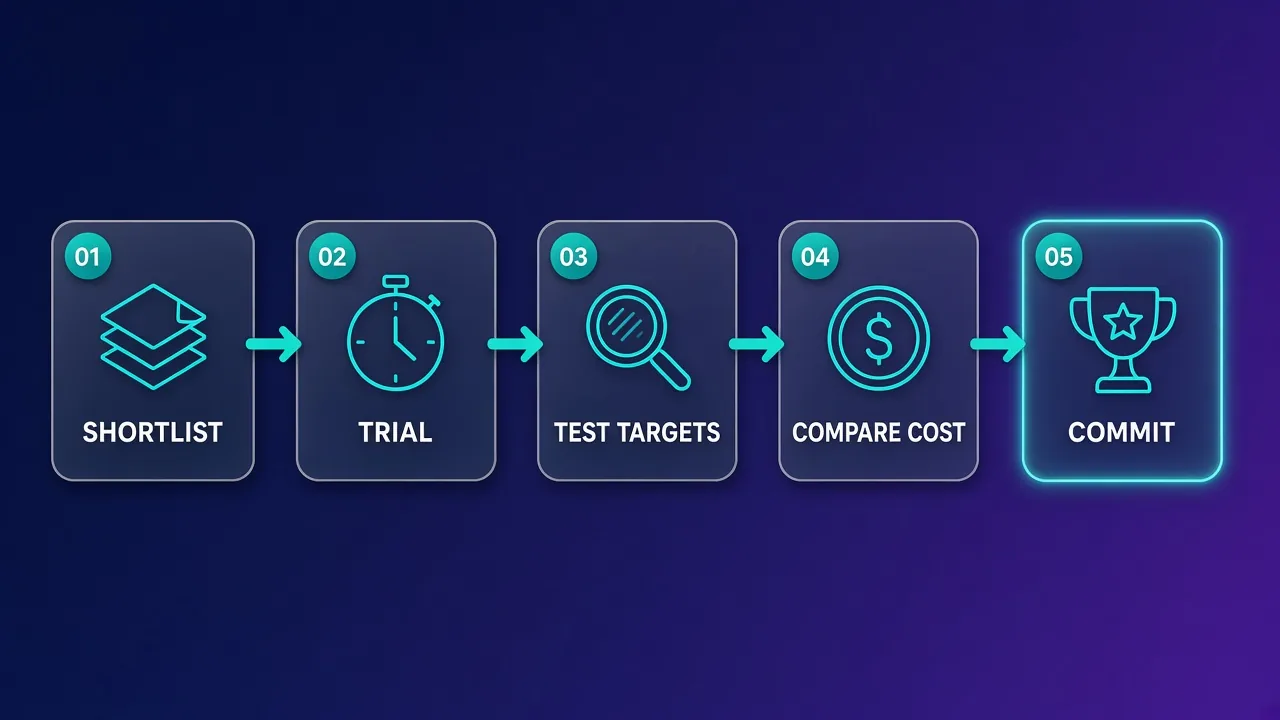
Migrating proxies is mostly about avoiding a blind cutover.
- Shortlist two or three providers based on the reason you're leaving, not on headline pool size.
- Run trials in parallel. Use each provider's trial, free tier or smallest plan against the same targets at the same time of day.
- Test your real targets. Measure success rate, response time and how often you hit CAPTCHAs or blocks, and test the exact geo and session settings you use.
- Compare cost per successful request. A cheaper per-GB rate means little if success drops.
- Commit gradually. Move a share of traffic first, keep Decodo as a fallback for a billing cycle, then cut over.
Technical details to check before you move
- Endpoint format and authentication: username-password syntax for country, city and session parameters differs between providers, so update your client code.
- Session behaviour: confirm how long sticky sessions last and how rotation is triggered. Our explainer on sticky sessions covers what to look for.
- Protocol support: if your tooling needs SOCKS5, verify it on the specific product, not just the provider.
- Concurrency limits: some plans cap threads or ports.
Watch for unused balance
Before you cancel, check whether you have remaining traffic or an active subscription period with your current provider, and plan the cutover so you aren't paying twice for longer than you need to.
Peer-to-peer vs ISP-sourced residential IPs
One difference between these providers is easy to miss on a pricing page: where residential IPs physically come from. Most large residential pools, including many value-tier ones, are built from consumer devices whose owners opted in through an app or SDK. Traffic exits through a real household connection, which is why it looks authentic to target sites. The cost of that model is variability: a device can go offline, change networks or slow down, and your session goes with it.
ISP-sourced or static residential IPs work differently. The addresses are registered to consumer internet providers but hosted on stable infrastructure, so they hold a session far longer and respond more consistently. NetNut's direct-ISP model leans on this approach, and several providers here, including IPRoyal, SOAX and Evomi, sell static ISP products alongside their rotating pools.
Neither is strictly better. Rotating peer-to-peer pools give you breadth and natural-looking diversity for large scraping jobs; ISP IPs give you stability for logins, account management and long-running sessions. If you're switching because sessions keep dropping, the fix may be a different product type rather than a different provider. Our comparison of residential, ISP and datacenter proxies explains when each one makes sense.
Pricing models compared
Most residential proxies on this list are billed per GB of traffic, but the terms differ in ways that matter more than the headline rate:
- Expiring vs non-expiring traffic. Subscription plans usually reset each cycle; IPRoyal's residential traffic doesn't expire.
- Pay-as-you-go vs commitments. Some providers reward volume commitments with lower rates; NetNut leans toward commitments, while IPRoyal and Evomi suit small purchases.
- Per-IP plans. Datacenter and ISP products are usually sold per IP, which is easier to budget for heavy traffic.
- Trials and refunds. Free tiers, paid trials and money-back windows vary; use them before committing.
Check each provider's card above for current starting prices and trial details, since those change more often than articles do.
The bottom line
Decodo remains a strong all-rounder, so the best alternative is the one that fixes the specific thing you want fixed. Choose IPRoyal for non-expiring pay-as-you-go traffic, SOAX for precise targeting, Webshare for free testing and datacenter value, NetNut for stable ISP-routed sessions, Massive for auditable sourcing, and Evomi for budget pricing with a compliance angle. Trial two of them against your real targets, compare cost per successful request, and switch gradually.
Frequently asked questions
It depends on why you're switching. IPRoyal suits intermittent users thanks to non-expiring residential traffic, SOAX suits teams needing city and ISP targeting on every plan, and NetNut suits workloads that need stable, ISP-routed sessions.
Yes. Decodo is the current name of the provider formerly known as Smartproxy. It offers residential, mobile, ISP and datacenter proxies plus a Site Unblocker.
IPRoyal is known for residential traffic that never expires and true pay-as-you-go pricing with no required subscription. That makes it a good fit if your proxy use comes in bursts.
SOAX offers country, region, city and ISP-level targeting on every plan rather than reserving it for higher tiers. That's useful for local SEO, ad verification and regional price checks.
Webshare offers a forever-free plan with 10 datacenter proxies and a small monthly bandwidth allowance, no card required. It's handy for testing targets, though it isn't a like-for-like replacement for a residential pool.
Massive sources residential IPs exclusively through a consent-based, auditable SDK model and supports KYC, GDPR and CCPA compliance. Evomi offers a compliance-forward posture under Swiss jurisdiction at budget pricing, though its network is newer.
Trial two or three providers in parallel against your real targets, compare success rate and cost per successful request, then move a share of traffic first while keeping your current provider as a fallback for one billing cycle.
It can be, especially for long, stable sessions, because NetNut routes through ISP partners instead of peer-to-peer devices. It leans toward business customers with higher minimum commitments and fewer pay-as-you-go options.