Table of contents
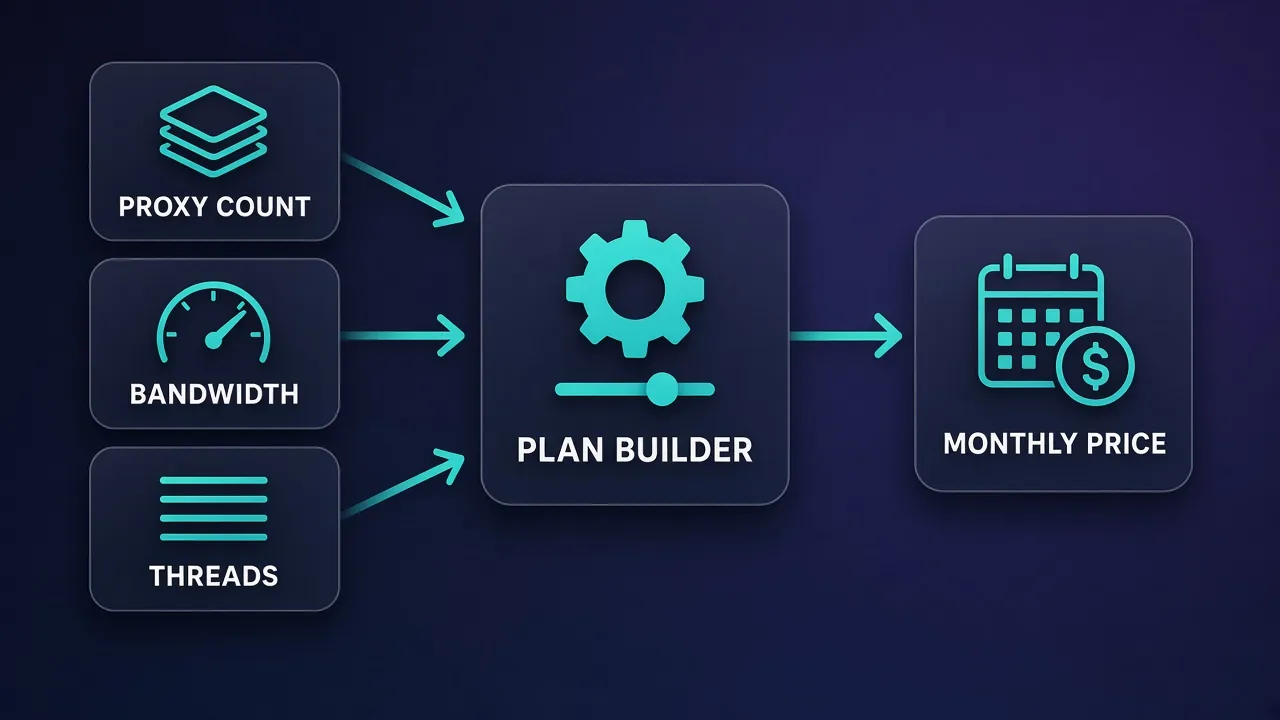
Webshare has one of the most unusual pricing pages in the proxy market. Instead of three or four fixed tiers, it gives you a plan builder: pick a proxy type, choose how many proxies or gigabytes you want, adjust bandwidth and threads, and the monthly price recalculates in front of you. That flexibility is great once you understand it and confusing before you do, because the three products are billed in different units and the discounts kick in at different volumes.
This guide breaks down how Webshare's pricing actually works across its datacenter, static residential (ISP) and rotating residential products, what the free plan really includes, where the volume discounts land, and how to choose a configuration that fits your workload. If you are still deciding between providers, our Webshare vs Bright Data comparison and our guide on how to choose a proxy provider are good companions.
Prices at a glance (checked October 2026)
Datacenter proxies start at $2.99/month for 100 proxies, static residential at $0.30 per proxy (from $6/month for 20), and rotating residential at $3.50/GB on a 1 GB plan, falling to $1.40/GB at 3,000 GB. A free plan with 10 proxies and 1 GB/month needs no card. Proxy prices change often, so confirm on Webshare's site before buying.
How Webshare's Pricing Model Works
Most proxy providers sell bundles: a residential plan with a fixed number of gigabytes, or a datacenter package with a fixed number of IPs. Webshare instead treats each product as a set of dials.
- Proxy type: datacenter (Webshare calls these proxy server plans), static residential, or rotating residential.
- Quantity: number of proxies for datacenter and static residential, or number of gigabytes for rotating residential.
- Bandwidth and threads: for the per-proxy products, Webshare lists bandwidth options from 250 GB up to unlimited and thread limits from 500 to 3,000, subject to its fair usage policy.
The practical upshot is that you are rarely forced to buy a bigger package just to get one feature. If you need 300 proxies with modest bandwidth, you can configure roughly that, rather than jumping to the next fixed tier. The flip side is that the headline "from" prices assume minimal settings; adding bandwidth, threads or extra options raises the monthly total.
Plans are billed as subscriptions and auto-renew at the end of each term by default. If an automatic renewal fails, Webshare says it emails a link to pay manually.
Webshare's Three Products and Their Billing Units
| Product | Billed by | Entry price (Oct 2026) | Best for |
|---|---|---|---|
| Datacenter (proxy server) | Per proxy, per month | $2.99/mo for 100 proxies ($0.0299 each) | High-volume requests to tolerant targets, APIs, testing |
| Static residential (ISP) | Per proxy, per month | $6/mo for 20 proxies ($0.30 each) | Logins, account management, long sessions |
| Rotating residential | Per GB of traffic, per month | $3.50/GB on a 1 GB plan | Defended sites, geo-targeted scraping, ad verification |
| Free plan | Free | 10 proxies, 1 GB/month | Testing and very light personal use |
The key distinction is the unit. With per-proxy products, your cost is predictable and does not depend on how many pages you load (within bandwidth limits). With per-GB rotating residential, your cost scales directly with traffic, so page weight, retries and wasted requests all show up on the bill.
Datacenter Proxy Pricing
Datacenter proxies are Webshare's cheapest and most established product. At the time of writing, the per-proxy price falls as the quantity rises:
| Proxies | Price per proxy | Monthly total |
|---|---|---|
| 10 (free plan) | $0 | $0 |
| 100 | $0.0299 | $2.99 |
| 250 | $0.0299 | $7.47 |
| 1,000 | $0.0269 | $26.91 (list $29.90) |
| 5,000 | $0.0239 | $119.60 (list $149.50, 20% off) |
| 60,000 | $0.0179 | $1,076.40 (list $1,794.00) |
Webshare advertises datacenter locations in more than 50 countries, a 100+ Gbps aggregate network, and 99.97% uptime. Those are the provider's own figures, not independent measurements, but they indicate the product is built for throughput.
What drives datacenter cost
- Proxy count is the main lever; discounts grow with quantity, and 1,000 proxies already carries about 10% off list.
- Bandwidth allowance starts at 250 GB and can be raised to unlimited, subject to fair use.
- Thread limits cap concurrent connections, from 500 up to 3,000.
For many scraping jobs, the entry 100-proxy configuration is enough to validate a pipeline before committing to more. Datacenter IPs are registered to hosting providers, so heavily defended targets may block them; our residential vs ISP vs datacenter guide explains why ASN matters.
Static Residential (ISP) Proxy Pricing
Webshare's static residential proxies are ISP-issued IPs that stay assigned to you. The product page names AT&T, Sprint and Cox Communications among the ISPs, and Webshare states plainly that on its platform "static residential" and "ISP proxy" describe the same product.
| Proxies | Price per proxy | Monthly total |
|---|---|---|
| 20 | $0.30 | $6.00 |
| 50 | $0.30 | $15.00 |
| 250 | $0.30 | $75.00 |
| 10,000 | $0.225 | Volume tier, 25% off list |
Pricing is flat at $0.30 per proxy for small and mid-size plans, with discounts beginning at larger quantities and reaching $0.225 per proxy at 10,000 proxies. Webshare describes these IPs as dedicated to one customer, with bandwidth up to unlimited under its fair usage policy, threads from 500 to 3,000, HTTP and SOCKS5 support, and speeds of up to 1 Gbps.
Because you pay per IP rather than per gigabyte, static residential can be far cheaper than rotating residential for bandwidth-heavy work that does not need a new IP every request, such as monitoring a fixed set of pages or keeping accounts logged in. It is the opposite trade-off from rotating residential: fewer IPs, more traffic per IP.
Unlimited means fair use
Webshare marks its unlimited bandwidth options as subject to its Fair Usage Policy. If you plan sustained heavy transfer, read that policy first rather than assuming truly uncapped throughput.
Rotating Residential Proxy Pricing
Rotating residential is where the per-gigabyte math applies. Webshare advertises a pool of more than 80 million residential IPs across 195 countries, with targeting by country, state, city, ZIP code and ASN set through the proxy username.
| Plan size | Price per GB | Monthly total |
|---|---|---|
| 1 GB | $3.50 | $3.50 |
| 10 GB | $2.75 | $27.50 |
| 25 GB | $2.60 | $65.00 |
| 250 GB | $2.00 | $500.00 |
| 3,000 GB | $1.40 | $4,200.00 |
The pricing page shows a crossed-out list price of $7.00/GB next to every tier, so the displayed rates are framed as discounts. What matters for budgeting is the effective per-GB figure at the volume you will really use. Plans are billed monthly based on plan size.
Webshare also notes that some websites are restricted on its residential network to prevent misuse, and that certain targets can be unblocked after a short KYC (know your customer) check. If your project depends on a specific site, confirm access before committing to a large plan.
Estimating your residential bandwidth
Per-GB billing rewards efficiency. A rough way to size a plan:
- Measure the average transfer size of a target page with your actual client (HTML only for a request-based scraper, full assets for a browser).
- Multiply by pages per month, then add a margin for retries and failed requests.
- Cut waste: block images, fonts and media in headless browsers, reuse sessions, and avoid re-fetching unchanged pages.
A browser loading full pages can consume many times the bandwidth of a lean HTML fetch, so the same crawl can land in very different tiers depending on your tooling. For cheaper residential options across providers, see our best cheap residential proxies roundup.
The Free Plan: What You Actually Get
Webshare's free plan is one of the few genuinely free tiers in the proxy market. According to the provider, it includes 10 proxies with up to 1 GB of bandwidth per month, for an unlimited time, with no credit card and no trial period. You only pay if you want more proxies, more bandwidth or extra features.
It is realistic to use the free plan for:
- testing your proxy integration code end to end;
- checking how a target site reacts to datacenter IPs;
- light personal use where 1 GB per month is plenty.
It is not designed for production scraping. Ten IPs and a small bandwidth cap will run out quickly on any meaningful crawl, and free tiers rarely represent the performance of paid configurations.
Choosing the Right Plan Builder Settings
The plan builder rewards a little up-front planning. Work through these questions before you configure anything:
1. How defended are your targets?
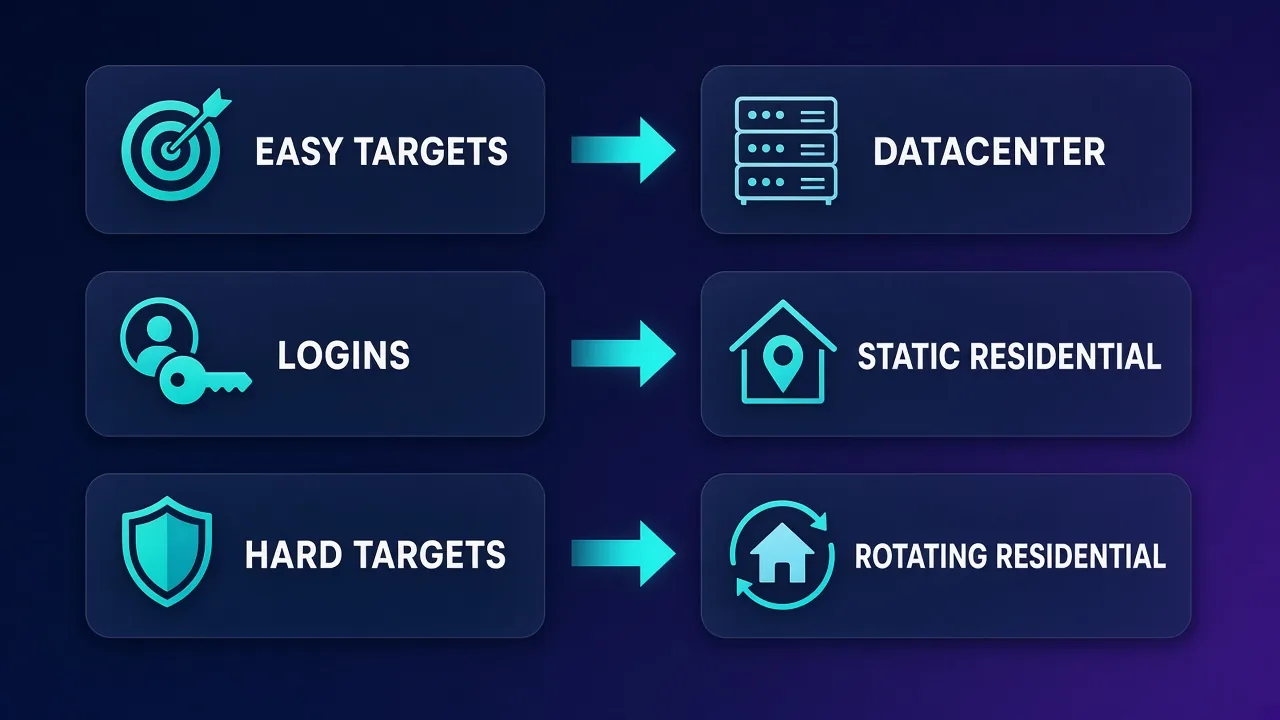
Start with datacenter for APIs, public datasets and sites with light protection. Move to static residential when sites check IP reputation on logins. Use rotating residential when targets block hosting ASNs or rate-limit aggressively per IP.
2. Do you need a new IP per request or a stable identity?
Rotation suits broad crawling. Stable identity suits accounts, carts and dashboards. Paying per GB for rotation you do not need is a common way to overspend.
3. How much traffic, really?
For per-proxy plans, estimate concurrent connections to set threads, and monthly transfer to set bandwidth. For rotating residential, estimate gigabytes using the method above and pick the tier just above your expected need rather than the cheapest per-GB rate you might never use.
4. Can you start small?
Because Webshare's refund window is short (see below), it is usually smarter to buy the smallest viable plan, run real workloads for a few days, and then scale up once you have measured usage.
Worked Cost Examples
The numbers below use only Webshare's published October 2026 rates and simple arithmetic, so you can see how different workloads translate into a monthly bill. Your real total will move with the bandwidth, thread and option settings you choose in the plan builder.
A developer testing an API integration
Start on the free plan's 10 proxies. When you outgrow the 1 GB monthly cap, the 100-proxy datacenter configuration at $2.99 per month is the natural next step. At this scale, the cost of proxies is negligible next to your own time, so the main question is whether the target accepts datacenter IPs at all.
A small team managing logged-in accounts
Suppose you run 50 accounts and want each to keep its own stable ISP address. Fifty static residential proxies at $0.30 each come to $15 per month. Doing the same with rotating residential would mean paying per gigabyte and fighting rotation with sticky sessions, which is usually more expensive and less stable for this job.
A growing residential crawl
A crawl that needs about 25 GB of residential traffic costs $65 per month at $2.60 per GB. If it grows tenfold to 250 GB, the 250 GB tier costs $500 per month at $2.00 per GB, rather than the $650 you would pay at the 25 GB rate. Volume discounts are meaningful here, but only if you actually use the traffic, so size up after measuring rather than in anticipation.
Per-IP versus per-GB for the same budget
For roughly the same spend, $75 buys 250 static residential proxies for a month, while $65 buys 25 GB of rotating residential traffic. The first gives you many stable identities with generous bandwidth; the second gives you access to a huge rotating pool but a fixed amount of transfer. Which is better depends entirely on whether your bottleneck is IP diversity or traffic volume.
Refunds, Payments and Billing Fine Print
Webshare's refund policy is narrow, so it is worth knowing before you buy. The provider states that it offers refunds when you cancel within 2 days of the original payment and meet usage conditions: bandwidth used below 1 GB on proxy server or static residential plans, or below 0.1 GB on rotating residential plans, and fewer than 1,000 proxies used. Full terms are in Webshare's Terms and Conditions, and refund requests go through its support team.
Supported payment methods listed by Webshare include major cards (Visa, Mastercard, American Express, Discover and others), plus Google Pay and Apple Pay, which are only available on mobile devices. If you rely on crypto or invoicing, check with Webshare first, since those are not on its published list.
| Billing detail | Webshare policy (as published) |
|---|---|
| Billing cycle | Monthly subscription, auto-renews by default |
| Refund window | 2 days from original payment, with usage limits |
| Free tier | 10 proxies, 1 GB/month, no card |
| Payment methods | Cards; Google Pay and Apple Pay on mobile |
Is Webshare Good Value?
Value depends on which product you buy.
- Datacenter: this is Webshare's strongest pricing story. Per-proxy costs at volume are low, setup is instant, and the free tier lets you test before paying.
- Static residential: competitive for small dedicated ISP pools, with per-IP pricing that keeps bandwidth-heavy, stable-identity work affordable.
- Rotating residential: the entry price is accessible and the top tiers are low per GB, but the pool is newer than those of long-established residential specialists. For the hardest targets, test success rates against alternatives before committing a large budget.
Where Webshare is less suited: teams that need hands-on account management or extensive live support on smaller plans, and buyers who want a single fixed bundle covering every proxy type. In those cases a more enterprise-oriented provider may justify a higher price.
Who should start with Webshare
Developers and small teams who want self-service setup, a real free tier to test with, and the ability to buy exactly the proxy count or bandwidth they need without a sales call.
Webshare at a Glance
For live ratings, starting prices and features from our database, here is the Webshare card:

Webshare
Webshare is the developer's self-service favorite. Instant activation, a free tier that is actually free, and the cheapest fast datacenter proxies in the market make it the easiest provider to just start using. The custom plan builder — pick your IP count, bandwidth, and threads — is a genuinely good model that lets you avoid paying for capacity you do not need. The residential pool is newer and less battle-tested than specialists, and support is thin on the lower tiers. For datacenter proxies, API-driven workflows, and anyone who wants to try before paying, Webshare is one of the best-value options around.
Conclusion
Webshare's pricing makes sense once you see it as three separate products with two billing units. Datacenter and static residential are priced per proxy, so costs stay predictable as traffic grows within your bandwidth allowance. Rotating residential is priced per gigabyte, so efficiency directly cuts your bill and volume brings the rate down from $3.50 to as low as $1.40 per GB. The free plan is a genuine way to test, the plan builder avoids paying for capacity you do not need, and the short refund window is the main reason to start small. Match the product to your targets, size the plan to measured usage, and recheck prices on Webshare's site before you buy, since proxy pricing moves quickly.
Frequently asked questions
As of October 2026, Webshare datacenter proxies start at $2.99 per month for 100 proxies, static residential proxies cost $0.30 each with plans from $6 per month, and rotating residential starts at $3.50 per GB on a 1 GB plan. Prices fall with volume and change often, so check Webshare's pricing page before buying.
Yes. Webshare offers 10 proxies with up to 1 GB of bandwidth per month for an unlimited time, with no credit card and no trial period. It is meant for testing and light use rather than production scraping.
Rotating residential is billed per gigabyte of traffic on a monthly plan. The published rate starts at $3.50 per GB for 1 GB and drops to $1.40 per GB at the 3,000 GB tier, with intermediate tiers such as $2.75 per GB at 10 GB.
Yes, on Webshare they are the same product. The IPs are issued by internet service providers such as AT&T, Sprint and Cox, stay assigned to you, and are billed per proxy rather than per gigabyte.
Webshare offers refunds if you cancel within 2 days of the original payment and stay under usage limits: less than 1 GB of bandwidth on proxy server or static residential plans, less than 0.1 GB on rotating residential plans, and fewer than 1,000 proxies used. Full terms are in its Terms and Conditions.
Webshare lists major cards including Visa, Mastercard, American Express and Discover, plus Google Pay and Apple Pay on mobile devices. If you need another method such as crypto, contact Webshare first because it is not on the published list.
Webshare offers bandwidth options up to unlimited on its per-proxy plans, but these are subject to its Fair Usage Policy. Read that policy before planning sustained heavy transfer so you know where the practical limits are.
Choose datacenter for APIs and lightly protected sites, static residential for logins and long-lived sessions, and rotating residential for defended or geo-targeted targets. Start with the smallest viable plan, measure real usage, and scale up, since the refund window is short.