Table of contents
Decodo and Bright Data both sell residential, mobile, ISP, and datacenter proxies, both support rotating and sticky sessions, and both appear on nearly every shortlist a scraping or data team builds. They are not aimed at the same buyer, though. Decodo, the provider formerly known as Smartproxy, has built its name on mid-market value: a large pool, a friendly dashboard, low entry prices, and fast live-chat support. Bright Data, which started life as Luminati Networks, is the enterprise heavyweight: the deepest targeting options in the market, a full managed-scraping and dataset platform, and a compliance process designed to satisfy legal and procurement teams.
So the honest answer to "Decodo vs Bright Data, which is better?" is that it depends on how much traffic you run, how precise your targeting has to be, how much engineering time you can spend, and how much paperwork your organization requires before it signs a vendor. This guide walks through the two providers on pool size and network types, geo-targeting, pricing models, tooling, support, and compliance, then gives you a practical framework for picking one. Where we mention prices, treat them as starting points that change over time; the live cards below and our dedicated pricing breakdowns carry the current figures.
Quick framing
Decodo is the "get a large, capable network without enterprise overhead" choice. Bright Data is the "buy the whole web-data platform, with audit-ready compliance" choice. Most teams should decide by workload shape, budget, and procurement needs rather than by brand recognition.
Decodo vs Bright Data: the quick verdict
If you only have a minute, this is the short version:
- Choose Decodo if you want a large residential pool at a lower entry price, a dashboard you can learn in an afternoon, a money-back window to test with, and 24/7 live chat. It suits freelancers, agencies, growth teams, and mid-sized data operations.
- Choose Bright Data if you need targeting down to state, city, ZIP code, ASN, or mobile carrier, an uptime SLA, managed scraping and ready-made datasets alongside raw proxies, and a vendor with a dedicated compliance team and mandatory KYC that your legal department can point to.
- Consider running both if your workloads are mixed. Some teams keep a premium provider for the hardest or most regulated jobs and route high-volume, lower-risk traffic through a mid-market network to control costs.
Here they are side by side, with ratings, plans, and any current deals pulled live from our reviews:

Decodo
Proxy
Bright Data
Proxy
Editor score
User rating
Starting price
Founded
What is Decodo?
Decodo is the rebranded Smartproxy, a provider founded in 2018 that grew quickly by making residential proxies approachable for people who are not proxy specialists. Its network is listed at 115M+ residential IPs (125M+ IPs in total) across 195+ locations, and it covers the four main proxy types: residential, mobile, ISP (static residential), and datacenter. You can choose rotating or sticky sessions, target by country, and on most plans narrow down to city level.
The appeal is less about any single headline feature and more about the overall package. Residential traffic starts at around $1.50/GB, the dashboard is designed to be beginner-friendly, there is a 14-day money-back guarantee, and support is available through 24/7 live chat. Decodo also offers an unblocker product for targets that resist plain proxies, so you are not forced to build every anti-bot workaround yourself.
Where Decodo is weaker
The trade-offs are real but predictable for a mid-market provider. Decodo has fewer enterprise compliance features than Bright Data, which can matter if your procurement team expects detailed sourcing documentation, and city-level targeting is limited on some plans. If you need very fine-grained location control on every request, check the specific plan before you commit. For a detailed look at how its plans are structured, see our Decodo pricing and plans explained guide.
Decodo
Decodo offers the best price-to-performance ratio in the industry. It delivers roughly 90% of what the enterprise leaders provide — high success rates, a large clean pool, sticky sessions, an unblocker — at a fraction of their cost. The dashboard is the friendliest of any major provider, the 14-day money-back guarantee removes the risk of trying it, and support actually responds. The main gaps are enterprise-grade compliance tooling and the very deepest targeting, neither of which most teams need. For startups, solo developers, and any team that wants professional results without enterprise pricing, Decodo is our top value pick and an easy recommendation.
What is Bright Data?
Bright Data has been operating since 2014, originally as Luminati Networks, and is one of the most established companies in web data. It runs four proxy networks (residential, datacenter, ISP, and mobile) and its residential network is listed at 150M+ IPs sourced from real consumer devices in 195 countries. On top of raw proxies, it offers a Web Scraper API and managed scraping services, plus ready-made datasets for teams that would rather buy the data than collect it.
That breadth is the main reason enterprises choose it. Bright Data reports 20,000+ customers and offers a 99.99% uptime SLA, and its targeting goes deeper than most competitors: country, state, city, ZIP code, ASN, and mobile carrier. It also enforces mandatory KYC for all users, maintains a dedicated compliance team, and describes its residential peers as opt-in and compensated, which is the kind of sourcing story legal teams like to see in writing.
Where Bright Data is weaker
The costs are price, complexity, and onboarding time. Bright Data sits at the premium end of the market, the control panel has a steep learning curve because it exposes so many products and settings, and mandatory KYC means you cannot always start routing traffic the same day you sign up. If you are comparing it against its closest enterprise rival, our Bright Data vs Oxylabs head-to-head goes deeper.
Bright Data
Bright Data remains the most complete data-collection platform money can buy. No competitor matches its combination of network scale, targeting granularity, and compliance tooling — and for enterprise teams whose revenue depends on reliable data, that completeness justifies the premium. The trade-offs are real: it is one of the priciest providers per gigabyte, the interface overwhelms newcomers, and KYC verification adds friction before you can route a single request. Smaller projects will get better value from Decodo or IPRoyal. But if you need city-level residential targeting at scale, a managed unblocker for the hardest targets, and audit-ready compliance, Bright Data is the default — and our highest-rated proxy provider overall.
Feature-by-feature comparison
The table below summarizes the differences that tend to decide a purchase. Figures come from the providers' published information as tracked in our provider database; prices are starting points and change over time.
| Feature | Decodo | Bright Data |
|---|---|---|
| Founded | 2018 (as Smartproxy) | 2014 (as Luminati Networks) |
| Residential pool | 115M+ residential (125M+ IPs total) | 150M+ residential from real consumer devices |
| Locations | 195+ locations | 195 countries |
| Proxy types | Residential, mobile, ISP (static residential), datacenter | Residential, datacenter, ISP, mobile |
| Geo-targeting | Country; city on most plans | Country, state, city, ZIP, ASN, mobile carrier |
| Sessions | Rotating or sticky | Rotating or sticky |
| Residential pricing | Starting around $1.50/GB | Starting around $4.20/GB pay-as-you-go; lower with monthly commitments |
| Beyond proxies | Unblocker | Web Scraper API, managed scraping, ready-made datasets |
| Reliability commitment | No uptime SLA listed in our data | 99.99% uptime SLA |
| Onboarding | Self-serve, beginner-friendly dashboard | Mandatory KYC for all users |
| Compliance | Fewer enterprise compliance features | Dedicated compliance team, opt-in compensated peers |
| Support | 24/7 live chat | Enterprise-oriented support for a 20,000+ customer base |
| Risk-free trial window | 14-day money-back guarantee | Check current terms on the provider's site |
| Proxyaxis editor rating | 4.5 | 4.7 |
Two patterns stand out. First, the gap in raw pool size is smaller than the gap in price, so for many general-purpose jobs Decodo delivers more IPs per dollar. Second, Bright Data's advantages cluster around precision, platform breadth, and governance, which are exactly the things that matter more as an organization grows.
Proxy pools and network types
Both providers offer the same four network types, so the question is less "which types do they have" and more "how deep is each network and how do you use it". If you are unsure which type you need in the first place, our explainer on residential vs ISP vs datacenter proxies covers the trade-offs in detail.
Residential
Residential IPs are the workhorse for scraping protected sites, ad verification, and localized SERP checks, because traffic appears to come from ordinary home connections. Bright Data lists the larger pool at 150M+ residential IPs, while Decodo lists 115M+. In practice, pool size matters most when you need many unique IPs in a narrow location; for broad, country-level work, both pools are large enough that other factors such as targeting, session control, and price usually matter more.
ISP (static residential)
ISP proxies give you residential-looking IPs that stay the same for long periods, which is useful for account management, checkout flows, and any task where a changing IP would look suspicious. Both providers offer them. Bright Data prices ISP proxies per IP, starting at about $1.30/IP, which makes cost predictable when you know how many identities you need.
Datacenter
Datacenter IPs are fast and inexpensive but easier for websites to recognize. They are a good fit for targets with light protection, internal testing, and high-throughput jobs where an occasional block is acceptable. Bright Data's datacenter proxies start at about $0.90/IP; Decodo also offers datacenter options for teams that want everything under one account.
Mobile
Mobile proxies route through carrier networks and tend to be the hardest for sites to block, because many real users share carrier IPs. They are typically the most expensive proxy type. Bright Data's mobile traffic starts at about $5.88/GB and can be targeted by mobile carrier, which is valuable for app testing and carrier-specific ad verification.
Targeting and session control
Targeting is where the two providers differ most clearly, and it is often the deciding factor for teams with location-sensitive work.
Geo-targeting depth
Decodo covers country-level targeting everywhere and city-level targeting on most plans. That is enough for the majority of use cases: checking prices in a given market, viewing localized search results, or testing a geo-restricted landing page. Bright Data goes further, offering state, city, ZIP code, ASN, and mobile carrier targeting. ZIP-level targeting matters for local SEO, delivery-zone pricing, and retail availability checks; ASN targeting matters when you need traffic to come from a specific network operator.
Rotating vs sticky sessions
Both providers let you rotate the IP on every request or keep the same IP for a period of time. Rotation spreads requests across many addresses, which helps with large crawls. Sticky sessions keep a consistent identity for multi-step flows such as logins, carts, and paginated results. If you are new to the concept, our guide to sticky sessions explained covers how session duration affects block rates and what to do when an IP drops mid-session.
Practical tip
Before choosing on targeting alone, list the exact locations your project needs and test them. If country or city is enough, the extra depth of ZIP and ASN targeting may not justify a higher per-GB cost. If you genuinely need ZIP or carrier precision, that requirement narrows the decision quickly.
Pricing models compared
Comparing proxy prices is tricky because providers mix several billing models and change rates regularly. Rather than treat any figure as final, it helps to understand the three models you will run into and how each provider uses them. For current numbers, see our Decodo pricing guide and our Bright Data pricing guide.
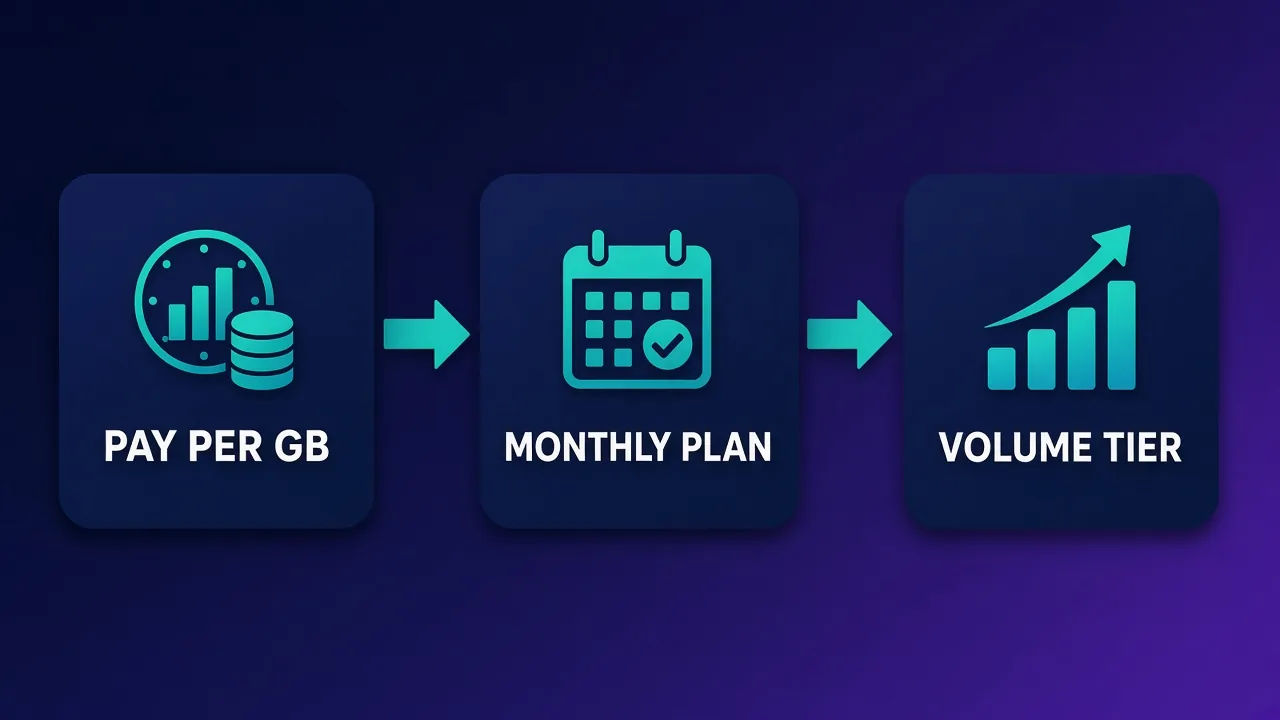
Pay per GB
Residential and mobile traffic is usually billed by bandwidth. Decodo's residential pricing starts around $1.50/GB, while Bright Data's pay-as-you-go residential pricing starts around $4.20/GB. Pay-per-GB is flexible and easy to start with, but costs scale directly with page weight, so heavy pages, images, and scripts can make a scraping job far more expensive than expected. Blocking unnecessary resources and caching where possible are the simplest ways to control spend.
Monthly plans and commitments
Both providers reward predictable usage. Bright Data's per-GB rate drops when you commit to a monthly plan instead of paying as you go, and Decodo also publishes several plan sizes, and our Decodo pricing guide shows how they compare. If your traffic is steady, a commitment usually beats pay-as-you-go; if it is spiky or experimental, flexibility may be worth the higher unit price.
Volume tiers and per-IP pricing
Static products such as ISP and datacenter proxies are often priced per IP rather than per GB. At Bright Data, datacenter starts around $0.90/IP and ISP around $1.30/IP. Per-IP billing suits workloads that keep a fixed set of identities and move a lot of data through them, because you are not paying for bandwidth on every request. At larger volumes, providers in this market commonly offer tiered or custom pricing, so it is worth asking for a quote once you have real usage numbers.
Prices change
All figures here are starting points from published pricing and will shift with promotions, plan changes, and volume. Always confirm on the provider's pricing page and compare the effective cost for your own traffic profile, not just the headline rate.
Ease of use, tooling, and support
A provider that is cheaper on paper can become expensive if your team spends days fighting configuration. This is one of Decodo's clearest advantages.
Dashboard and setup
Decodo's dashboard is built for people who want to generate credentials, pick a location, and start sending requests without reading a long manual. That simplicity is a big part of its appeal for agencies and small teams that do not have a dedicated proxy engineer.
Bright Data's control panel is more powerful and more complex. It exposes four proxy networks, scraping products, datasets, and many configuration options, which is a strength for large teams and a hurdle for newcomers. Expect a learning curve, and budget time for someone to own the setup.
Beyond raw proxies
Decodo offers an unblocker for difficult targets, which covers a common need without forcing you into a larger platform. Bright Data goes much further with its Web Scraper API, managed scraping services, and ready-made datasets. If your real goal is the data rather than the proxies, Bright Data can remove a lot of engineering work, at a price.
Support
Decodo provides 24/7 live chat, which is useful when a job breaks outside office hours and you need a quick answer. Bright Data serves a customer base of 20,000+ and is oriented toward enterprise accounts, with a dedicated compliance team and an uptime SLA that can matter for production pipelines. In both cases, the quality of support you receive will depend partly on your plan and account size.
Compliance, KYC, and ethical sourcing
For individual users this section may feel like a footnote; for regulated businesses it is often the whole decision.
Bright Data requires KYC verification for all users, runs a dedicated compliance team, and states that its residential peers opt in and are compensated. That gives procurement and legal teams a documented sourcing story and a vendor process they can audit. The downside is friction: onboarding takes longer, and some use cases may be restricted or require additional review.
Decodo is more self-serve and has fewer enterprise compliance features. That makes it faster to start and easier for smaller teams, but organizations with strict vendor-risk requirements should ask directly what documentation is available before committing.
Use proxies responsibly
Whichever provider you choose, respect target sites' terms, applicable privacy and data-protection laws, and reasonable request rates. A provider's compliance process does not make every use case acceptable, and responsibility for how traffic is used stays with you.
How to choose between them
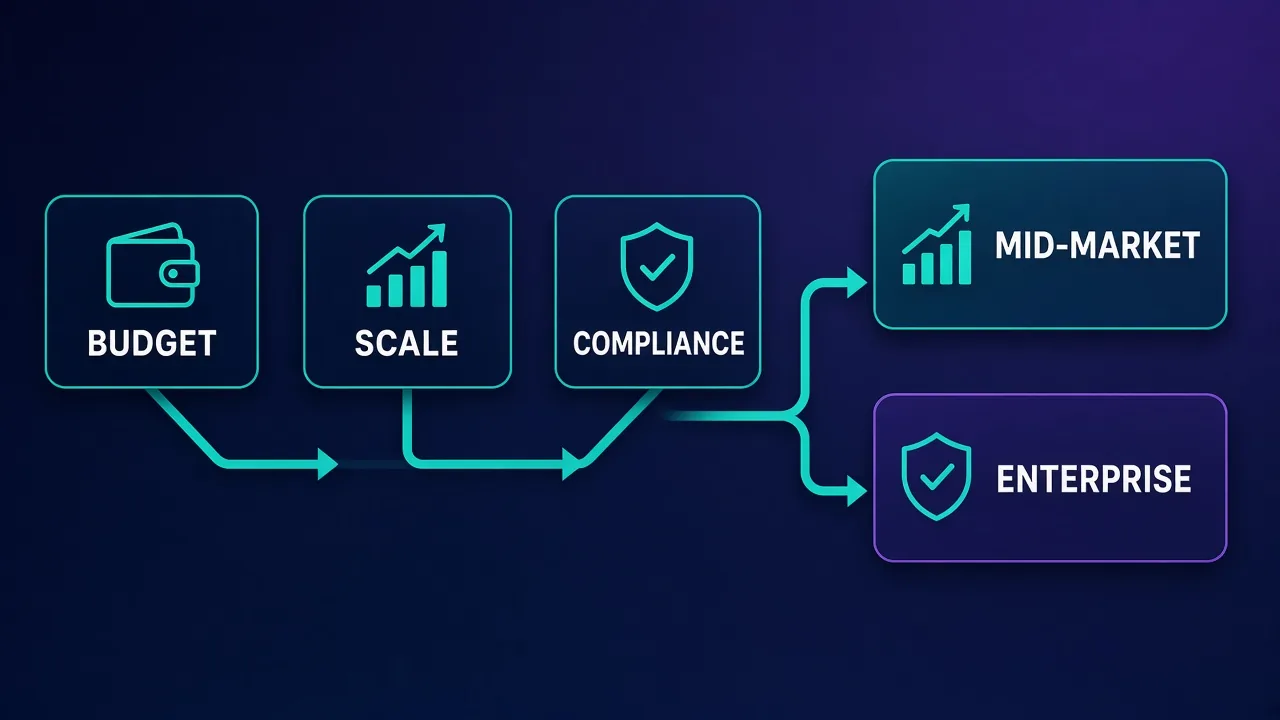
Most decisions come down to three questions, asked in order: what is your budget, how large and precise does the workload need to be, and how much compliance documentation does your organization require?
Start with budget
If cost per GB is your main constraint and your targeting needs stop at country or city, Decodo is usually the better fit. Its lower starting price, money-back guarantee, and easy setup let you validate a project without a large upfront commitment.
Then consider scale and precision
If you need ZIP, ASN, or carrier targeting, very large and consistent volumes, an uptime SLA, or managed scraping and datasets, Bright Data's depth starts to justify its premium. The larger and more business-critical the pipeline, the more those capabilities matter.
Finally, check compliance requirements
If your legal or procurement team needs KYC, documented peer consent, and a dedicated compliance contact, Bright Data is designed for that process. If your organization does not require that level of paperwork, Decodo's lighter onboarding is a benefit rather than a drawback.
Typical fits
- Freelancers and agencies running SEO checks, social management, or price monitoring for clients: Decodo, for its pricing and ease of use.
- Growth and e-commerce teams monitoring competitors in a handful of markets: Decodo, unless ZIP-level precision is required.
- Enterprise data teams running large, multi-region pipelines: Bright Data, for targeting depth, the SLA, and platform breadth.
- Regulated industries such as finance or large retail with strict vendor review: Bright Data, for its KYC and compliance process.
- Teams that want data, not infrastructure: Bright Data's datasets and managed scraping may be cheaper overall than building and maintaining your own scrapers.
When in doubt, run a small pilot on both with your real targets. Measure success rate, response time, and effective cost per successful request rather than relying on headline figures.
Alternatives worth considering
If neither provider is a perfect match, two other networks we have reviewed are worth a look, depending on what you value.
IPRoyal: for irregular usage
IPRoyal's residential traffic does not expire, with pricing starting from about $1.57/GB. That suits people who use proxies in bursts and do not want unused bandwidth to disappear at the end of a billing cycle.

IPRoyal
IPRoyal is the best pure pay-as-you-go deal in proxies. Non-expiring traffic is a genuinely customer-friendly policy that no major rival matches — buy what you need, use it whenever, lose nothing. The pool is smaller than the premium networks and success rates can soften on the most heavily defended targets, so high-volume enterprise scraping is not its strength. The dashboard is also fairly basic. For intermittent scraping, account work, and sneaker copping on a predictable budget, IPRoyal is an easy recommendation and one of the best value picks for occasional users.
SOAX: for precise targeting without enterprise pricing
SOAX includes city and ISP targeting on every plan, with residential pricing from about $2.20/GB and a $1.99 trial. It sits between Decodo and Bright Data for teams that want more targeting control without an enterprise contract.

SOAX
SOAX is the targeting specialist. City- and ISP-level selection on every plan — not locked behind premium tiers — is genuinely rare, and the continuously cleaned pool keeps success rates high where it matters. It is not the fastest network, the interface could use a refresh, and SOCKS5 coverage is uneven. Those are real but minor gripes against a provider that nails the fundamentals of precision and reliability. For ad verification, localized market research, and social-media work that depends on appearing in an exact location, SOAX is one of the best mid-market options available.
Final verdict
Decodo and Bright Data are both strong providers, and neither is the right answer for everyone. Decodo wins on value and accessibility: a large residential pool, a low entry price, a beginner-friendly dashboard, a 14-day money-back guarantee, and 24/7 live chat. It is the sensible default for freelancers, agencies, and mid-market teams whose targeting needs stop at country or city.
Bright Data wins on depth: a larger residential pool, targeting down to ZIP, ASN, and carrier, an uptime SLA, managed scraping and datasets, and a compliance process built for enterprise procurement. It costs more and takes longer to learn, but for large, regulated, or business-critical workloads, those capabilities can be worth the premium.
Our recommendation is simple: start from your requirements, not the brand. If you can describe your project in terms of budget, scale, and compliance, the choice usually becomes clear, and a short pilot on your real targets will confirm it.
Frequently asked questions
Yes. Decodo is the rebranded Smartproxy, a proxy provider founded in 2018. It offers residential, mobile, ISP (static residential), and datacenter proxies with rotating or sticky sessions.
Usually, yes, at the entry level. Decodo's residential proxies start at around $1.50/GB, while Bright Data's pay-as-you-go residential pricing starts at around $4.20/GB and drops with monthly commitments. Prices change often, so check each provider's current pricing for your traffic volume.
Bright Data lists the larger residential pool at 150M+ IPs from real consumer devices in 195 countries. Decodo lists 115M+ residential IPs (125M+ IPs in total) across 195+ locations. For most country-level work, both pools are large enough that targeting and price matter more.
Yes. Bright Data requires KYC verification for all users and has a dedicated compliance team. This adds time to onboarding but gives businesses a documented, auditable vendor process.
Decodo supports country targeting and, on most plans, city targeting. Bright Data goes further, with state, city, ZIP code, ASN, and mobile carrier targeting. If you need ZIP or carrier-level precision, Bright Data is the stronger fit.
Decodo is a good fit for beginners thanks to its beginner-friendly dashboard, 24/7 live chat, and 14-day money-back guarantee. Those features let you test a project without a large commitment or a steep learning curve.
It can be for enterprises that need deep geo-targeting, a 99.99% uptime SLA, managed scraping, ready-made datasets, and strict compliance processes. For smaller projects that only need country or city targeting, a mid-market provider like Decodo often delivers better value.
IPRoyal is worth a look if you want residential traffic that does not expire, starting from about $1.57/GB. SOAX includes city and ISP targeting on every plan, from about $2.20/GB, with a $1.99 trial.