Table of contents
Bright Data sits at the top of many proxy and data-collection shortlists — and its pricing page is where a lot of teams get confused. The company sells several product lines with different billing units, commitment styles, and overage behaviors. Paying for the wrong unit (or the wrong product) is how budgets quietly double. This guide explains how Bright Data’s pricing is structured in 2026, which levers actually move your bill, and who tends to overpay — without inventing list prices. For live plan details, use the provider card and product page linked below.
For a broader platform comparison, see Bright Data vs Oxylabs. If you are still choosing among proxy types before you talk pricing, read Residential vs ISP vs Datacenter Proxies.
Bright Data
Bright Data remains the most complete data-collection platform money can buy. No competitor matches its combination of network scale, targeting granularity, and compliance tooling — and for enterprise teams whose revenue depends on reliable data, that completeness justifies the premium. The trade-offs are real: it is one of the priciest providers per gigabyte, the interface overwhelms newcomers, and KYC verification adds friction before you can route a single request. Smaller projects will get better value from Decodo or IPRoyal. But if you need city-level residential targeting at scale, a managed unblocker for the hardest targets, and audit-ready compliance, Bright Data is the default — and our highest-rated proxy provider overall.
How Bright Data organizes its products
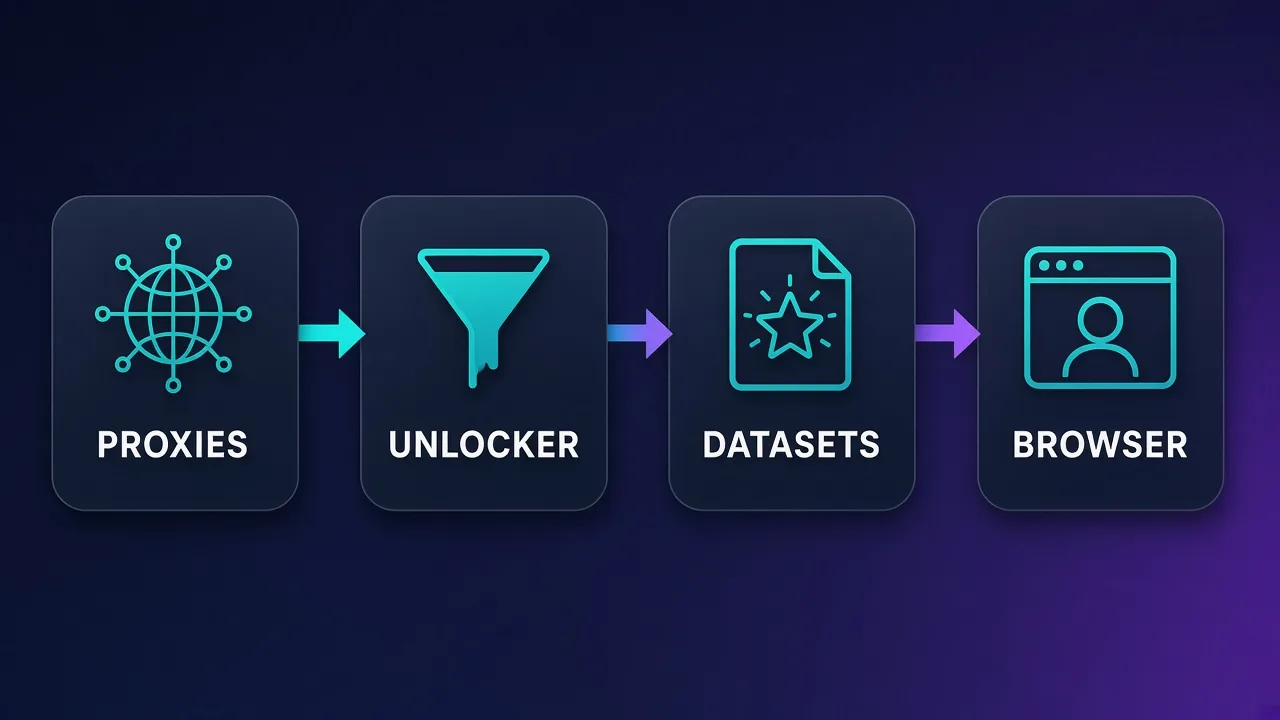
Bright Data is not a single “proxy SKU.” Pricing only makes sense once you map the job to a product line. At a high level, buyers usually encounter:
- Proxy networks — residential, mobile, ISP/static residential, and datacenter proxies consumed as network traffic or as IP/time allocations depending on the line.
- Scraping / unlocker style APIs — managed request APIs that handle challenges and rendering, typically billed per successful request or similar usage units.
- Datasets and ready-made data — packaged datasets sold separately from live proxy traffic.
- Browser / scraping browser products — remote browser infrastructure for sites that need full rendering and interaction.
- Add-ons and platform features — geo targeting precision, dedicated IPs, higher concurrency, support tiers, and similar extras that change the effective rate.
Two teams can both “use Bright Data” and have unrelated invoices because one buys raw residential bandwidth while the other buys an unlocker API and a dataset subscription. Always pin the product name before you compare quotes.
Do not compare $/GB across product lines
Residential bandwidth, ISP ports, datacenter IPs, and per-request APIs are different economic units. A cheaper-looking GB rate can lose to a request API (or the reverse) depending on page weight, retries, and success rate. Compare cost per successful outcome for your workload.
Billing units you will actually see
Bright Data’s public marketing and sales quotes revolve around a handful of units. Memorize these so you can read a quote without mixing apples and oranges:
| Billing unit | Common product context | What drives cost | Cost-control tip |
|---|---|---|---|
| Bandwidth (GB) | Residential / mobile networks | Bytes transferred, including retries and heavy assets | Block junk assets; cache; prefer lean responses |
| IP + time / ports | ISP / static and some datacenter plans | How many IPs and how long you hold them | Right-size pool; release idle IPs |
| Per request / success | Unlocker and scraping APIs | Billable responses, sometimes by complexity | Reduce retries; tune targeting; avoid duplicate jobs |
| Compute / browser time | Scraping browser style products | Session duration and concurrency | Shorten sessions; reuse where allowed |
| Dataset license | Ready-made datasets | Coverage, refresh cadence, seats | Buy only the verticals you use |
Exact meters, included allowances, and overage rules change over time and by contract. Treat the table as a map of what kind of number you are negotiating — then confirm the current meter on Bright Data’s site or in your quote. Live positioning for Bright Data stays on the Bright Data product page and the card above.
Commitments, platforms fees, and overages
Enterprise proxy pricing rarely ends at a sticker GB rate. When you evaluate Bright Data (or any peer), inspect:
- Minimum commit — monthly or annual spend floors that make small experiments expensive.
- Prepay vs postpay — prepaid wallets change cash flow; unused balance policies matter.
- Overage rates — what happens when you blow past the included GB or request bundle.
- Concurrency and throughput caps — soft limits that force you onto a higher tier.
- Geo and ASN premiums — some locations or network types cost more than the base rate.
- Success vs attempt billing — whether failed or challenged requests count.
- Support and SLA tiers — higher touch support can be bundled or additive.
Ask sales to spell each of these in the quote. Two quotes with the same headline rate can diverge by a wide margin once overage and geo multipliers apply.
Retries are a hidden multiplier
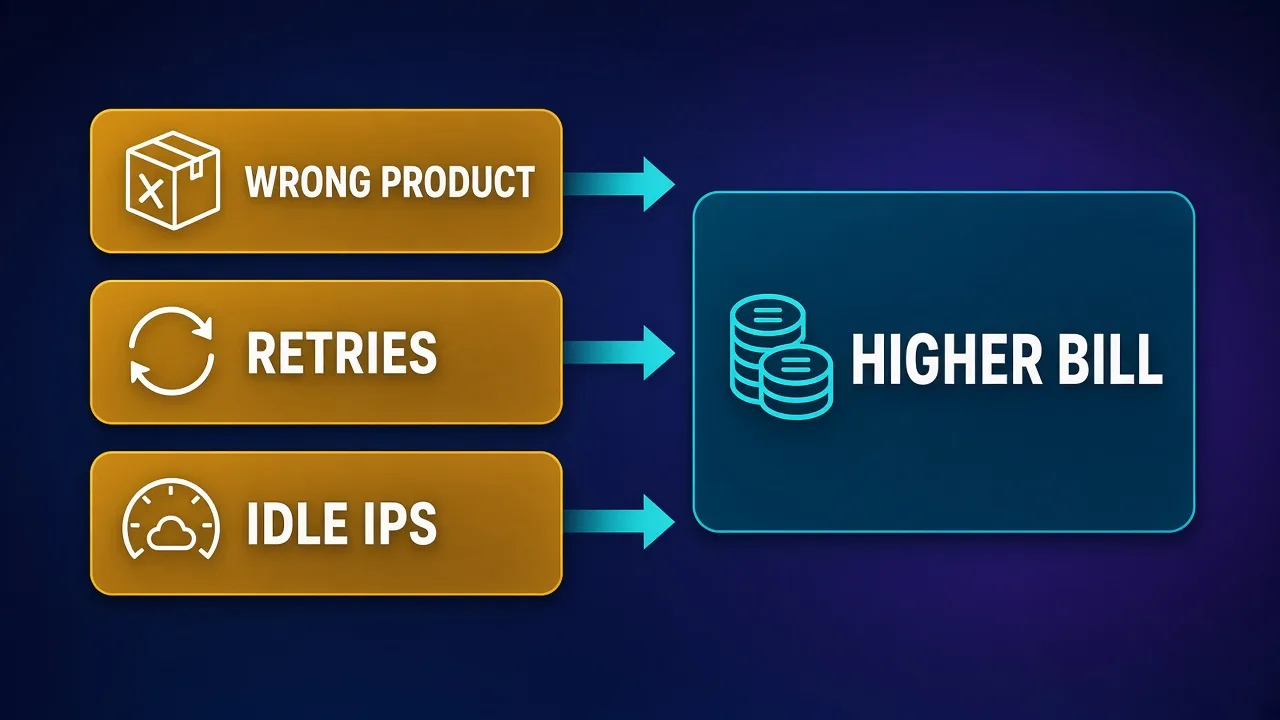
On bandwidth plans, every retried page download burns GB again. On per-request APIs, aggressive retry loops can dominate the invoice. Cap retries, classify errors, and do not retry hard blocks blindly.
Residential and mobile: when GB pricing hurts
Residential and mobile networks are usually the most expensive proxy traffic Bright Data sells, because the supply is scarcer and more trusted by target sites. Teams overpay on these lines when:
- They download full pages with images, fonts, and trackers instead of stripping assets.
- They use residential IPs for jobs that datacenter or ISP would pass.
- They rotate on every request during a multi-step login that needed a sticky session — causing repeats and account friction.
- They run low-success scrapers that fetch the same failing URL thousands of times.
If your workload is account-sensitive but not bandwidth-heavy (social logins, ad accounts, creator tools), sticky ISP often beats residential GB economics. If you only need anonymous high-volume fetches on tolerant targets, datacenter is usually the cheaper experiment. Bright Data offers multiple network types — pick deliberately.
ISP / static and datacenter economics
ISP (static residential) and datacenter products are often priced around allocated IPs, ports, or time rather than pure GB. That flips the optimization problem:
- Under-utilization wastes money — paying for 500 IPs while 40 active Selenium workers run is pure leakage.
- Over-sharing burns trust — stuffing many unrelated accounts through one IP creates platform risk that no discount fixes.
- Lease length matters — short tests may not need month-long IP holds; long account warm-ups might.
Model cost as dollars per active concurrent identity, not dollars per marketed IP count. Align pool size with real browser or bot concurrency.
Unlocker and scraping API pricing logic
Managed scraping APIs trade higher per-unit prices for lower engineering time: anti-bot handling, rendering, and retries move into the vendor’s stack. You overpay on these when:
- The target is easy enough that a raw proxy + your own HTTP client would suffice.
- You send duplicate jobs (same URL, same parameters) without caching.
- You enable premium rendering options on pages that are static JSON underneath.
- You lack success-rate monitoring, so you keep paying for systematically failing tasks.
You underpay relative to engineering cost when the API’s success rate frees a team that would otherwise maintain parsers and challenge solvers. Price the API against fully loaded engineer hours, not against raw residential GB alone.
Who overpays — and who gets a fair deal
Patterns we see repeatedly when reviewing Bright Data-style invoices (qualitative — not a claim about any one customer’s contract):
| Profile | Common mistake | Better framing |
|---|---|---|
| Early-stage scraper | Annual residential commit before product-market fit | Smaller prepaid + measure success/GB first |
| Selenium / account farm | Residential rotating on login flows | Sticky ISP sized to active profiles |
| Data team | Unlocker API for simple GETs | Datacenter or self-managed proxy where the site allows |
| Enterprise ops | Ignoring geo multipliers and overage tiers | Quote every target country; set budget alarms |
| Analysts | Re-scraping what a dataset already covers | Check dataset catalog before live collection |
Fair deals tend to share traits: clear product mapping, a commit that matches measured usage (not aspirational volume), alarms on spend, and a quarterly review of whether the job still belongs on the same line.
Build a unit-economics sheet before you sign
Columns that matter: product line, billing unit, expected successful outcomes per day, bytes or requests per outcome, concurrency, geo mix, retry rate, and monthly ceiling. Fill it with your numbers, then ask vendors to price that sheet — not a generic “GB package.”
How to read a Bright Data quote in practice
- Name the product — residential network vs ISP vs unlocker vs browser vs dataset.
- Name the meter — GB, IP-time, request, browser-minute, or license.
- List inclusions — soft caps, geos, concurrency, support.
- List multipliers — premium locations, rendering, residential vs datacenter.
- List overage — rate and whether overage is automatic.
- List exit terms — unused prepaid balance, rollover, early termination.
- Compare alternatives on the same sheet — not on marketing landing pages alone.
When you compare Bright Data with peers such as Oxylabs, Decodo, SOAX, or NetNut, force every quote onto that same sheet. Headline rates without meters are not comparable.
Bright Data
Proxy

Oxylabs
Proxy
Editor score
User rating
Starting price
Founded
Alternatives worth pricing on the same worksheet
Depending on volume and support needs, teams often price Bright Data alongside other published providers. Use live cards for current positioning — do not rely on memorized list prices.
Oxylabs
Frequent enterprise alternative with residential, ISP, and scraping API lines. Compare meters and commit floors side by side.
Oxylabs
Oxylabs is the enterprise provider that gets the fundamentals right. The network is huge and well-maintained, the scraper APIs are genuinely best-in-class, and the documentation and SDKs make integration faster than almost any competitor. What sets it apart from Bright Data is service: dedicated account managers, responsive support, and cleaner tooling mean less time fighting the platform and more time shipping. The cost is higher entry pricing, and the deepest discounts favor high-volume commitments. For serious commercial data operations that can justify the spend, Oxylabs is a top-two choice and frequently the one teams stay with long-term.
Decodo
Often evaluated when you want strong residential/ISP performance without the heaviest enterprise sales motion.

Decodo
Decodo offers the best price-to-performance ratio in the industry. It delivers roughly 90% of what the enterprise leaders provide — high success rates, a large clean pool, sticky sessions, an unblocker — at a fraction of their cost. The dashboard is the friendliest of any major provider, the 14-day money-back guarantee removes the risk of trying it, and support actually responds. The main gaps are enterprise-grade compliance tooling and the very deepest targeting, neither of which most teams need. For startups, solo developers, and any team that wants professional results without enterprise pricing, Decodo is our top value pick and an easy recommendation.
SOAX
Flexible targeting and session controls; useful as a second quote for sticky account workloads.

SOAX
SOAX is the targeting specialist. City- and ISP-level selection on every plan — not locked behind premium tiers — is genuinely rare, and the continuously cleaned pool keeps success rates high where it matters. It is not the fastest network, the interface could use a refresh, and SOCKS5 coverage is uneven. Those are real but minor gripes against a provider that nails the fundamentals of precision and reliability. For ad verification, localized market research, and social-media work that depends on appearing in an exact location, SOAX is one of the best mid-market options available.
NetNut
Another enterprise-leaning network to put on the same unit-economics sheet for bandwidth and ISP-style needs.

NetNut
NetNut's direct-ISP architecture is more than marketing — it genuinely delivers steadier, faster sessions than peer-to-peer networks, because it does not depend on consumer devices staying online. That makes it a standout for uptime-critical workloads like brand protection and ad verification, where a dropped session means lost data. The trade-offs are business-oriented pricing, higher minimum commitments, and a dashboard that takes some learning. If session stability is your priority and you operate at business scale, NetNut is one of the most reliable residential networks available and well worth the 7-day trial.
Proxyaxis also tracks Webshare and IPRoyal for teams that want lighter plans while they validate demand.
Practical checklist before you buy
- Define success: verified page, logged-in session, structured record — not “requests sent.”
- Measure a pilot week on the smallest prepaid tier you can.
- Separate account-sticky traffic from anonymous crawl traffic; they rarely share an optimal product.
- Turn on spend alerts the same day credentials arrive.
- Revisit product fit monthly; scrapers change faster than annual contracts.
- Keep credentials and zone passwords in a secret manager; leaked zones become stolen spend.
Workload recipes and rough cost drivers
Without inventing dollar list prices, you can still rank which Bright Data-style lines tend to dominate cost for common jobs. Use this as a planning heuristic, then validate with a pilot and a live quote.
- SERP and open-web crawl — Often datacenter or a scraping API. Cost drivers: request volume, JS rendering, and retry rate on blocked queries.
- E-commerce price monitoring — Mix of datacenter for easy pages and residential/unlocker for hardened product pages. Cost drivers: page weight (images) and challenge frequency.
- Social / ad account operations — Sticky ISP or residential sessions. Cost drivers: number of concurrent identities and session length, not raw GB.
- Travel and fare aggregation — Frequently needs higher-trust IPs plus careful session handling. Cost drivers: geo spread and burst concurrency around fare refreshes. Related reading: Best Proxies for Travel Fare Aggregation.
- AI agent browsing — Can burn browser-minutes and residential GB quickly if agents wander. Cap tools, cache, and prefer structured APIs when the site offers them. See Best Proxies for AI Agents.
Write each recipe as: target difficulty × sessions × bytes or requests per success × retry factor. That single expression usually predicts whether a Bright Data residential commit or a lighter peer plan is the rational first buy.
Governance: keep pricing honest after kickoff
Signing the contract is not the finish line. Bright Data and peers will happily keep charging while your scraper drifts. Install lightweight governance:
- Weekly usage export — GB, requests, or IP-hours by zone/product; alert on week-over-week spikes.
- Success-rate dashboard — pair spend with outcomes so a silent blocker does not look like “healthy traffic.”
- Zone hygiene — separate zones for prod vs experiment so a bad test cannot drain the production wallet.
- Quarterly product fit review — ask whether each job still belongs on its current line, or whether a dataset/API replacement appeared.
- Credential rotation — treat zone passwords like cloud keys; leaked credentials become unbounded spend.
Teams that treat proxy spend like cloud spend — tagged, alerted, reviewed — rarely get surprised by Bright Data invoices. Teams that treat it like a flat SaaS seat almost always do.
Conclusion
Bright Data pricing is understandable once you stop treating it as one number. Identify the product line, lock the billing unit, and price successful outcomes — not vanity GB or IP counts. Teams that overpay usually mismatched the product (residential for a datacenter job, unlocker for a simple GET), ignored retries, or signed a commit ahead of measured usage. Use the live Bright Data card for current packaging, put Oxylabs and other peers on the same worksheet, and let unit economics — not brand gravity — pick the contract.
Next reads: the Bright Data vs Oxylabs comparison for product fit, and the proxy type guide so you choose the network before you negotiate the meter.
Frequently asked questions
Bright Data prices several product lines separately—proxy networks, unlocker/scraping APIs, datasets, and browser products—each with its own billing unit such as bandwidth, IP-time, per request, or license. Always identify the product and meter before comparing quotes.
Residential and mobile proxy traffic is commonly associated with bandwidth (GB) billing, but ISP, datacenter, unlocker APIs, browsers, and datasets often use other meters. Do not assume every Bright Data product is priced per GB.
Typical drivers are retries downloading full pages, using residential IPs for jobs that cheaper networks could handle, premium geo multipliers, overage rates after a commit, or paying for idle ISP/datacenter capacity you are not using.
Use residential when you need diverse, trusted consumer IPs for sensitive targets. Prefer sticky ISP when accounts need a stable exit and your bandwidth is modest. Price both against successful outcomes for your concurrency, not against marketing GB rates alone.
Per request they often look more expensive than raw GB, but they can be cheaper overall when they raise success rates and cut engineering time. They are a poor fit for simple GETs you can already complete with datacenter proxies.
Put both quotes on the same unit-economics sheet: product line, billing unit, expected successful outcomes, bytes or requests per outcome, geo mix, concurrency, retry rate, commit, and overage. Headline rates without identical meters are not comparable.
Enterprise deals often include monthly or annual commits, but availability of smaller prepaid or pay-as-you-go style options can vary by product and time. Confirm current minimums on Bright Data’s site or in a sales quote rather than relying on outdated list assumptions.
Use the live Bright Data provider card and product page on Proxyaxis, and verify final numbers on Bright Data’s own pricing or quote. Proxyaxis cards stay synced to catalog data so blog articles do not hardcode fragile list prices.