Table of contents
Decodo (the provider formerly known as Smartproxy) has built its reputation on being the "value" pick among mainstream proxy vendors, but its pricing page can still confuse first-time buyers. Residential, mobile, ISP, datacenter, and Web Scraping API products each use a different billing meter, and several of them offer two or three purchase models side by side. This guide explains how Decodo's plans are shaped in 2026, what each meter actually charges you for, and the situations where Decodo tends to win on value versus where another provider may fit better. We deliberately avoid quoting list prices, because they change often and Decodo regularly runs promotions. The live provider and comparison cards below always show current pricing pulled from our database.
If you are still deciding which network type you need, start with How to Choose a Proxy Provider. For context on how enterprise-focused competitors package their catalogs, see Oxylabs Pricing Explained and Bright Data Pricing Explained.

Decodo
Decodo offers the best price-to-performance ratio in the industry. It delivers roughly 90% of what the enterprise leaders provide — high success rates, a large clean pool, sticky sessions, an unblocker — at a fraction of their cost. The dashboard is the friendliest of any major provider, the 14-day money-back guarantee removes the risk of trying it, and support actually responds. The main gaps are enterprise-grade compliance tooling and the very deepest targeting, neither of which most teams need. For startups, solo developers, and any team that wants professional results without enterprise pricing, Decodo is our top value pick and an easy recommendation.
How Decodo organizes its pricing
Decodo does not sell one universal plan. Its public pricing is split by product line, and each line has its own page with its own tabs. Treat them as separate purchases, because they are billed separately and solve different problems:
- Residential proxies are rotating or sticky IPs from home connections, billed by bandwidth (GB). They are offered as monthly subscription tiers, an Enterprise tab for larger volumes, and a Pay As You Go option.
- Mobile proxies are IPs from carrier networks, also billed by bandwidth. They follow the same overall shape as residential: monthly GB tiers, an Enterprise tab, and Pay As You Go.
- ISP (static residential) proxies are fixed IPs registered to internet service providers. These come in three flavors: dedicated IPs, shared IPs billed per GB, and shared IPs billed per IP.
- Datacenter proxies are fast server IPs with lower trust. These are also sold three ways: shared pay per GB, shared pay per IP, and dedicated IPs.
- Web Scraping API is a managed product that handles proxies, retries, and optional JavaScript rendering for you. It uses monthly request-volume plans, including a free plan.
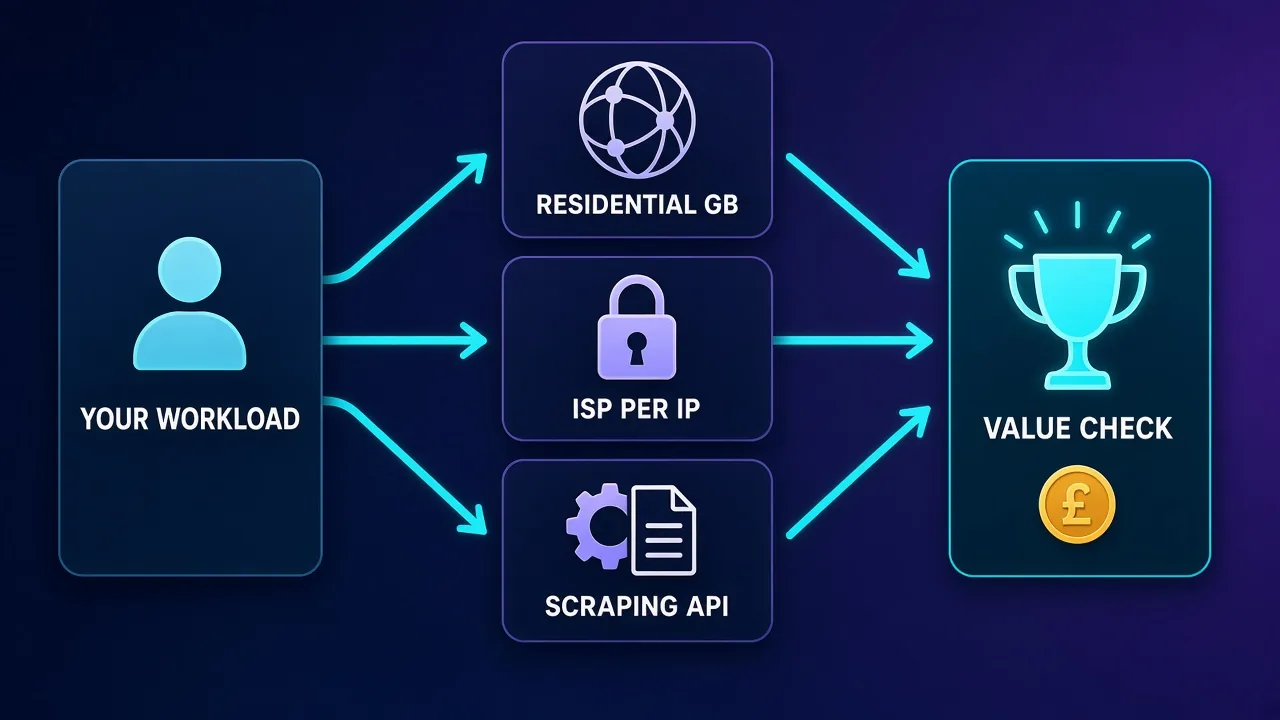
The practical consequence is simple: before you compare Decodo with anyone else, decide which product line you are actually buying. A residential GB rate, a dedicated ISP seat, and a scraping API request are three different units, and lining them up in one column of a spreadsheet produces misleading conclusions.
Why we don't print prices here
Decodo's list prices, discounts, and tier sizes change throughout the year, and its pages sometimes show promotional rates next to the regular ones. Rather than freezing a number that may be stale next week, this article explains the plan structure. Use the live Decodo card on this page, or the vendor's own pricing page, for today's figures.
Billing units at a glance
Most Decodo pricing questions become easy once you know which meter applies. The table below maps each product line to its billing unit and the factor that actually moves your invoice.
| Product line | Purchase models on the pricing page | What you pay for | What drives the bill up |
|---|---|---|---|
| Residential | Monthly GB tiers, Enterprise, Pay As You Go | Bandwidth transferred through the network | Heavy pages, unneeded assets, retries, failed requests |
| Mobile | Monthly GB tiers, Enterprise, Pay As You Go | Bandwidth over carrier IPs | Same as residential, but each wasted GB costs more |
| ISP (static residential) | Dedicated, Pay per GB, Pay per IP | Either the number of IPs or the traffic, depending on the model | Holding idle IPs, or picking per-GB for traffic-heavy jobs |
| Datacenter | Pay per GB, Pay per IP, Dedicated | Traffic, or a set of IPs plus traffic, or dedicated IPs | Using DC on targets that block it, causing retries |
| Web Scraping API | Free plan, monthly volume plans, Enterprise | Requests, with cost per request depending on configuration | Premium proxy pool and JavaScript rendering on every call |
Every subscription price on Decodo's pages is shown before VAT, and the billing is processed through a merchant of record (Paddle), so the amount on your card statement can differ from the headline figure depending on your country's tax rules. Factor that in when you build a budget.
Residential proxies: subscription tiers vs Pay As You Go
Residential proxies are the product most people mean when they search for "Decodo pricing." The meter is bandwidth: you pay for the gigabytes that pass through the network, not for the number of IPs you touch. Rotation, sticky sessions, and location targeting down to fine-grained levels are included with the plan rather than sold as add-ons, according to Decodo's pricing page, which is one of the main reasons the provider is often described as good value.
Monthly subscription tiers
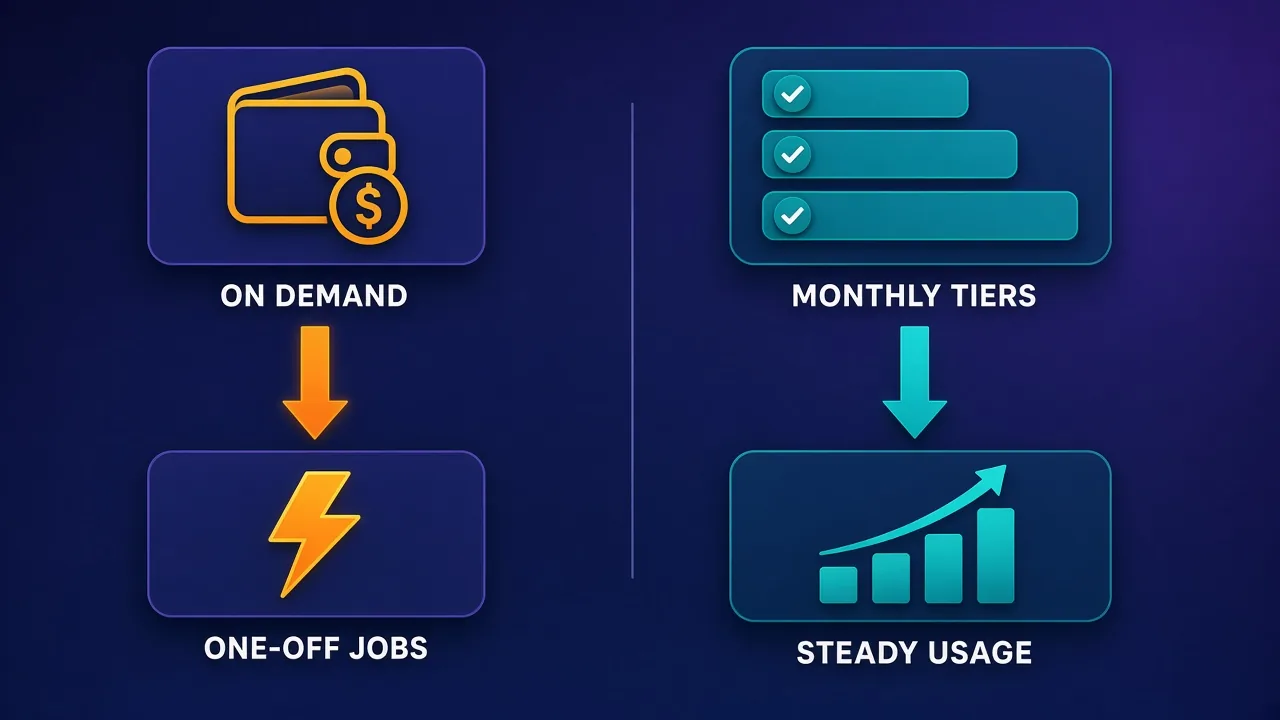
The default way to buy residential traffic is a monthly subscription. You pick a GB bucket, and the effective price per GB falls as the bucket gets larger. Larger buyers see a separate Enterprise tab that continues the same pattern at higher volumes. The structure rewards predictable usage: if you know roughly how much traffic your scrapers or account tools burn each month, a tier that matches that usage almost always beats paying as you go.
The catch with any GB subscription is matching the tier to reality. Buy too small and you either run out mid-month or move up a tier; buy too large and you pay for headroom you never use. Decodo lets you change or cancel the plan, with changes taking effect at the next billing cycle, so it is sensible to start one size smaller than your estimate and adjust after a month of real data.
Pay As You Go
Pay As You Go is designed for one-off projects and irregular workloads. It runs through Decodo's Wallet: you top up credits first, then buy gigabytes one at a time without a recurring subscription. The per-GB rate is higher than the subscription tiers, which is the trade-off for not committing to a monthly bucket.
Two rules matter here. First, Decodo states that you cannot hold a monthly subscription and Pay As You Go on the same product at the same time, so it is one or the other. Second, because you buy in small increments, Pay As You Go works best for short tests, a single research sprint, or workloads that only run a few times a year.
Bandwidth meters punish waste
On any GB plan, every retried request and every image, font, or tracking script you download is billed. Blocking unneeded assets, caching responses, and capping retries can shrink a residential bill more than switching providers does. Compare costs per successful page, not just headline per-GB rates.
Mobile proxies: the same shape at a higher trust tier
Decodo's mobile proxy pricing mirrors the residential layout: monthly GB tiers with a falling per-GB rate, an Enterprise tab, and a Wallet-based Pay As You Go option that cannot run alongside a subscription. Mobile IPs come from carrier networks, which many platforms treat as highly trustworthy because large numbers of real users share them. That trust is why mobile bandwidth generally sits above residential on the price stack across the industry.
When we checked the mobile pricing page while preparing this article, the plan cards showed promotional pricing next to struck-through regular rates, and the FAQ text further down the same page quoted a different Pay As You Go figure from the card. That is a good reminder of why you should check the live card and your checkout total rather than a figure copied from a blog post or an older FAQ. Mobile makes financial sense when your workload depends on carrier trust, such as mobile-first apps or account-sensitive social tools, and it is usually overkill for general scraping that residential IPs can handle.
ISP (static residential) proxies: dedicated, per GB, or per IP
ISP proxies give you fixed IPs that look residential to target sites but are hosted on fast infrastructure. Decodo sells them in three models, and picking the right one has a bigger effect on cost than picking the right tier:
- Dedicated: you pay for a number of IPs reserved only for you. Decodo markets this option with generous bandwidth and concurrency, so traffic volume is less of a concern. This suits long-lived identities, such as e-commerce or social accounts that should always appear from the same address.
- Pay per GB (shared): you pay for traffic rather than IP count, on shared static IPs. This makes sense when you need static-looking IPs for light, bursty jobs where holding seats all month would be wasteful.
- Pay per IP (shared): you pay by the number of shared static IPs. This is often the cheapest way to get a fixed address when exclusivity is not essential.
The trade-off is exclusivity versus price. Shared IPs can carry history from other customers, while dedicated IPs cost more but give you full control over reputation. For account management, the question is usually "how many identities do I need to keep stable?" rather than "how many gigabytes will I use?" For more on why session stability matters, our best cheap residential proxies roundup covers how budget buyers balance rotating and static options.
One payment detail is worth knowing: Decodo's FAQ notes that cryptocurrency is accepted for most products but not for ISP proxies or for the datacenter Pay per IP option. If you plan to pay in crypto, check this before choosing a model.
Datacenter proxies: the cheapest meter, sold three ways
Datacenter proxies are Decodo's lowest-cost network product. They are fast and stable but easier for strict websites to detect, because their IP ranges belong to hosting companies rather than consumer ISPs. Decodo offers three models:
- Pay per GB: you pay only for traffic and get access to a shared pool of rotating and static IPs. This is good for budget-friendly collection on tolerant targets.
- Pay per IP: you buy a specific number of shared IPs in chosen locations together with a traffic allowance. Minimum quantities apply, so check the live page.
- Dedicated: private datacenter IPs billed by IP count, marketed with unmetered traffic. This suits steady, high-throughput jobs on sites without advanced anti-bot systems.
Datacenter wins when the target tolerates it. Decodo itself recommends residential proxies over datacenter for harder scraping targets, and that is honest advice: if a cheap datacenter IP fails often enough, the retries and engineering time can outweigh the savings. Run a small pilot before committing to a large datacenter bucket.
Web Scraping API: pay per request, priced by configuration
Decodo has consolidated its earlier Core and Advanced scraping plans into a single Web Scraping API, and its documentation states that the older plans are no longer available for new purchases. The current model is a set of monthly plans sized by request volume, each with its own request-rate limit, plus a free plan that Decodo says does not require a credit card.
The important nuance is that not every request costs the same. According to Decodo's documentation, the cost of a request depends on two settings:
- Proxy pool: a Standard pool for simpler sites, and a Premium pool for targets with stronger anti-bot protection. Pre-built target templates default to Premium.
- JavaScript rendering: a headless browser render costs more than a plain HTML fetch because it uses more resources.
That design lets you save money by using Standard proxies and turning rendering off for static pages, and paying more only for pages that need it. Teams that leave Premium and rendering switched on for every call can burn through a plan much faster than expected. If you are comparing the API with raw residential bandwidth, compare cost per successful, usable result, not cost per request versus cost per GB.
Trials, refunds, and billing rules that change effective cost
The headline rate is only part of the cost. Several policies on Decodo's pricing pages affect what you actually pay:
- Free trials: residential plans offer a short free trial with a small data allowance for new users, and the trial rolls into the selected plan automatically unless you cancel. The Web Scraping API has a free plan instead.
- Money-back window: self-service purchases come with a money-back option, but Decodo lists conditions. It applies only to the first purchase, not if you used the free trial, only within a limited window, and only if you have not used more than a set share of the plan's traffic.
- Billing-cycle changes: upgrades, downgrades, and cancellations apply from the next billing cycle, and the plan you already paid for stays active until the cycle ends.
- Taxes and payment methods: prices are shown before VAT. Cards, PayPal, Alipay, Google Pay, and Apple Pay are accepted, with crypto excluded for some static products.
- Sub-users: the dashboard lets you create sub-users with traffic limits, which helps agencies and teams stop one project from draining a shared plan.
Trial and refund are mutually exclusive
Decodo states that the money-back option does not apply if you start with the residential free trial. If you think you might want a refund, decide before you activate the trial, and read the current refund terms on Decodo's site, since conditions can change.
When Decodo wins on value (and when it doesn't)
"Value" depends on your workload, not on a headline rate. Based on how the plans are structured, here is where Decodo tends to be a strong fit:
Where Decodo tends to win
- Small and mid-sized residential users: the subscription tiers start small, include targeting and session control with the plan, and scale down per GB as you grow. That combination suits solo developers, agencies, and growing data teams.
- Mixed workloads under one account: you can run residential for hard targets, datacenter for tolerant ones, and ISP for stable identities from a single dashboard and billing relationship.
- Teams that want to test before committing: the residential trial, Pay As You Go, and the free scraping API plan make it cheap to validate success rates on your own targets.
- Static identities on a budget: the shared Pay per IP ISP model is an inexpensive route to fixed addresses when exclusivity is not critical.
Where another provider may fit better
- Very large enterprise commitments with custom compliance, procurement, or dedicated account requirements. Enterprise-first vendors may offer negotiated packages that matter more than list rates.
- Extremely irregular, tiny usage, where paying a monthly subscription is wasteful and even Pay As You Go increments may be more than you need.
- Niche geographies or specialized pools where a competitor's coverage on your specific target matters more than price.
Decodo vs Oxylabs, Bright Data, and value-focused alternatives
Decodo is usually shortlisted alongside two kinds of competitor: enterprise platforms with broad catalogs, and budget-focused residential sellers. The live comparison cards below show current pricing and ratings side by side, so you do not have to rely on numbers that may be out of date.
Decodo vs Oxylabs
Both providers sell residential, ISP, datacenter, and scraping API products. Oxylabs leans toward enterprise packaging and larger contracts, while Decodo emphasizes self-service plans that start small. If your team can buy entirely through a dashboard, compare the two on the same workload. Our Oxylabs pricing guide explains its meters in detail.
Decodo
Proxy

Oxylabs
Proxy
Editor score
User rating
Starting price
Founded
Decodo vs Bright Data
Bright Data has one of the broadest catalogs in the market, with many specialized products and add-ons. That breadth helps complex enterprise use cases but can make quotes harder to read. Decodo's catalog is narrower and simpler to price. See Bright Data Pricing Explained for how its plans are structured.
Decodo
Proxy
Bright Data
Proxy
Editor score
User rating
Starting price
Founded
Value-focused alternatives worth pricing
If cost per GB is your main concern, put a couple of budget-oriented providers on the same worksheet. SOAX is known for flexible targeting, IPRoyal for straightforward residential purchasing, and Webshare for low-cost datacenter and proxy-list style plans. Check each live card for current terms.

SOAX
SOAX is the targeting specialist. City- and ISP-level selection on every plan — not locked behind premium tiers — is genuinely rare, and the continuously cleaned pool keeps success rates high where it matters. It is not the fastest network, the interface could use a refresh, and SOCKS5 coverage is uneven. Those are real but minor gripes against a provider that nails the fundamentals of precision and reliability. For ad verification, localized market research, and social-media work that depends on appearing in an exact location, SOAX is one of the best mid-market options available.

IPRoyal
IPRoyal is the best pure pay-as-you-go deal in proxies. Non-expiring traffic is a genuinely customer-friendly policy that no major rival matches — buy what you need, use it whenever, lose nothing. The pool is smaller than the premium networks and success rates can soften on the most heavily defended targets, so high-volume enterprise scraping is not its strength. The dashboard is also fairly basic. For intermittent scraping, account work, and sneaker copping on a predictable budget, IPRoyal is an easy recommendation and one of the best value picks for occasional users.

Webshare
Webshare is the developer's self-service favorite. Instant activation, a free tier that is actually free, and the cheapest fast datacenter proxies in the market make it the easiest provider to just start using. The custom plan builder — pick your IP count, bandwidth, and threads — is a genuinely good model that lets you avoid paying for capacity you do not need. The residential pool is newer and less battle-tested than specialists, and support is thin on the lower tiers. For datacenter proxies, API-driven workflows, and anyone who wants to try before paying, Webshare is one of the best-value options around.
How to estimate your monthly Decodo bill
A rough estimate is enough to choose the right plan shape. Work through these steps before you buy:
- Classify the workload. Rotating collection on protected sites points to residential. Long-lived accounts point to ISP. Tolerant, high-volume targets point to datacenter. Pages you would rather not engineer around point to the scraping API.
- Measure page weight. For bandwidth plans, fetch a sample of target pages through a proxy and record the average response size with your real asset-blocking settings. Multiply by the pages you expect to fetch each month.
- Add a failure buffer. Estimate your retry rate from a pilot and add that overhead to the bandwidth or request count. Do not guess at zero.
- Count identities, not just traffic. For ISP or dedicated datacenter, decide how many stable IPs you actually need active at the same time.
- Map the estimate to a tier. Compare your number against the current tiers on the live card. If you land between two tiers, start with the smaller one and upgrade at the next cycle if needed.
- Add taxes and compare per outcome. Include VAT where it applies, then divide by successful pages or active accounts to get a cost per outcome you can compare against other providers.
Revisit the estimate after the first full month. Real usage nearly always differs from the plan, and Decodo's next-cycle plan changes make it easy to correct course.
Final verdict
Decodo's pricing is easier to understand than it first looks once you separate its product lines. Residential and mobile are bandwidth meters with monthly tiers and a Wallet-based Pay As You Go option. ISP and datacenter add per-IP and dedicated models. The Web Scraping API charges per request, with cost depending on the proxy pool and rendering mode. The provider tends to deliver strong value for small to mid-sized teams that want self-service plans, bundled targeting, and the ability to mix network types under one account. Larger enterprises with custom procurement needs, or buyers with unusual geographic requirements, should still price Oxylabs, Bright Data, and budget alternatives on the same worksheet.
Whatever you choose, ignore headline rates in isolation. Classify the workload, estimate real traffic or identities, run a short pilot, and compare cost per successful result. Then check the live Decodo card above for today's pricing before you commit.
Frequently asked questions
Decodo prices each product line separately. Residential and mobile proxies are billed by bandwidth through monthly GB tiers or Pay As You Go, ISP and datacenter proxies offer per-GB, per-IP, and dedicated models, and the Web Scraping API uses monthly request-volume plans. Check the live Decodo card or pricing page for current rates.
Yes. Residential and mobile proxies can be bought with Pay As You Go through Decodo's Wallet, where you top up credits and buy gigabytes in small increments without a subscription. The per-GB rate is higher than the monthly tiers, and Decodo states you cannot run Pay As You Go and a monthly subscription on the same product at the same time.
Residential proxies are billed per GB of bandwidth, not per IP, and every plan includes access to the rotating pool with targeting and session options. Per-IP pricing applies to Decodo's ISP and datacenter products instead. Larger monthly tiers lower the effective per-GB rate.
Dedicated ISP plans reserve static IPs for you alone and are billed by IP count. Pay per GB uses shared static IPs and bills by traffic, while Pay per IP bills by the number of shared static IPs. Dedicated costs more but gives you full control over IP reputation for long-lived accounts.
Decodo offers a short free trial with a small data allowance on residential plans for new users, and the Web Scraping API has a free plan that Decodo says needs no credit card. The residential trial rolls into the selected plan unless you cancel. Note that Decodo's money-back option does not apply if you used the trial.
Self-service purchases include a money-back option with conditions: it covers only the first purchase, must be requested within a limited window, and is void if you used the free trial or exceeded a set share of the plan's traffic. Read the current terms on Decodo's site before buying, since conditions can change.
The Web Scraping API uses monthly plans sized by request volume, plus a free plan, after Decodo replaced its older Core and Advanced plans. The cost of each request depends on whether you use the Standard or Premium proxy pool and whether JavaScript rendering is enabled. Using Standard proxies without rendering on simple pages keeps costs down.
It depends on the product and workload, so compare cost per successful result rather than headline rates. Decodo focuses on self-service plans that start small, while Oxylabs and Bright Data lean toward broader enterprise catalogs and negotiated contracts. Use the live comparison cards on Proxyaxis for current pricing side by side.