Table of contents
IPRoyal is one of the providers people shortlist when they want residential proxies without an enterprise contract. The pricing page looks simple, but the number in the menu, "from $1.75/GB", is not what most buyers will pay. This guide walks through every IPRoyal price list as it appeared on iproyal.com on 3 November 2026: residential pay as you go versus subscription, the 10 TB condition behind the headline rate, ISP, datacenter and mobile proxies, and the refund and fee rules in the terms. Then we do the math for a few realistic budgets so you can see what a month actually costs.
Prices checked on 3 November 2026
Every figure below was read from IPRoyal's own pricing pages and legal pages on the day this was published. Proxy prices change often, so treat this as a snapshot and confirm the number at checkout before you buy.
IPRoyal pricing at a glance
IPRoyal sells five self-service products, and each is billed in a different unit. Residential and rotating mobile proxies are billed by the gigabyte of traffic you use. ISP, datacenter and dedicated mobile proxies are billed per IP (or per device) for a fixed period. A newer Web Unblocker product is billed per thousand requests. Here are the "from" prices IPRoyal lists in its pricing menu:
| Product | Billing unit | Lowest listed price | What that price assumes |
|---|---|---|---|
| Residential proxies | Per GB | $1.75/GB | Subscription custom plan of 10 TB (10,000 GB) or more |
| ISP (static residential) proxies | Per proxy | $1.80/proxy | 24-hour rental, "starting from" |
| Datacenter proxies | Per proxy | $1.39/proxy | 90-day rental, "starting from" |
| Mobile proxies | Per day / per GB | $10.11/day | Dedicated mobile proxy for 24 hours |
| Web Unblocker | Per 1,000 requests | $1.00 | Listed as a new product |
The pattern is the same across the table: each "from" price is the cheapest point of a sliding scale. To understand what you will pay, you need the tiers underneath.
Residential proxy pricing: pay as you go vs subscription
Residential proxies are IPRoyal's main product. The page advertises a pool of 64M+ residential IPs across 195+ countries, with city-level targeting, sticky sessions of up to 7 days, auto-rotation every 1, 10 or 30 minutes and unlimited concurrent sessions. All of that is the same whichever way you pay. What changes is the price per GB and how the plan renews.
The pricing page has two tabs. The first is labelled "Subscription (5% off)" and the second is "Pay As You Go". These are the per-GB rates on each tab:
| Package | Pay as you go | Subscription (5% off) |
|---|---|---|
| 1 GB | $7.35/GB | $7.00/GB |
| 2 GB | $6.25/GB | $5.95/GB |
| 10 GB | $5.51/GB | $5.25/GB |
| Custom plans | $1.84/GB from 10 TB | $1.75/GB from 10 TB |
How pay as you go works
Pay as you go is a one-off purchase of traffic. IPRoyal's page says there is a zero monthly minimum and no long-term contract, and it highlights "never expiring traffic": the gigabytes you buy stay on your account until you use them. That makes it the safer choice for a first test, a project with an uncertain size, or work that happens in bursts. The trade-off is a slightly higher rate per GB.
How the subscription works
The subscription takes 5% off and renews automatically. IPRoyal's Subscription Terms describe residential plans as "data-based": you pick an amount of data, the default billing period is one month, and each renewal adds the same amount of data again. Unused data from earlier months accumulates rather than disappearing, which is more generous than many monthly residential plans. A few rules are worth knowing before you subscribe:
- Auto-renewal is switched on when you order, and you are charged upfront before each new period.
- IPRoyal says it emails a reminder 5 days before each renewal on monthly plans.
- Cancelling a data-based subscription is permanent. To restart, you place a new order at whatever the price is then.
- After you cancel, the data you already paid for stays usable as long as your account is active.
- A top-up has to be equal to or larger than your current package, and the topped-up amount becomes the new baseline for later renewals.
- Pay-as-you-go purchases cannot be converted into a subscription.
Quick rule of thumb
If you are not sure you will use the same amount every month, the 5% saving is small next to the risk of renewing traffic you do not need. Start on pay as you go and switch once your usage is predictable.
The 10 TB catch behind the $1.75/GB headline
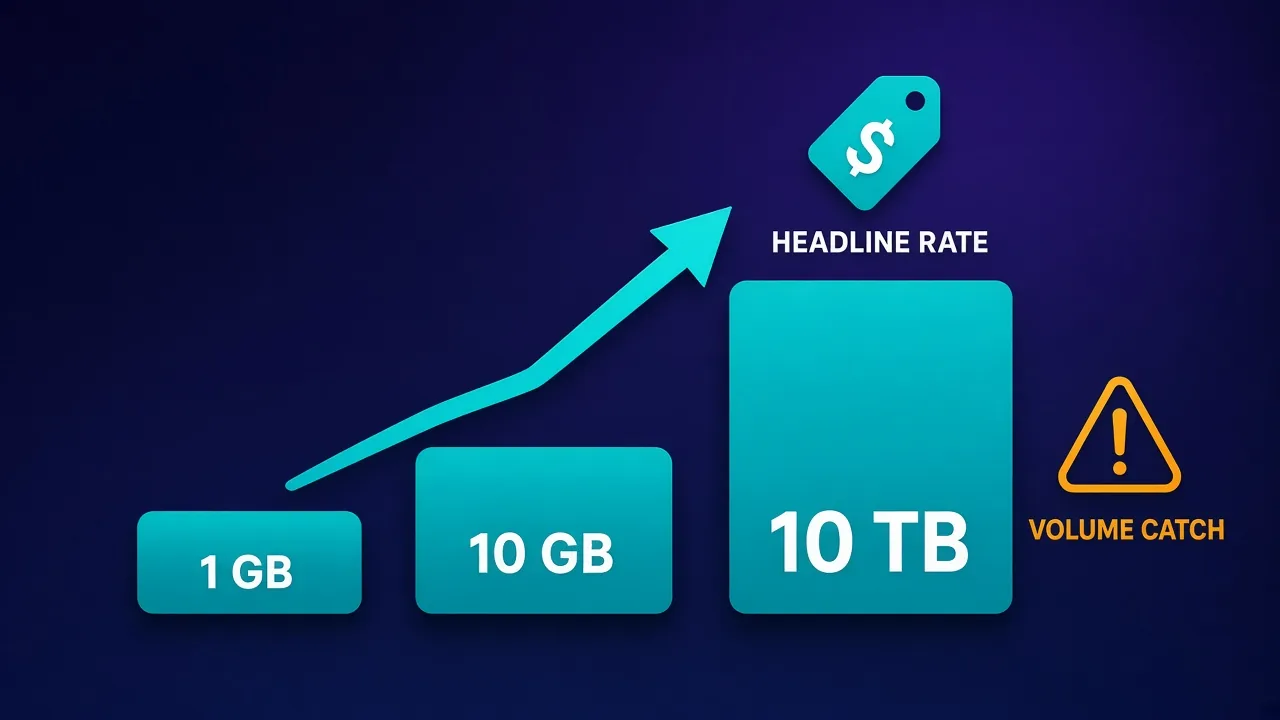
The figure IPRoyal promotes everywhere, "from $1.75/GB", carries a condition printed under the custom plan card: "$1.75/GB available from 10 TB (10,000 GB)". On the pay-as-you-go tab the same tier is $1.84/GB from 10 TB.
Ten terabytes is a lot of residential traffic. At $1.75/GB, 10,000 GB works out to $17,500, and at $1.84/GB it is $18,400. That is an enterprise-scale purchase. For everyone below that line, the self-service tiers shown on the page stop at 10 GB, where the rate is $5.25/GB on subscription and $5.51/GB on pay as you go. So for a typical small team, the real price is roughly three times the headline.
This is not unusual in the proxy market; most providers advertise their deepest volume rate. It does mean you should compare providers on the tier you will actually buy, not on the number in the menu. Between the 10 GB package and the 10 TB custom plans, the public page does not list intermediate prices, so if you expect to use something like 100 GB or 1 TB a month it is worth asking IPRoyal's sales team (the page has a "Talk to Sales" option) for a quote in writing.
Compare like with like
When another provider quotes a per-GB price, check the plan size it applies to. A $3.50/GB rate on a 1 GB plan and a $1.75/GB rate on a 10 TB plan are not comparable offers.
What you actually pay: worked examples
Here is the residential math at the tiers IPRoyal shows publicly. These are list prices before any service fee or tax that appears at checkout.
| Monthly need | Pay as you go | Subscription | Notes |
|---|---|---|---|
| 1 GB test | $7.35 | $7.00 | Pay as you go is the sensible way to test |
| 2 GB | $12.50 | $11.90 | $0.60 saved by subscribing |
| 10 GB | $55.10 | $52.50 | $2.60 saved by subscribing |
| 10 TB | $18,400 | $17,500 | Custom plan tier |
Two things stand out. First, the gap between the two billing models is only a few dollars at small sizes, so flexibility is usually worth more than the discount. Second, the drop from the 1 GB rate to the 10 GB rate is about 25%, so if you know you will use 10 GB over time, buying the 10 GB pay-as-you-go package once is cheaper than buying 1 GB ten times, and the traffic does not expire.
A practical tip on usage: residential proxies are billed on all traffic that passes through them, including images, scripts and retries. Blocking images and fonts in your scraper, reusing sessions and avoiding needless retries can cut gigabytes noticeably, which matters more than the billing model at $5–7/GB.
How IPRoyal sources its residential IPs (and the abuse reports)
Residential IPs have to come from real home connections, and IPRoyal's pool relies on people sharing their bandwidth through an app. Security firm GreyNoise describes Pawns.app as a "direct partner" of IPRoyal that supplies proxy nodes, and says it appears to be a rebrand of "IPRoyal Pawns" owned by the same people. Users install it and get paid for the bandwidth they share.
That model has been abused. In October 2026, GreyNoise reported an actor it tracks as skynox7 that compromised at least 143 edge devices in 34 countries, including D-Link NAS boxes, Ubiquiti video recorders and SAP NetWeaver servers, and installed Pawns.app on them under the attacker's own payout account. AhnLab's ASEC team has documented similar cases: droppers spread through adware that installed IPRoyal Pawns without the user's permission, and attacks on poorly managed MS-SQL servers that installed it alongside other proxyware.
None of these reports says IPRoyal installed the software itself. In the reported cases, criminals used it on devices they didn't own and collected the payouts. GreyNoise notes that the Pawns binaries "are not necessarily malware unless installed without consent." IPRoyal's sourcing policy says suppliers must show that device owners gave informed consent, and that it checks its pool daily against public abuse databases.
What this means for buyers
A low price per GB doesn't tell you how the IPs were obtained. Some exits in any app-sourced pool may sit on devices whose owners never agreed. Use residential IPs only for legitimate work, read IPRoyal's acceptable use policy, and ask any provider how it proves consent before you commit to a large plan.
ISP proxy pricing
ISP proxies (sometimes called static residential proxies) are IPs registered to consumer internet providers but hosted on fast servers. You keep the same IP for the whole rental, which suits account management and long sessions. IPRoyal prices them per proxy for a fixed period:
| Rental period | Starting price per proxy |
|---|---|
| 24 hours | $1.80 |
| 30 days | $2.70 |
| 60 days | $2.55 |
| 90 days | $2.40 |
The longer rentals are listed as a monthly-equivalent rate, so a longer commitment lowers the effective monthly cost. The page says the ISP product covers 31+ countries with state and city targeting, unlimited sessions and both HTTP(S) and SOCKS5. Note the words "starting from": the final price can depend on location and quantity, so check the configurator for your exact country.
Datacenter proxy pricing
Datacenter proxies are the cheapest per IP and the fastest, but websites recognise datacenter IP ranges more easily, so they suit targets that are not strict about proxies. IPRoyal lists these starting prices:
| Rental period | Starting price per proxy |
|---|---|
| 30 days | $1.57 |
| 60 days | $1.48 |
| 90 days | $1.39 |
IPRoyal says its datacenter IPs cover 50+ countries with state and city targeting, unlimited threads, dual authentication and HTTP/HTTPS plus SOCKS5 support. Each IP is dedicated to you for the rental period. If you need hundreds of datacenter IPs, it is worth comparing against providers that price shared datacenter proxies in cents; Webshare, for example, lists shared proxy server plans from $2.99 a month for 100 proxies. Dedicated and shared IPs are different products, though, so match the access type before comparing.
Mobile proxy pricing
Mobile proxies route traffic through IPs from mobile carriers. They are the most expensive type but carry high trust on social platforms and app testing. IPRoyal sells them two ways.
Rotating mobile proxies (per GB)
| Package | Price per GB |
|---|---|
| 2 GB | $6.80 |
| 10 GB | $6.00 |
| 50 GB | $5.60 |
| 100 GB | $5.20 |
Dedicated mobile proxies (per device and period)
| Rental period | Starting price |
|---|---|
| 24 hours | $10.11 per day |
| 30 days | $130 per month |
| 60 days | $123.50 per month |
| 90 days | $117 per month |
IPRoyal describes the dedicated option as "basically renting a phone with a SIM card": the proxy is reserved for you, with no bandwidth or session limits, plus auto-rotation and instant IP change. It advertises 4.5M+ mobile IPs. Interestingly, rotating mobile traffic at 10 GB ($6.00/GB) is only a little more than residential traffic at 10 GB on pay as you go ($5.51/GB), so if a target treats mobile IPs better it can be worth testing both.
Refunds, fees and the fine print
IPRoyal's Terms of Service (effective 15 October 2026) are strict on refunds, and it is better to know this before buying than after.
- Fees are non-refundable by default. All paid fees are described as non-cancelable and non-refundable, with a short list of exceptions.
- Faulty service in the first 24 hours. If a service is inactive or defective in the first 24 hours for reasons outside your control and IPRoyal cannot fix it in that window, you are entitled to a full refund. If you contact them after 24 hours, the service is presumed to have been fine.
- Discretionary refunds. IPRoyal may refund in exceptional cases at its full discretion if you email with a reasoned request.
- Crypto payments are never refundable, not even under the 24-hour defect rule.
- A service fee can apply. The terms allow IPRoyal to add a service fee, fixed or a percentage, that can vary by product, plan and payment method. It must be shown at checkout before you pay, and it is non-refundable except when the underlying purchase is refunded under the 24-hour rule.
- Deleting your account forfeits unused service. Use or withdraw any balance first; crypto balances cannot be withdrawn.
The terms also mention that IPRoyal may offer a limited free trial for evaluation, subject to eligibility checks. Availability changes, so check the site or help center rather than counting on one.
Test small before you pay big
Because refunds are narrow, buy the smallest pay-as-you-go package first, run your real workload against your real targets within 24 hours, and only then buy more. If something is broken, report it inside that first day.
How IPRoyal compares with Webshare and Decodo
Price alone never decides a proxy provider, but it helps to see IPRoyal's residential rates next to two common alternatives. These figures were also checked on the providers' own pricing pages on 3 November 2026.
| Provider | Small residential plan | Pay as you go | Lowest advertised rate | Refund window |
|---|---|---|---|---|
| IPRoyal | 1 GB at $7.00/GB (subscription) | $7.35/GB at 1 GB, traffic never expires | $1.75/GB from 10 TB | Defects in first 24 hours; otherwise discretionary |
| Webshare | 1 GB rotating residential at $3.50/GB | Not listed for residential | $1.40/GB at 3,000 GB | Within 2 days if under 0.1 GB used on rotating residential |
| Decodo | 3 GB at $3.75/GB, billed monthly | $4/GB, bought one GB at a time | $2/GB at 1,000 GB (Enterprise) | 14-day money-back on first purchase if under 20% of traffic used |
On list price for small residential plans, IPRoyal is the most expensive of the three. Where it stands out is flexibility: pay-as-you-go traffic that never expires, subscription data that rolls over, sticky sessions up to 7 days, and a broad catalogue of ISP, datacenter and mobile products in one dashboard. For a deeper look at the two cheapest options, see our IPRoyal vs Webshare comparison and our Webshare pricing breakdown.
IPRoyal
Best for buyers who want non-expiring residential traffic, long sticky sessions and the option to add ISP or mobile proxies later without switching providers.

IPRoyal
IPRoyal is the best pure pay-as-you-go deal in proxies. Non-expiring traffic is a genuinely customer-friendly policy that no major rival matches — buy what you need, use it whenever, lose nothing. The pool is smaller than the premium networks and success rates can soften on the most heavily defended targets, so high-volume enterprise scraping is not its strength. The dashboard is also fairly basic. For intermittent scraping, account work, and sneaker copping on a predictable budget, IPRoyal is an easy recommendation and one of the best value picks for occasional users.
Webshare
Best for tight budgets and datacenter-heavy work, with a free 10-proxy plan to test and low per-GB residential rates at bigger plan sizes.

Webshare
Webshare is the developer's self-service favorite. Instant activation, a free tier that is actually free, and the cheapest fast datacenter proxies in the market make it the easiest provider to just start using. The custom plan builder — pick your IP count, bandwidth, and threads — is a genuinely good model that lets you avoid paying for capacity you do not need. The residential pool is newer and less battle-tested than specialists, and support is thin on the lower tiers. For datacenter proxies, API-driven workflows, and anyone who wants to try before paying, Webshare is one of the best-value options around.
Decodo
Best for buyers who want a lower small-plan residential rate with a free trial and a clearer money-back policy on the first purchase.

Decodo
Decodo offers the best price-to-performance ratio in the industry. It delivers roughly 90% of what the enterprise leaders provide — high success rates, a large clean pool, sticky sessions, an unblocker — at a fraction of their cost. The dashboard is the friendliest of any major provider, the 14-day money-back guarantee removes the risk of trying it, and support actually responds. The main gaps are enterprise-grade compliance tooling and the very deepest targeting, neither of which most teams need. For startups, solo developers, and any team that wants professional results without enterprise pricing, Decodo is our top value pick and an easy recommendation.
Which IPRoyal plan should you choose?
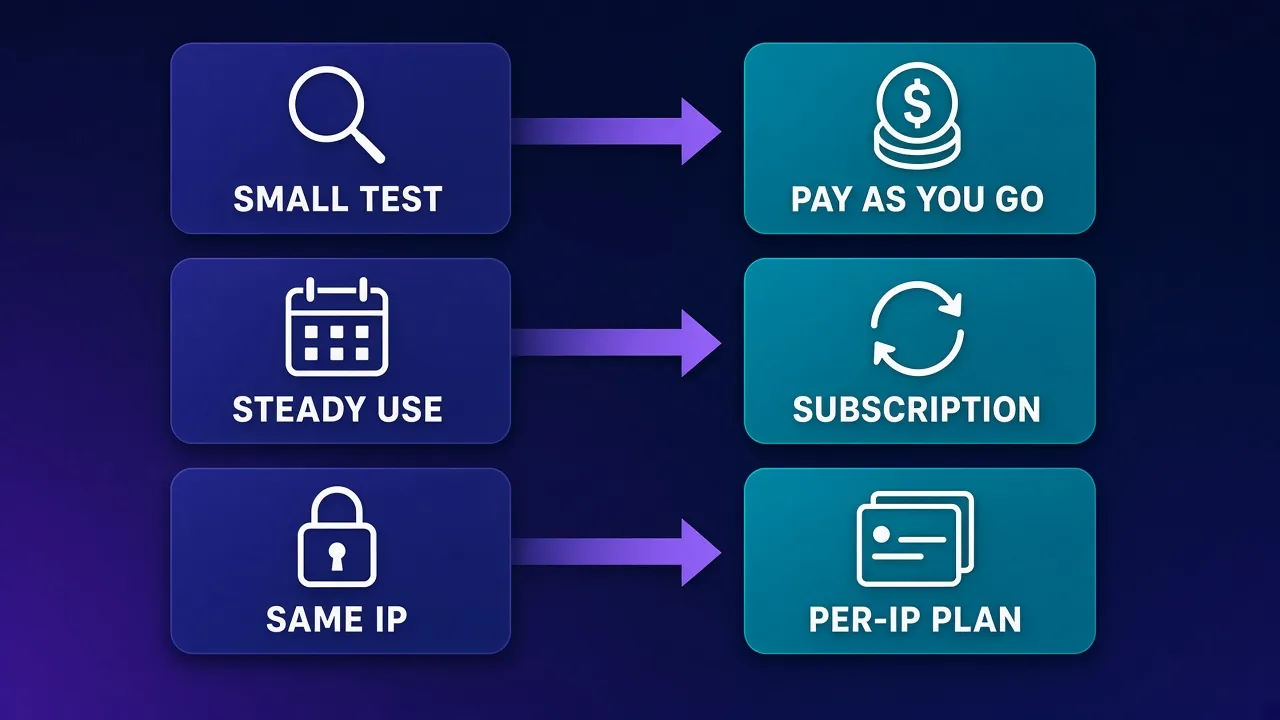
Most buyers land in one of three situations:
- You are testing or your volume is unpredictable. Buy residential pay as you go. Start with 1 or 2 GB, measure how many GB your workload really uses, and move up to the 10 GB package when you are confident. Unused traffic does not expire, so overbuying slightly is not wasted.
- You use a steady amount every month. The subscription saves 5% and unused data accumulates, so it is reasonable once your usage is stable. Set a reminder before each renewal and remember that cancelling is permanent.
- You need the same IP for days or weeks. Look at ISP proxies for account work and eCommerce, or dedicated mobile proxies for social and app workflows. Per-IP billing is more predictable than per-GB billing when you keep sessions open for a long time and move a lot of data.
If your workload is heavy scraping of tough targets, residential per-GB costs can add up quickly. Compare IPRoyal's 10 GB rate with the lower-cost options in our guide to the best cheap residential proxies before committing.
Who IPRoyal pricing is (and isn't) for
IPRoyal's pricing works well for freelancers, small agencies and developers who buy residential traffic in irregular amounts and hate losing unused gigabytes at the end of a month. It also suits teams that want residential, ISP, datacenter and mobile proxies from one provider and one dashboard.
It is a weaker fit if you are purely price-driven on small residential plans, since competitors list lower per-GB rates at 1–10 GB. It is also a weaker fit if you want a generous refund policy: outside the 24-hour defect rule, refunds are at IPRoyal's discretion, and crypto payments are never refundable. And if you are somewhere between 10 GB and 10 TB a month, you will need a custom quote, because the public page does not show those tiers.
The bottom line
IPRoyal's "from $1.75/GB" is real, but it only applies from 10 TB. For most buyers the honest numbers are $7.35/GB for a 1 GB pay-as-you-go test and $5.25 to $5.51/GB at 10 GB. What you get for that price is unusual flexibility: traffic that never expires on pay as you go, rollover data on subscriptions, long sticky sessions and a full range of static and mobile products. Test small, check the checkout total for any service fee, report problems within 24 hours, and pick the billing model that matches how predictable your usage really is.
Frequently asked questions
On 3 November 2026 IPRoyal listed residential pay-as-you-go traffic at $7.35/GB for 1 GB, $6.25/GB for 2 GB and $5.51/GB for 10 GB. The subscription tab is 5% cheaper, at $7.00, $5.95 and $5.25 per GB for the same packages.
Only at very large volume. IPRoyal states that $1.75/GB is available from 10 TB (10,000 GB) on its subscription custom plans, and the pay-as-you-go equivalent is $1.84/GB from 10 TB. Most small buyers will pay between $5.25 and $7.35 per GB.
IPRoyal advertises never-expiring traffic for residential pay-as-you-go purchases, so the gigabytes stay on your account until you use them. On subscriptions, its Subscription Terms say unused data accumulates with each renewal, and after cancellation you can keep using data you already paid for while your account is active.
The subscription saves 5% and renews automatically each month. At small sizes that is only a few dollars, for example $52.50 versus $55.10 for 10 GB, so it makes sense mainly when your monthly usage is steady. If your usage varies, pay as you go is usually the safer choice.
IPRoyal listed ISP proxies starting from $1.80 per proxy for 24 hours, $2.70 for 30 days, $2.55 for 60 days and $2.40 for 90 days. Datacenter proxies started from $1.57 per proxy for 30 days, $1.48 for 60 days and $1.39 for 90 days. Final prices can vary by location and quantity.
Rotating mobile proxies were listed from $6.80/GB for 2 GB down to $5.20/GB for 100 GB. Dedicated mobile proxies started at $10.11 for 24 hours, $130 per month for 30 days, $123.50 per month for 60 days and $117 per month for 90 days.
Refunds are limited. IPRoyal's Terms of Service give a full refund if a service is inactive or defective in the first 24 hours and cannot be fixed in that window, and otherwise refunds are at its discretion. Payments made in cryptocurrency are not refundable in any case.
Its Terms of Service allow a service fee on top of the price, which can be fixed or a percentage and can differ by product and payment method. The terms say any such fee must be shown at checkout before you pay, so check the final total on the order screen.
IPRoyal says its supply partners must show evidence that device owners gave informed consent, and that it checks its pool daily against public abuse databases. However, GreyNoise and AhnLab have reported criminals installing IPRoyal's Pawns bandwidth-sharing app on hacked devices without the owners' consent. The reports don't say IPRoyal installed it itself, but buyers should use residential IPs only for legitimate work and ask how consent is verified.