Table of contents
eBay is one of the richest public sources of e-commerce data on the web. Sold listings show what buyers actually paid, active listings show where sellers are pricing today, and category pages reveal how crowded a niche has become. That makes eBay a common target for price monitoring, resale research, and market analysis. It also means eBay invests heavily in spotting automated traffic, so a scraper that works on day one can start hitting blocks and verification pages by day three.
This guide explains which proxy types work best for collecting public eBay data, how to structure rotation and retries, and which providers are worth shortlisting. We also cover the compliance side, because eBay has its own rules and official APIs that should be your first stop. Provider details link to live Proxyaxis cards instead of quoted prices, since pool sizes and pricing change often.
The short version
For most eBay scraping, rotating residential proxies with country targeting are the safest default. Use datacenter proxies only for light, low-frequency checks, and consider a managed scraping API if you would rather not run your own retry and rendering logic. Check eBay's official developer APIs and user agreement before you scrape anything.
Why eBay scraping needs proxies at all
If you only check a handful of listings a day from your own connection, you probably do not need proxies. The trouble starts with volume. A price tracker that watches thousands of listings, or a research job that walks every page of a category, sends far more requests from a single IP address than any human shopper would. eBay's systems notice that pattern quickly.
Proxies solve the volume problem by spreading requests across many exit IP addresses. Instead of one address making ten thousand requests, you might have thousands of addresses each making a few. To eBay, that looks much closer to ordinary shopper traffic, as long as the rest of your requests also look ordinary.
Proxies also solve the location problem. eBay runs separate country sites, and prices, shipping options, and even search results differ depending on where a visitor appears to be. If you need to see what a buyer in Germany or Australia sees, you need exit IPs in those countries. Our guide to geo-targeting in proxies explains how country and city targeting work under the hood.
How eBay detects scrapers
No marketplace publishes its full detection stack, but the broad signals are well understood across the industry. eBay, like other large retailers, looks at several layers at once rather than relying on any single check.
- IP reputation and type. Addresses from cloud hosting ranges are easy to identify and are treated with more suspicion than consumer broadband or mobile addresses. Our explainer on what an ASN is covers why the network an IP belongs to matters so much.
- Request rate and rhythm. Perfectly even request timing, or bursts of hundreds of page loads per minute from one address, rarely comes from a person.
- Headers and fingerprints. Missing or inconsistent browser headers, unusual TLS fingerprints, and default library user agents all stand out.
- Behavior across pages. Real shoppers search, browse, and click through. A client that only ever requests deep listing URLs, in sequence, looks mechanical.
- Challenge responses. When eBay is unsure, it may serve a verification page or a CAPTCHA. Clients that ignore or fail these get blocked faster.
The practical lesson is that proxies are necessary but not sufficient. A clean residential IP paired with a bare HTTP library and no pacing will still get flagged. For the bigger picture, see how websites detect bots and why proxies get blocked.
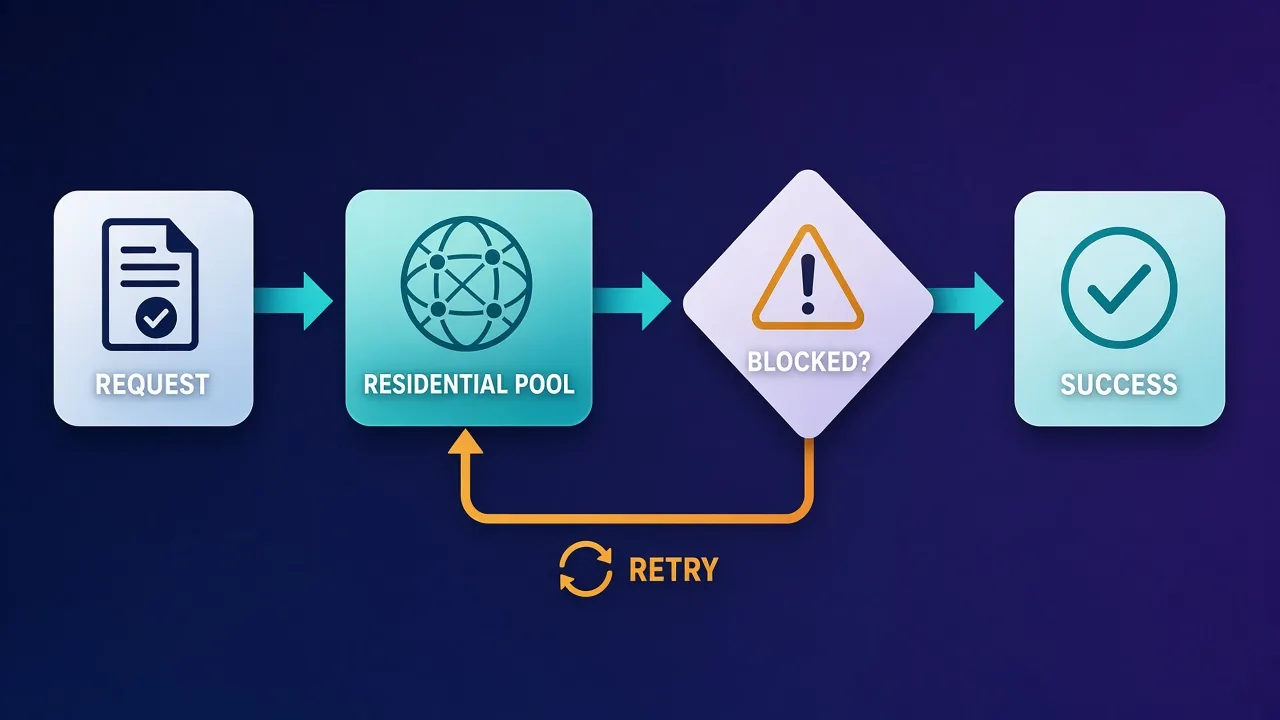
Which proxy types work best for eBay
There are four main proxy types you will see marketed for e-commerce scraping. Each has a place, but they are not interchangeable.
Rotating residential proxies
Residential proxies route your traffic through IP addresses assigned by consumer internet providers to real households. To eBay, a request from one of these addresses looks like a normal shopper on home broadband. Rotating residential pools give you a different IP per request or per short session, which is exactly what large-scale listing and search collection needs. This is the default choice for most eBay projects.
ISP (static residential) proxies
ISP proxies are hosted in data centers but registered under consumer internet provider networks. They are fast and stable, and they keep the same IP for weeks or months. That stability is useful for logged-in seller tools, but it is less helpful for scraping public listings, where you usually want lots of different IPs rather than a few long-lived ones.
Datacenter proxies
Datacenter proxies are the cheapest and fastest option, but they come from hosting networks that are easy to identify. They can work for occasional checks on a small set of listings, especially with careful pacing, but they tend to hit verification pages sooner on heavily protected marketplaces.
Mobile proxies
Mobile proxies use addresses from cellular carriers. They usually carry strong trust because many real users share each mobile IP, but they cost more and are slower. For eBay scraping they are rarely necessary unless you have a specific mobile-only need. Our guide on why mobile proxies are more expensive explains the economics.
If you want a deeper comparison of the three most common types, read residential vs ISP vs datacenter proxies.
Proxy types compared for eBay scraping
| Proxy type | Detection risk on eBay | Speed | Cost posture | Best eBay use |
|---|---|---|---|---|
| Rotating residential | Low when paced well | Moderate | Usually billed per GB | Search pages, listings, sold data at scale |
| ISP (static residential) | Low to moderate | Fast | Usually billed per IP | Logged-in seller dashboards, stable sessions |
| Datacenter | Higher | Fastest | Lowest per request | Light, low-frequency spot checks |
| Mobile | Lowest | Slower | Highest | Rarely needed; mobile-specific views |
| Managed scraping API | Handled by vendor | Varies | Usually billed per successful request | Teams that do not want to run retry and rendering logic |
Best proxy providers for eBay scraping
These picks are based on the qualities that matter most for marketplace scraping: large and diverse residential pools, reliable country targeting, flexible rotation and session control, and clear documentation. Live cards below pull current plan and pricing details from our database, so check them rather than relying on any figure you see quoted elsewhere.
Bright Data: deepest targeting and tooling
Bright Data is a strong fit for teams running eBay collection across many country sites. Its residential network supports fine-grained geo-targeting, and it offers scraping tools alongside raw proxies if you later want to offload unblocking. It is aimed more at mid-market and enterprise buyers, so smaller projects may find simpler options easier to start with.
Bright Data
Bright Data remains the most complete data-collection platform money can buy. No competitor matches its combination of network scale, targeting granularity, and compliance tooling — and for enterprise teams whose revenue depends on reliable data, that completeness justifies the premium. The trade-offs are real: it is one of the priciest providers per gigabyte, the interface overwhelms newcomers, and KYC verification adds friction before you can route a single request. Smaller projects will get better value from Decodo or IPRoyal. But if you need city-level residential targeting at scale, a managed unblocker for the hardest targets, and audit-ready compliance, Bright Data is the default — and our highest-rated proxy provider overall.
Oxylabs: enterprise-grade residential and scraper APIs
Oxylabs pairs a large residential pool with e-commerce focused scraping APIs. That combination works well if you want to start with proxies and keep the option of moving hard targets to a managed API. Documentation and support are geared toward data teams running steady, high-volume jobs.

Oxylabs
Oxylabs is the enterprise provider that gets the fundamentals right. The network is huge and well-maintained, the scraper APIs are genuinely best-in-class, and the documentation and SDKs make integration faster than almost any competitor. What sets it apart from Bright Data is service: dedicated account managers, responsive support, and cleaner tooling mean less time fighting the platform and more time shipping. The cost is higher entry pricing, and the deepest discounts favor high-volume commitments. For serious commercial data operations that can justify the spend, Oxylabs is a top-two choice and frequently the one teams stay with long-term.
Decodo: balanced value for mid-size projects
Decodo, formerly known as Smartproxy, is a common pick for teams that want solid residential coverage without enterprise contracts. Setup is straightforward, rotation and sticky options are easy to configure from the username, and it suits price trackers that grow from hundreds to many thousands of listings.

Decodo
Decodo offers the best price-to-performance ratio in the industry. It delivers roughly 90% of what the enterprise leaders provide — high success rates, a large clean pool, sticky sessions, an unblocker — at a fraction of their cost. The dashboard is the friendliest of any major provider, the 14-day money-back guarantee removes the risk of trying it, and support actually responds. The main gaps are enterprise-grade compliance tooling and the very deepest targeting, neither of which most teams need. For startups, solo developers, and any team that wants professional results without enterprise pricing, Decodo is our top value pick and an easy recommendation.
SOAX: flexible geo and ASN targeting
SOAX lets you narrow traffic by country, region, and network, which helps when you need to see eBay the way a buyer in a specific market does. It is a good choice for localized pricing research across several eBay country sites.

SOAX
SOAX is the targeting specialist. City- and ISP-level selection on every plan — not locked behind premium tiers — is genuinely rare, and the continuously cleaned pool keeps success rates high where it matters. It is not the fastest network, the interface could use a refresh, and SOCKS5 coverage is uneven. Those are real but minor gripes against a provider that nails the fundamentals of precision and reliability. For ad verification, localized market research, and social-media work that depends on appearing in an exact location, SOAX is one of the best mid-market options available.
NetNut: stable residential throughput
NetNut sources much of its residential capacity through ISP partnerships, which can mean steadier connections than some peer-to-peer pools. That is helpful for long-running monitoring jobs where consistency matters as much as raw pool size.

NetNut
NetNut's direct-ISP architecture is more than marketing — it genuinely delivers steadier, faster sessions than peer-to-peer networks, because it does not depend on consumer devices staying online. That makes it a standout for uptime-critical workloads like brand protection and ad verification, where a dropped session means lost data. The trade-offs are business-oriented pricing, higher minimum commitments, and a dashboard that takes some learning. If session stability is your priority and you operate at business scale, NetNut is one of the most reliable residential networks available and well worth the 7-day trial.
IPRoyal: approachable entry point
IPRoyal is a practical starting point for smaller eBay projects and testing. It offers residential, ISP, and datacenter products, so you can compare proxy types on your own target pages before committing to one.

IPRoyal
IPRoyal is the best pure pay-as-you-go deal in proxies. Non-expiring traffic is a genuinely customer-friendly policy that no major rival matches — buy what you need, use it whenever, lose nothing. The pool is smaller than the premium networks and success rates can soften on the most heavily defended targets, so high-volume enterprise scraping is not its strength. The dashboard is also fairly basic. For intermittent scraping, account work, and sneaker copping on a predictable budget, IPRoyal is an easy recommendation and one of the best value picks for occasional users.
Webshare: budget datacenter for light checks
Webshare is best known for affordable datacenter proxies. For eBay, treat it as an option for light, infrequent checks on a small set of listings rather than full-scale collection, and expect to pace requests carefully.

Webshare
Webshare is the developer's self-service favorite. Instant activation, a free tier that is actually free, and the cheapest fast datacenter proxies in the market make it the easiest provider to just start using. The custom plan builder — pick your IP count, bandwidth, and threads — is a genuinely good model that lets you avoid paying for capacity you do not need. The residential pool is newer and less battle-tested than specialists, and support is thin on the lower tiers. For datacenter proxies, API-driven workflows, and anyone who wants to try before paying, Webshare is one of the best-value options around.
If you are deciding between the two largest providers, this side-by-side card summarizes how they compare:
Bright Data
Proxy
Oxylabs
Proxy
Editor score
User rating
Starting price
Founded
Managed scraping APIs as an alternative
Running your own proxy pipeline means you own every part of the problem: rotation, retries, header management, CAPTCHA handling, and parsing. Managed scraping APIs bundle those pieces behind a single endpoint. You send a URL and receive the page, and the vendor deals with blocks on their side.
This trade-off is mostly about time and control. APIs are faster to get working and easier to maintain, but you have less control over request behavior and you pay per successful request rather than per gigabyte. Proxies cost less at very high volume if you have the engineering time to tune them. Many teams use both: proxies for easy pages and an API for the stubborn ones.

ScraperAPI
ScraperAPI nails the "I just want the data" use case. You send a URL, it handles proxies, anti-bot, CAPTCHAs, and rendering, and you get the page back — no infrastructure to maintain. Billing per successful request is genuinely fair, the free tier is generous, and the structured endpoints for Google and Amazon save real work. The trade-off is flexibility: you give up direct IP control, and at very high volumes buying bandwidth directly can be cheaper. For developers who value time over fine-grained control, ScraperAPI is one of the easiest and most reliable ways to scrape at scale.

Zyte
Zyte API is the most complete scraping-as-a-service offering from the most credible engineering lineage in the space (they wrote Scrapy). Automatic ban handling, escalation, and rendering behind a success-priced API genuinely deletes the proxy-ops workload. It is not a general-purpose proxy — account management and browser-based workflows need conventional providers — and heavy scraping teams with anti-bot expertise can beat its per-request economics. For developer teams whose product is the data, not the infrastructure, it is the benchmark.
For a broader roundup, see our guide to the best data extraction APIs.
How to set up an eBay scraping pipeline with proxies
The exact code depends on your language and framework, but the structure of a reliable pipeline is the same everywhere.
- Start with official data sources. Check whether eBay's developer APIs already provide the fields you need. An API key is more stable than any scraper.
- Pick a proxy type and country. For public listing data, start with rotating residential proxies targeted to the eBay country site you are collecting from.
- Use realistic clients. Send a full, consistent set of browser headers, or use a real browser through a tool like Playwright or Puppeteer for pages that rely on JavaScript.
- Pace requests. Add randomized delays and cap concurrency per exit IP. Slow and steady usually beats fast and blocked.
- Detect blocks explicitly. Check status codes and look for verification page markers in the response body, not just HTTP 200.
- Retry on a fresh IP. When you detect a block, back off and retry the same URL through a new exit IP, with a retry limit so failures do not loop forever.
- Cache and deduplicate. Do not re-fetch listings you already have unless the data you need has changed.
- Monitor success rates. Track the share of successful responses per proxy type and per country, and change course when it drops.
Here is a minimal Python pattern for rotating residential requests with block detection and retries. Gateway host, port, and credentials vary by provider, so replace the placeholders with values from your dashboard.
import random
import time
import requests

PROXY = "http://USERNAME-country-us:PASSWORD@gateway.example.com:7777"
HEADERS = {
    "User-Agent": "Mozilla/5.0 (Windows NT 10.0; Win64; x64) AppleWebKit/537.36 "
                  "(KHTML, like Gecko) Chrome/124.0 Safari/537.36",
    "Accept-Language": "en-US,en;q=0.9",
}

def looks_blocked(resp):
    if resp.status_code in (403, 429, 503):
        return True
    body = resp.text.lower()
    return "captcha" in body or "verify" in body

def fetch(url, max_retries=4):
    for attempt in range(max_retries):
        try:
            resp = requests.get(
                url,
                headers=HEADERS,
                proxies={"http": PROXY, "https": PROXY},
                timeout=30,
            )
            if not looks_blocked(resp):
                return resp.text
        except requests.RequestException:
            pass
        # back off before retrying through a fresh rotating IP
        time.sleep((2 ** attempt) + random.uniform(0.5, 1.5))
    return None
Because the gateway rotates IPs per request by default on most residential products, each retry naturally goes out through a different address. For a deeper walk-through of rotation and session pools, read how to rotate proxies in Python.
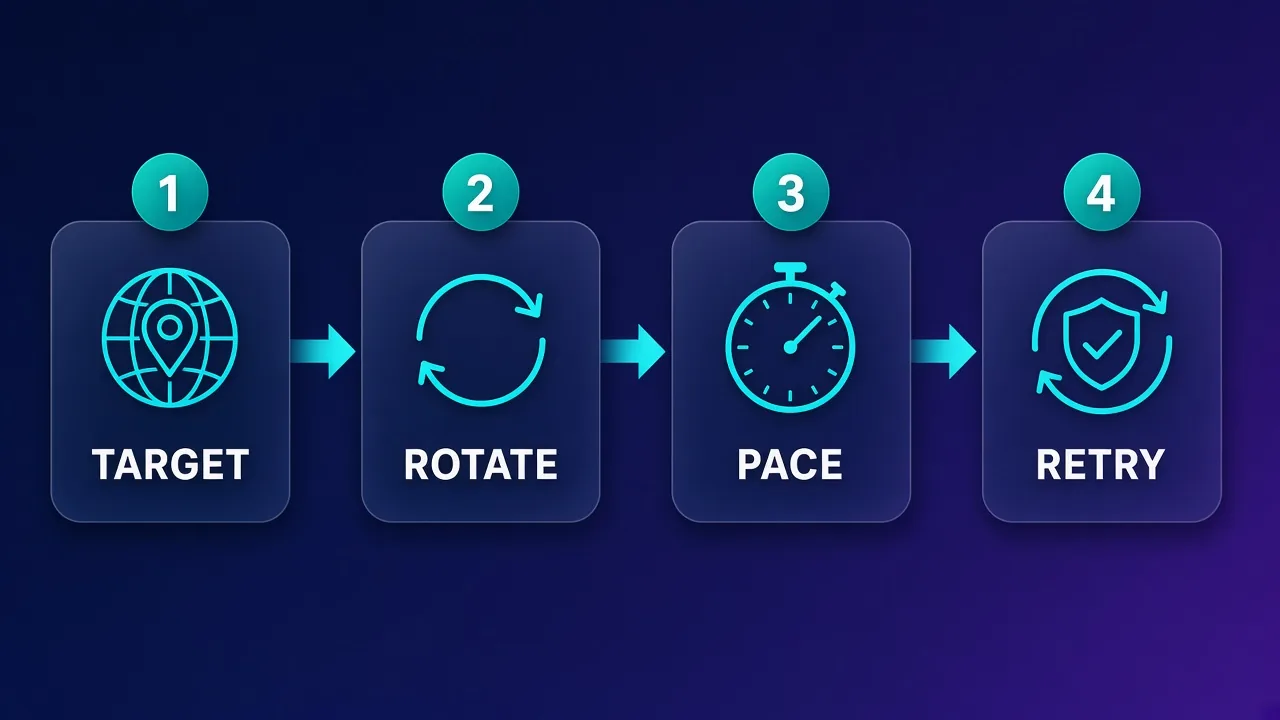
Rotating vs sticky sessions on eBay
Most public eBay data, such as search results and individual listings, can be fetched one request at a time. Each request stands alone, so per-request rotation is ideal. It spreads load and limits how much any single IP is exposed.
Sticky sessions make more sense when you need continuity across several requests. Examples include walking through paginated results with cookies set by the first page, or using a logged-in seller tool where an IP change mid-session could trigger a security check. Keep sticky sessions short and only as long as the task needs. Our guide to sticky sessions covers session duration and how providers implement it.
Do not mix logged-in accounts with scraping traffic
If you manage a real eBay seller account, never route bulk scraping through the same IP or browser profile you use to log in. A block on scraping traffic should never be able to touch your selling account.
Compliance: eBay's rules and official APIs
Before scraping eBay, read its user agreement and robots rules. Like most marketplaces, eBay restricts automated access to its site in its terms, and those terms can change. Scraping public pages sits in a legal and contractual grey area that depends on your jurisdiction, what data you collect, and how you use it. This article is not legal advice, and if your project is commercial or large, talk to a lawyer.
eBay also runs an official developer program with APIs for searching and reading listing data. For many use cases, such as tracking prices on specific items or researching categories, an official API is more reliable, more stable, and clearly permitted. Use scraping only for gaps the APIs do not cover, and keep the scope narrow.
Whatever route you take, follow a few common-sense rules:
- Collect only public data you genuinely need.
- Avoid collecting personal information about buyers or sellers.
- Keep request rates modest so you are not burdening the site.
- Respect blocks as a signal to slow down, not as a challenge to escalate.
- Choose providers that source residential IPs ethically and with consent. Our guide to what makes a proxy provider trustworthy lists what to check.
Never bypass logins or scrape private data
Do not scrape content behind a login you are not authorized to use, and do not collect private account, message, or payment data. That moves well beyond public data collection and carries serious legal risk.
Common mistakes that get eBay scrapers blocked
- Using default library user agents. A request that announces itself as a script is easy to filter.
- Hammering one IP. Even residential IPs get flagged if each one sends too many requests.
- Treating every 200 response as success. Verification pages often return 200. Check the content.
- Mismatched locations. A US exit IP requesting a regional eBay site with mismatched language headers looks odd.
- No backoff. Retrying instantly after a block simply burns through IPs faster.
- Scraping what you could cache. Re-fetching unchanged listings wastes bandwidth and increases exposure.
Costs and trade-offs
Residential proxies are usually billed by bandwidth, so page weight matters. Listing pages can be heavy with images and scripts. If you only need text data, fetching raw HTML instead of rendering the full page in a browser can cut bandwidth dramatically. Blocking images, fonts, and media in headless browsers helps too.
Datacenter and ISP proxies are usually billed per IP, which makes them cheaper per request at high volume but less effective on heavily protected pages. Managed APIs are billed per successful request, which makes costs predictable but higher per page. The right choice depends on your volume, how much engineering time you have, and how much a failed request costs you.
A practical approach is to run a small trial with two or three providers against your real target pages, measure success rate and bandwidth per successful page, and compare the cost per usable record rather than the headline price.
Who this setup is and is not for
A rotating residential setup is a good fit for resellers tracking sold prices, brands monitoring unauthorized listings, analysts researching category trends, and tools that compare marketplace pricing across regions.
It is a poor fit if the official eBay APIs already give you what you need, if you only check a few listings occasionally, or if your plan depends on collecting personal data. In those cases, the API, a manual process, or a different data source is the better answer.
Bottom line
For most eBay scraping, start with the official developer APIs, then fill gaps with rotating residential proxies targeted to the right country site. Pace requests, detect blocks by content rather than status code alone, and retry on fresh IPs with backoff. Bright Data and Oxylabs suit larger teams that want deep tooling, Decodo and SOAX are strong mid-market options, NetNut offers steady throughput, and IPRoyal and Webshare are sensible for smaller tests. Compare live plans on the cards above, run a short trial against your own target pages, and choose based on cost per successful record.
Frequently asked questions
Rotating residential proxies are the safest default for scraping public eBay data. They use IP addresses from consumer internet providers, so requests look like ordinary shoppers. Pair them with country targeting that matches the eBay site you are collecting from.
You can for light, infrequent checks on a small set of listings, especially with careful pacing. Datacenter IPs come from hosting networks that are easy to identify, so they tend to hit verification pages sooner at higher volume. For sustained collection, residential proxies are more reliable.
It depends on your jurisdiction, what data you collect, and how you use it. eBay's user agreement restricts automated access, and those terms can change. Check eBay's official developer APIs first, avoid personal data, and get legal advice for commercial projects.
Yes. eBay runs a developer program with APIs for searching and reading listing data. For many price tracking and research needs, an official API is more stable and clearly permitted than scraping, so it should be your first stop.
Use per-request rotation for public pages such as search results and individual listings, since each request stands alone. Use short sticky sessions only when you need continuity, such as paginated flows that depend on cookies or logged-in seller tools.
Proxies only fix the IP layer. Default library user agents, missing browser headers, unnatural request timing, and no backoff after blocks still give scrapers away. Add realistic headers, randomized delays, content-based block detection, and retries on fresh IPs.
There is no published safe number, and thresholds can change. Start slow, cap concurrency per exit IP, and track your success rate over time. If verification pages increase, reduce your request rate before adding more IPs.
A managed scraping API is faster to set up and handles retries and unblocking for you, billed per successful request. Running your own proxies gives more control and can cost less at high volume if you have engineering time. Many teams combine both.