Table of contents
Facebook (Meta) account and ads operations fail for many reasons that have nothing to do with creative quality: shared household IPs across unrelated Business Managers, abrupt country jumps, noisy datacenter ASNs, and browser fingerprints that do not match the egress. Proxies will not fix weak offer compliance or policy violations — but the right sticky ISP or residential setup paired with disciplined browser isolation is still table stakes for agencies and in-house growth teams that manage multiple legitimate pages and ad accounts.
This roundup focuses on Business Manager and ads ops realities: sticky sessions, ASN reputation, geo consistency, anti-detect pairing, and providers whose pools are commonly evaluated for social/ads work. Always follow Meta’s terms and local advertising law; treat this as infrastructure guidance, not a playbook for abuse. For IP-type fundamentals see residential vs ISP vs datacenter; for protocol choice see SOCKS5 vs HTTP proxies.
Compliance first
Using proxies to evade enforcement, create inauthentic engagement, or misrepresent identity can violate Meta policies and applicable law. Prefer setups that support real businesses, clear geo presence, and accountable admins. When in doubt, ask counsel — not a proxy salesperson.
What Facebook ads ops actually need from a proxy
Unlike SERP scraping, ads and account work is session-heavy. A media buyer logging into Business Manager, uploading creatives, and editing budgets expects the same plausible network identity across a work block. That usually means:
- Sticky sessions measured in tens of minutes to many hours — not a new exit every request.
- ISP / static residential IPs when you need long-lived reputation that looks like a normal broadband line.
- Geo alignment between the account’s expected market, billing profile, and the proxy’s country (and often city).
- Low subnet neighbors that are not already burned by abusive automation on the same /24.
- Clean pairing with one anti-detect (or hardened) browser profile per identity — one profile, one proxy habit.
Rotating residential still has a role for light research, competitive creative checks, or public page fetches. It is a weaker default for the admin session that holds 2FA and payment instruments.
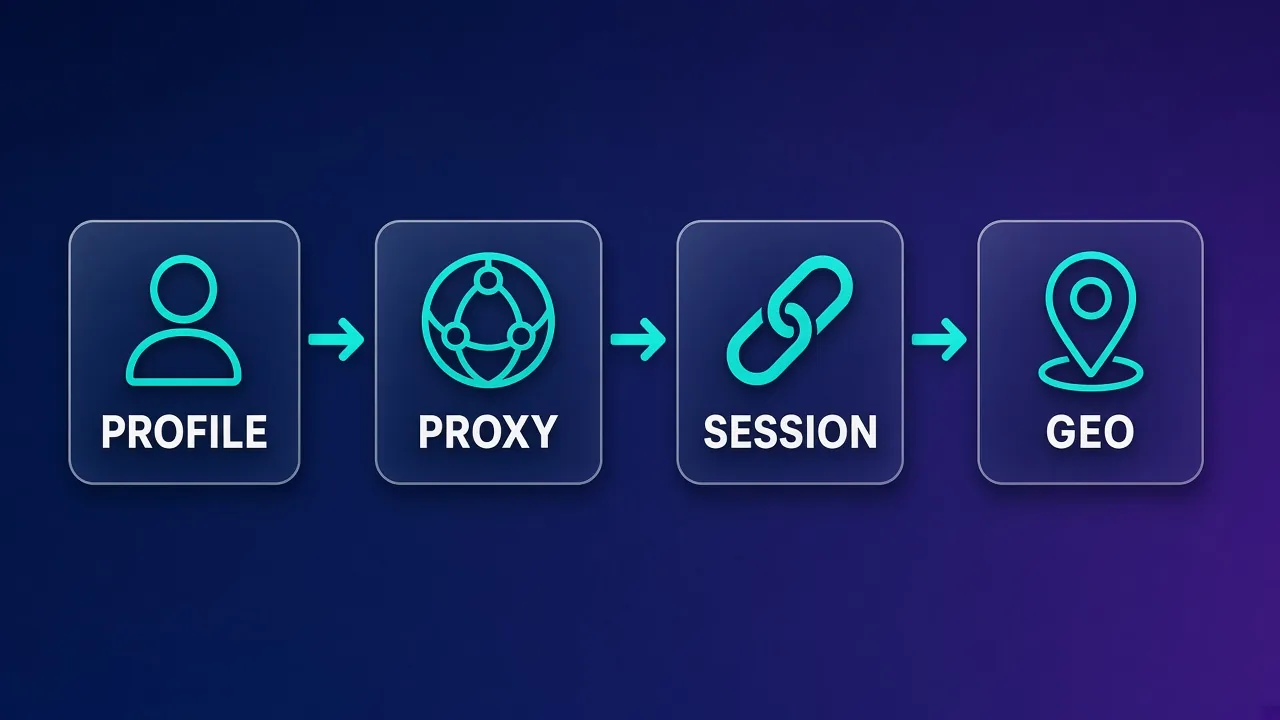
ISP vs residential vs datacenter for Meta workflows
| Type | Best for | Watch-outs |
|---|---|---|
| ISP / static residential | Business Manager logins, long buyer sessions, client seats | Higher cost per IP; verify true ISP ASN not recycled DC |
| Rotating residential | Public research, light checks, broad geo coverage | Poor fit for sticky admin work if exits jump too often |
| Datacenter | Internal tools, non-login monitoring, cheap concurrency | Often challenged on consumer logins; reputation risk |
Most serious ads desks standardize on sticky ISP for human buyers and keep a smaller rotating residential budget for research. Datacenter can still monitor public landing pages or non-authenticated endpoints, but it is rarely the primary login path.
Anti-detect browsers and proxy pairing
Meta looks beyond IP: cookies, device graphs, unusual automation patterns, and payment trails matter. Anti-detect browsers help teams separate client environments so cookies and fingerprints do not bleed across advertisers. The proxy is the network half of that isolation.
Operational rules that hold up in practice:
- One Business Manager identity (or tightly related set) per browser profile.
- One sticky proxy endpoint dedicated to that profile — do not share exits across unrelated clients.
- Match timezone, language, and geo hints in the profile to the proxy country.
- Warm new seats gradually; sudden high-spend behavior from a cold environment invites review.
- Test WebRTC / DNS leaks so the real office IP does not appear beside the proxy IP.
Compare team-oriented antidetect options such as Multilogin and AdsPower when you standardize a desk:

Multilogin
Browser

AdsPower
Browser
Editor score
User rating
Starting price
Founded
Office IP vs proxy IP
If buyers sometimes work “bare” on the corporate fiber and sometimes on a US ISP proxy, Meta may see conflicting locations. Pick a policy: either always proxy for that seat, or keep that seat native to the office geo — mixing casually is how trust scores get weird.
How we evaluated providers for this list
We prioritized qualitative fit for Facebook accounts and ads — not a single lab score:
- Availability of sticky or static ISP/residential products suitable for login sessions.
- Geo coverage depth for common ads markets.
- Dashboard/API ergonomics for assigning exits to seats.
- Reputation in social/ads operator communities (directional, not gospel).
- Transparent product labeling so you can tell ISP from rotating residential.
Prices change; use the live Proxyaxis provider cards below rather than memorized rates. Run your own canary logins and pixel checks before migrating a whole agency.
Best proxy providers for Facebook accounts and ads
Bright Data
Enterprise-grade networks with dedicated ISP/residential product lines and mature targeting. Strong when you need governance, large seat counts, and clear separation between scraping APIs and sticky account exits. Overkill for a single freelancer; excellent for agencies that already operate vendor security reviews.
Bright Data
Bright Data remains the most complete data-collection platform money can buy. No competitor matches its combination of network scale, targeting granularity, and compliance tooling — and for enterprise teams whose revenue depends on reliable data, that completeness justifies the premium. The trade-offs are real: it is one of the priciest providers per gigabyte, the interface overwhelms newcomers, and KYC verification adds friction before you can route a single request. Smaller projects will get better value from Decodo or IPRoyal. But if you need city-level residential targeting at scale, a managed unblocker for the hardest targets, and audit-ready compliance, Bright Data is the default — and our highest-rated proxy provider overall.
Oxylabs
Another enterprise staple with ISP and residential options plus serious documentation. Frequently shortlisted beside Bright Data for compliance-heavy teams. Prefer their sticky/ISP SKUs for Business Manager work rather than pure rotating residential scrapers.

Oxylabs
Oxylabs is the enterprise provider that gets the fundamentals right. The network is huge and well-maintained, the scraper APIs are genuinely best-in-class, and the documentation and SDKs make integration faster than almost any competitor. What sets it apart from Bright Data is service: dedicated account managers, responsive support, and cleaner tooling mean less time fighting the platform and more time shipping. The cost is higher entry pricing, and the deepest discounts favor high-volume commitments. For serious commercial data operations that can justify the spend, Oxylabs is a top-two choice and frequently the one teams stay with long-term.
Bright Data
Proxy
Oxylabs
Proxy
Editor score
User rating
Starting price
Founded
Decodo
Often considered a flexible mid-market alternative when you want residential/ISP capability without only-enterprise procurement. Useful second quote for sticky social and ads desks that still want self-serve onboarding.

Decodo
Decodo offers the best price-to-performance ratio in the industry. It delivers roughly 90% of what the enterprise leaders provide — high success rates, a large clean pool, sticky sessions, an unblocker — at a fraction of their cost. The dashboard is the friendliest of any major provider, the 14-day money-back guarantee removes the risk of trying it, and support actually responds. The main gaps are enterprise-grade compliance tooling and the very deepest targeting, neither of which most teams need. For startups, solo developers, and any team that wants professional results without enterprise pricing, Decodo is our top value pick and an easy recommendation.
SOAX
Known for granular targeting and session controls that map well to “keep this buyer in-city for the afternoon” workflows. A regular contender when geo precision matters more than maximum enterprise SSO features.

SOAX
SOAX is the targeting specialist. City- and ISP-level selection on every plan — not locked behind premium tiers — is genuinely rare, and the continuously cleaned pool keeps success rates high where it matters. It is not the fastest network, the interface could use a refresh, and SOCKS5 coverage is uneven. Those are real but minor gripes against a provider that nails the fundamentals of precision and reliability. For ad verification, localized market research, and social-media work that depends on appearing in an exact location, SOAX is one of the best mid-market options available.
NetNut
Frequently evaluated for ISP-style and high-performance peer products. Worth a trial when you care about latency for dashboard-heavy buying sessions and want an alternative ASN footprint to the two largest enterprise brands.

NetNut
NetNut's direct-ISP architecture is more than marketing — it genuinely delivers steadier, faster sessions than peer-to-peer networks, because it does not depend on consumer devices staying online. That makes it a standout for uptime-critical workloads like brand protection and ad verification, where a dropped session means lost data. The trade-offs are business-oriented pricing, higher minimum commitments, and a dashboard that takes some learning. If session stability is your priority and you operate at business scale, NetNut is one of the most reliable residential networks available and well worth the 7-day trial.
The Social Proxy
Positioned toward social-account workflows; operators often try it when the job is sticky continuity for profiles rather than bulk SERP collection. Validate pool freshness and sticky TTL against your seat map before standardizing.
The Social Proxy
For high-value social accounts, a dedicated modem is the gold standard, and The Social Proxy executes it properly: real SIM hardware in named cities, unlimited data, API rotation, and an identity no other customer can poison. The economics only work when the accounts justify ~$90/month per identity cluster, and the finite city list constrains geo-sensitive plans. If your Instagram or TikTok operation loses real money when an account dies, this is what the premium buys.
Live Proxies
Another social-ops-oriented option where sticky residential/ISP-style sessions are the selling point. Compare real stickiness, replacement policy, and geo list with The Social Proxy and your ISP shortlist.

Live Proxies
Private allocation is a real answer to shared-pool roulette: Live Proxies' model of giving your account its own stable residential set produces the most consistent session behaviour we have seen outside premium ISP products. You pay for that consistency, and volume scrapers who just need gigabytes will find better economics in open pools. For ticketing, e-commerce, and account work where one bad shared IP can cost real money, it is among the best-designed newcomers.
IPRoyal
Accessible residential and static options that many smaller teams use to prototype geo-aligned seats before committing to enterprise contracts. Check static/ISP inventory quality carefully for ads logins; rotating products remain better for research.

IPRoyal
IPRoyal is the best pure pay-as-you-go deal in proxies. Non-expiring traffic is a genuinely customer-friendly policy that no major rival matches — buy what you need, use it whenever, lose nothing. The pool is smaller than the premium networks and success rates can soften on the most heavily defended targets, so high-volume enterprise scraping is not its strength. The dashboard is also fairly basic. For intermittent scraping, account work, and sneaker copping on a predictable budget, IPRoyal is an easy recommendation and one of the best value picks for occasional users.
Proxy-Seller
Often used for purchasing ISP/static lists across many countries. Handy when you need specific city inventory for client markets; still verify ASN type and exclusivity so you are not sharing a noisy neighbor set.

Proxy-Seller
Proxy-Seller is excellent value if you want fixed, dedicated IPs instead of metered bandwidth. Per-IP pricing from $1.30 with unlimited bandwidth, flexible rental terms, and unusually cheap IPv6 make it a smart choice for account management and SEO. It is not the place for large rotating-residential workloads — the per-IP model does not scale to mass scraping that needs thousands of fresh addresses. The dashboard is also plain and functional rather than polished. But for stable, dedicated identities at a low cost, backed by 24/7 support, Proxy-Seller is one of the better dedicated-proxy specialists around.
NodeMaven
Modern residential/ISP-focused provider that shows up in mid-market shortlists for sticky account work. Run parallel canaries against Decodo/SOAX to compare challenge rates on your exact geos.

NodeMaven
NodeMaven's quality-filtered pool is a genuinely different pitch in a market obsessed with pool size, and it works: the IPs you get are noticeably cleaner, and holding one for a day makes account workflows far more stable than typical 10–30 minute sticky windows. You pay more per gigabyte than at budget providers, and raw-volume scrapers should look elsewhere — this is a precision tool. For multi-accounting through anti-detect browsers and any workflow where one flagged IP costs you an account, NodeMaven justifies its premium.
Suggested stack patterns
Agency with 20+ client seats: Enterprise ISP from Bright Data or Oxylabs (or both for failover ASNs), anti-detect with role-based access (Multilogin/AdsPower class), documented seat→proxy map, and a small rotating residential wallet for competitive research.
In-house brand, few ad accounts: A handful of sticky ISP exits in the HQ country, normal Chrome/Firefox hardened profiles or a light antidetect, and strict “no shared Wi-Fi hopping” rules for anyone with admin access.
Solo media buyer testing new geos: Start with mid-market sticky (Decodo, SOAX, NodeMaven, IPRoyal static) and one profile per market. Do not scale spend until the environment looks boring and consistent for several days.
Failover without chaos
Keep a spare ISP in a nearby city for true outages — but do not rotate spares daily. Sudden IP flapping looks riskier than a single stable line that occasionally needs a planned cutover.
Setup checklist for a new Facebook ads seat
- Create or assign a clean browser profile; disable unnecessary extensions.
- Assign a sticky ISP proxy; confirm country/city via an IP intelligence check.
- Verify DNS and WebRTC do not leak the host IP.
- Align profile locale/timezone with the proxy geo.
- Log in, complete any security checks once, then keep the same path for routine work.
- Separate research browsing (rotating residential) from the admin profile.
- Document the seat owner, proxy SKU, and replacement procedure.
Related reading as you harden the desk: proxies for Reddit automation (different platform, similar sticky lessons) and Multilogin vs AdsPower for team browser choice.
Pitfalls that get accounts reviewed
- Sharing one residential sticky across unrelated advertisers “to save money.”
- Jumping from US ISP to EU datacenter between morning and afternoon sessions.
- Running automation scripts inside the same profile that holds payment methods.
- Ignoring that mobile app access and desktop proxy access can disagree on location.
- Buying the cheapest unlimited rotating plan and forcing it into login flows.
- Assuming a proxy alone replaces quality identity verification and policy-compliant creatives.
Cost and budgeting (without invented list prices)
Expect sticky ISP to cost more per seat than raw residential gigabytes. Enterprise contracts add support and compliance value; mid-market self-serve wins on speed to first test. Budget also for anti-detect licenses, password managers, and the human time to keep seat maps accurate — infrastructure is wasted if buyers casually log in from home fiber “just this once.”
Use live cards on Proxyaxis for current packaging. Re-quote quarterly; proxy markets move.
Who this roundup is (not) for
For: agencies, freelancers managing multiple legitimate client pages, in-house performance teams expanding geos carefully, and ops engineers standardizing seat hygiene.
Not for: anyone seeking to mass-create inauthentic assets, evade law enforcement, or replace creative/policy quality with network tricks. Proxies are plumbing; they are not a growth strategy.
Sticky sessions in practice for Business Manager
Sticky means the provider keeps routing your authenticated gateway username (or session ID) to the same exit IP for a configured lifetime. For ads work, think in work-blocks: a morning optimization pass, a creative upload window, a reporting hour. If your sticky TTL is five minutes and your buyer works for ninety, you will rotate mid-task and look like a traveler hopping networks — even if each IP is “residential.”
Ask vendors explicitly: sticky duration options, what happens when the exit goes offline, whether sticky is per-IP exclusive or shared, and whether city targeting survives a sticky refresh. Then match buyer habits to TTL. Some desks prefer day-long static ISP assignments so stickiness is effectively permanent until you change the port mapping.
Session discipline also includes not mixing tools: the phone app on cellular LTE, the desktop on a US ISP proxy, and a colleague’s laptop on office fiber are three network stories for one admin user. Pick the canonical path for that seat and document it.
Geo, billing, and page authenticity signals
Network geo is only one layer Meta can correlate with billing country, page audience, tax forms, and historical admin locations. A Brazilian storefront exclusively managed from a US ISP exit is not automatically “wrong,” but sudden unexplained jumps without a business reason invite friction. When you expand into a new market, stand up a seat whose proxy, locale, and operating hours match that market — and keep HQ seats stable.
Agencies serving many countries often maintain a library of ISP exits labeled by client and market, with change control so freelancers cannot casually switch ports. That operational maturity matters as much as which brand sold you the IP.
Monitoring, alerts, and replacement playbooks
Treat proxies like production dependencies. Minimum viable ops:
- Daily IP reputation / reachability check for each production sticky.
- Alert when a buyer reports unexpected checkpoints or “confirm it’s you” loops.
- Cold spare ISPs in the same country, not yet attached to spend-heavy seats.
- Written cutover steps: pause campaigns if required, switch proxy, clear conflicting sessions, re-verify.
- Quarterly vendor review against challenge rates and support quality — not just sticker price.
When an exit is clearly burned, replace it; do not “save” it by rotating rapidly through a residential pool during login. Burned sticky ISP should go back to the vendor under their replacement policy when applicable.
How Facebook proxy needs differ from pure scraping
Scrapers optimize for coverage, retries, and bandwidth efficiency. Ads seats optimize for continuity, low drama, and human pacing. A pool that wins SERP benchmarks can still be a bad Business Manager companion if sticky inventory is thin or shared aggressively. Conversely, a small premium ISP list may be useless for large-scale public data collection but perfect for ten carefully managed advertisers.
Keep budgets separate in accounting: research GB versus seat IPs. That prevents growth teams from draining sticky inventory on tasks that should use rotating residential — a pattern we also see when people conflate social automation with SERP work on platforms like Reddit (see our Reddit automation proxy guide for the sticky-versus-rotate split in another context).
Conclusion
The best proxies for Facebook accounts and ads in 2026 are the ones that give you sticky, geo-true, reputable ISP or residential exits you can dedicate per seat — then stay boringly consistent. Bright Data and Oxylabs anchor the enterprise end; Decodo, SOAX, NetNut, NodeMaven, IPRoyal, Proxy-Seller, The Social Proxy, and Live Proxies populate strong mid-market and social-ops shortlists. Pair them with real anti-detect discipline, respect Meta’s rules, and verify everything with canaries before you migrate production Business Managers. For broader value shopping on rotating residential, see best cheap residential proxies; for provider trust criteria, read what makes a proxy provider trustworthy.
Frequently asked questions
Sticky ISP (static residential) proxies are the usual default for Business Manager and buyer sessions because they keep a stable, broadband-like IP. Rotating residential fits research better than long admin sessions. Datacenter IPs are often challenged on consumer logins.
If you manage multiple unrelated advertisers or clients on one machine, anti-detect (or strict profile isolation) helps keep cookies and fingerprints from blending. The proxy handles network identity; the browser profile handles local identity. One profile should map to one proxy habit.
It is a bad idea. Free pools are noisy, shared, and frequently abused, which raises checkpoint risk. For anything tied to billing and ads spend, pay for dedicated sticky inventory from a reputable provider and verify geo and ASN yourself.
Match sticky TTL to real work blocks — often tens of minutes to many hours — or use true static ISP assignments that stay put until you change them. Very short sticky windows that rotate mid-edit create unnecessary location churn.
Unrelated clients and Business Managers generally should not share exits. Related pages under one legitimate business can sometimes share a carefully managed environment, but agencies usually dedicate sticky IPs per client seat to reduce cross-linking risk.
For logins and ongoing ads ops, ISP/static residential is typically preferred. Rotating residential is useful for public research and light checks. Always confirm the provider’s labeling — some “ISP” products vary in exclusivity and ASN quality.
No. Proxies cannot fix policy violations, poor authenticity signals, or abusive behavior. They only help keep network identity consistent and separated. Creative quality, verification, and compliant practices still matter most.
Enterprise desks often evaluate Bright Data and Oxylabs ISP products. Mid-market and social-ops shortlists frequently include Decodo, SOAX, NetNut, NodeMaven, IPRoyal, Proxy-Seller, The Social Proxy, and Live Proxies. Always trial on your geos before standardizing.