Table of contents
If you've ever wondered how a web scraper can make millions of requests without getting blocked, or how a price-monitoring tool checks thousands of products without tripping a single CAPTCHA, the answer is almost always rotating proxies. They are the quiet engine behind large-scale web automation — and the mechanism is more elegant than most people expect. This guide explains exactly how rotating proxies work, from the pool of IP addresses behind them to the gateway that cycles through them, the two rotation models you'll choose between, how to control it in code, and the trade-offs to weigh before you rely on one.
What is a rotating proxy?
A rotating proxy is a proxy service that automatically assigns a different IP address to your requests from a large pool of addresses. Instead of every request leaving from one fixed IP — the way a single static proxy works — your traffic is spread across many IPs, so each request can appear to come from a different user, location, or device.
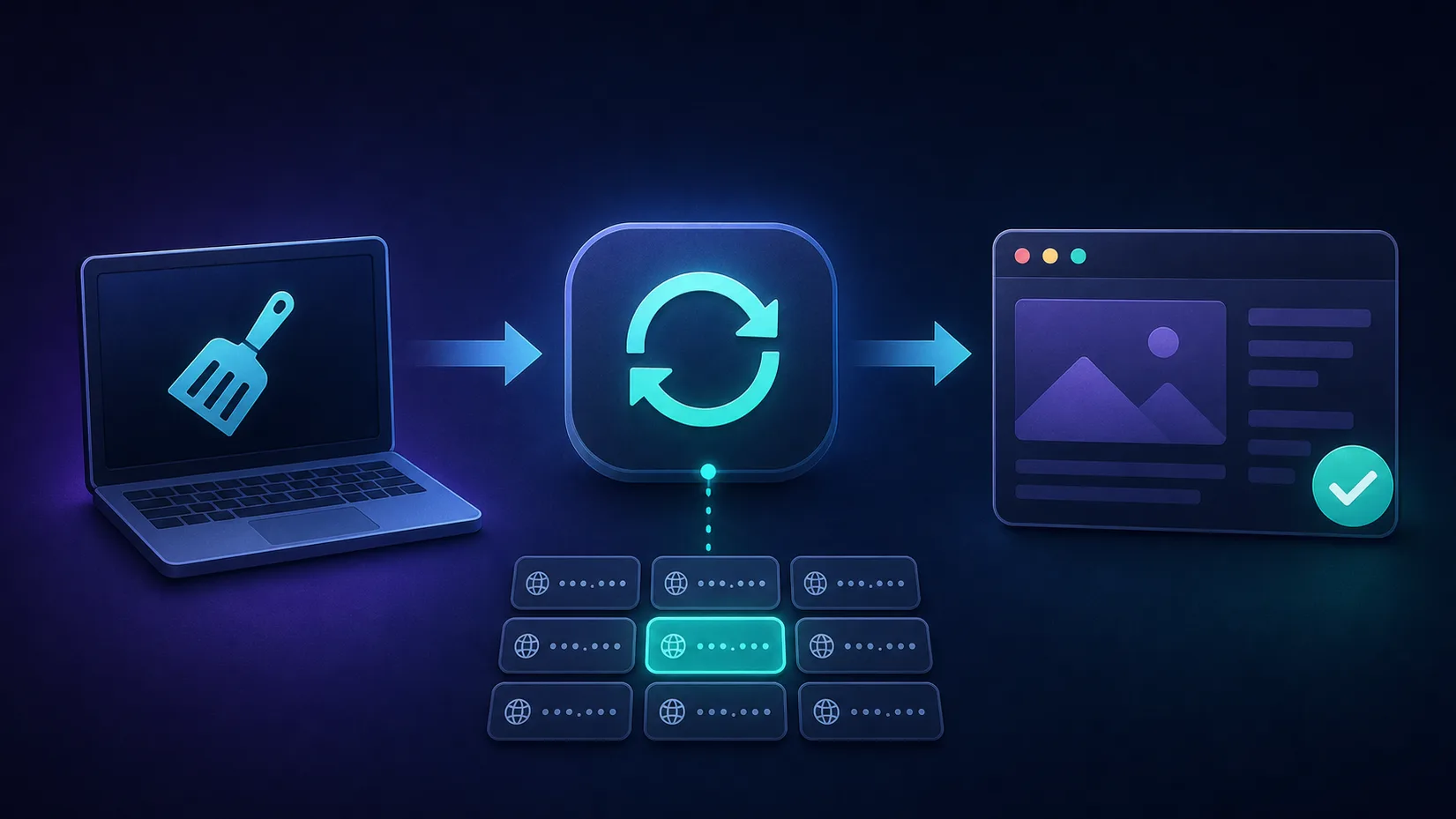
The key idea is that you don't manage a list of proxies and swap between them. You connect to a single entry point, and the provider's infrastructure handles the cycling behind the scenes. From your side, it looks like one proxy; on the exit side, it's hundreds, thousands, or millions of addresses. That sleight of hand is what makes rotating proxies so powerful for anything done at scale.
How rotating proxies work: the basic mechanism
At the heart of a rotating proxy is a component usually called a backconnect gateway (or rotating gateway). You send your request to this single gateway address and port. The gateway then:
- Receives your request at one fixed endpoint (e.g.
gateway.provider.com:7000). - Selects an IP from the provider's pool, according to your rotation settings.
- Forwards your request out through that chosen IP, so the target website sees that address, not yours and not the gateway's.
- Relays the response back to you through the same path.
Because you always talk to the same gateway, your scraper's configuration never changes — but the exit IP can change on every single request. This is the architectural trick that lets one line of code in your application stand in for an enormous, constantly-shifting fleet of addresses.
The proxy pool: where the rotating IPs come from
A rotating proxy is only as good as the pool behind it. That pool is the collection of IP addresses the gateway can choose from, and providers source them in different ways depending on the network type:
- Residential pools are made of real home IPs assigned by ISPs, contributed by users who opt in through apps and SDKs. These look like ordinary people and are highly trusted.
- Datacenter pools are blocks of IPs hosted on servers. They're fast and cheap but easier for sites to detect.
- Mobile pools are carrier-assigned 4G/5G IPs routed through real devices — the most trusted and the most expensive. (We cover the economics in mobile proxies explained.)
The size and freshness of the pool matter more than the headline number. A pool of millions of IPs only helps if those addresses are live and haven't already been flagged on the sites you target. A good provider continuously cycles fresh IPs in and burned ones out.
How the gateway actually picks an IP varies between providers: some choose at random, others use round-robin, and the better ones steer you toward the least-recently-used or highest-reputation addresses for your specific target. Many also let you constrain the pool — by country, city, or even ASN — so every rotated IP still matches the location your task needs. This is exactly why two services advertising identically sized pools can feel completely different in practice: the selection logic and geo-control matter as much as the raw IP count.
The two rotation models: per-request vs sticky sessions
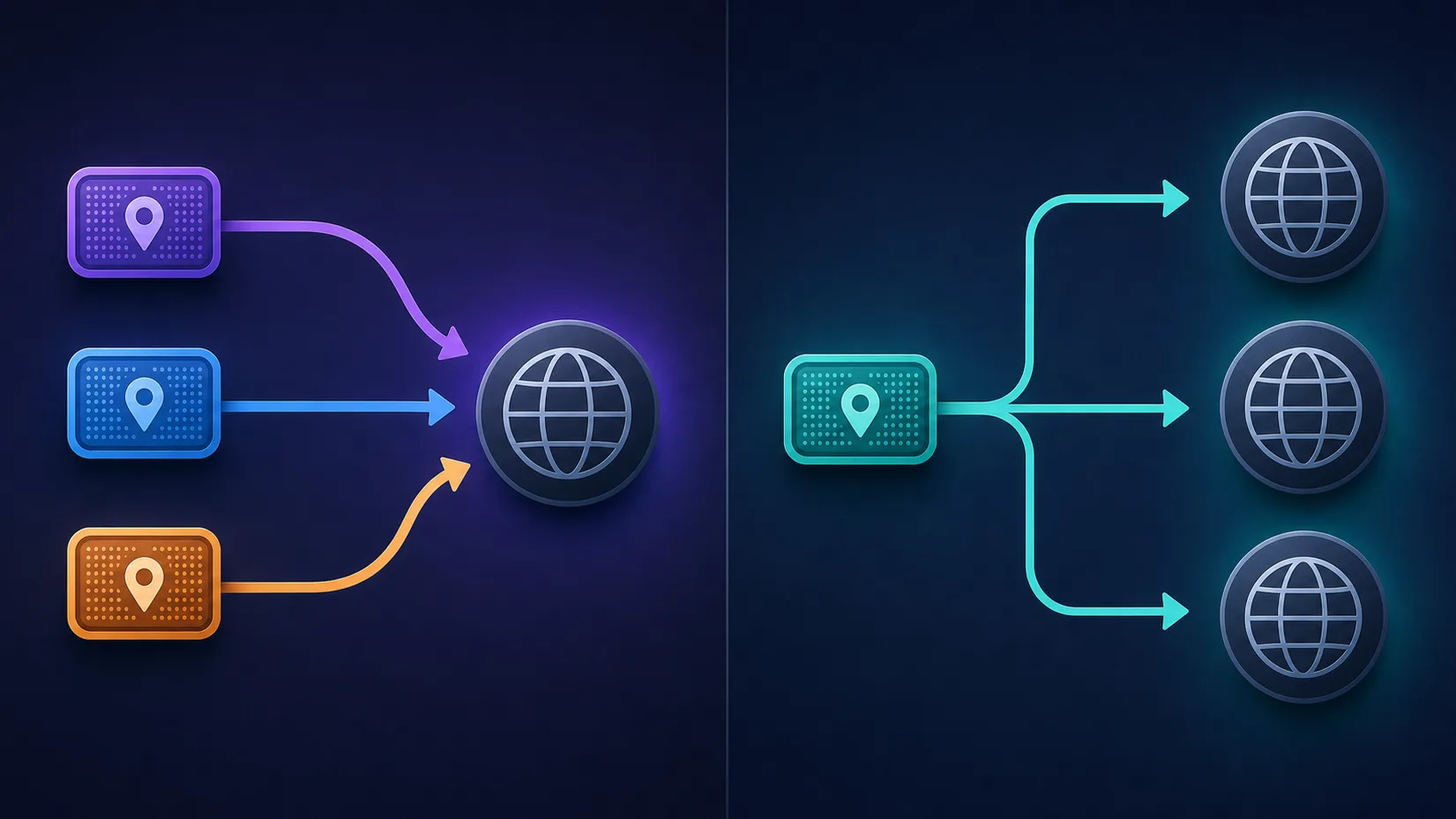
Rotation isn't one-size-fits-all. Every rotating proxy offers two fundamental modes, and choosing the right one is the single most important decision you'll make:
- Per-request rotation. Every request you send gets a brand-new IP from the pool. This is ideal for high-volume, stateless jobs — scraping search results, crawling independent product pages, gathering public data — where each request stands alone and a fresh IP every time spreads the load invisibly.
- Sticky sessions. The gateway holds the same IP for a set window (commonly 1 to 30 minutes, sometimes configurable) so a sequence of requests shares one identity. This is essential for stateful flows — logging in, adding to a cart, paginating through a session, completing a multi-step checkout — where switching IPs mid-task would instantly look suspicious.
Rule of thumb
If your task has no memory between requests, use per-request rotation. The moment a task needs to "stay logged in" or remember a cart, switch to a sticky session — rotating mid-session is one of the fastest ways to get blocked.
How rotation is controlled in practice
Providers expose rotation in two common ways: through different ports (one port rotates every request, another keeps a sticky IP), or through a session token embedded in the username. The username method is the most flexible and widely used.
With per-request rotation, you just send requests through the gateway and each one exits from a different IP:
# Each request through the rotating gateway exits from a different pool IP
curl -x http://USERNAME:PASSWORD@gateway.provider.com:7000 https://api.ipify.org
curl -x http://USERNAME:PASSWORD@gateway.provider.com:7000 https://api.ipify.org
# → the two calls return two different IP addresses
To pin a sticky IP, you add a session identifier to the username. As long as you reuse the same session ID, the gateway returns the same exit IP; change the ID and you get a new one:
import requests

# A session ID in the username pins one IP for that session's lifetime
session_id = "session-42"
proxy = f"http://USERNAME-{session_id}:PASSWORD@gateway.provider.com:7000"
proxies = {"http": proxy, "https": proxy}

# Every call reusing session-42 keeps the same exit IP
r1 = requests.get("https://api.ipify.org", proxies=proxies)
r2 = requests.get("https://api.ipify.org", proxies=proxies)
print(r1.text, r2.text)  # same IP both times
The exact format (the keyword, the separator, whether you set a country or city) varies by provider, but the principle — a single endpoint plus parameters that tell the gateway how to behave — is universal. The same setup works in any HTTP client, including browser-automation tools like Playwright.
Why rotate at all? The problems rotation solves
Rotation exists because the modern web actively defends against automation. Send too many requests from one IP and you'll hit a wall fast. Rotating proxies solve three concrete problems:
- Rate limits and IP bans. Sites throttle or ban an address that makes too many requests. Spreading requests across many IPs keeps each one under the radar.
- Anti-bot detection. Reputation systems score IPs; a residential or mobile IP making human-paced requests blends in where a hammering datacenter IP would be flagged.
- Geo-restrictions. Content, prices and search results vary by location. A pool spanning many countries lets you see each region's view by choosing where the exit IP sits.
Rotating vs static proxies
Rotating proxies aren't always the right answer. A static (dedicated) proxy gives you one fixed IP for your exclusive use — and for some jobs that's exactly what you want. Here's the trade-off:
| Aspect | Rotating proxy | Static (dedicated) proxy |
|---|---|---|
| Exit IP | Changes per request or per session | One fixed IP |
| Best for | High-volume scraping, crawling, data collection | Long sessions, account management, consistent identity |
| Block resistance | High — load is spread across many IPs | Lower — all activity rides on one address |
| Sessions | Per-request or sticky (configurable) | Always the same identity |
| Setup | One gateway endpoint, provider manages the pool | You manage the IP directly |
Common use cases for rotating proxies
Rotation shines wherever volume and stealth matter at the same time:
- Web scraping and crawling — gathering public data across many pages without tripping rate limits. (New to it? See how web scraping works.)
- SEO and SERP tracking — pulling search rankings from the right locations, at scale.
- Price and product monitoring — checking competitor catalogues quietly and consistently.
- Ad verification — confirming ads render correctly across regions.
- Market research — collecting reviews, listings and sentiment from many sources.
Best practices and common pitfalls
Rotating proxies aren't a licence to ignore good behaviour — the teams that get the best success rates pair rotation with care:
- Throttle politely. Rotation hides your volume, but pounding a target is still abusive and risks getting whole IP ranges flagged. Add randomised delays.
- Use sticky sessions for stateful flows. Never let the IP change mid-login or mid-checkout.
- Match geography to intent. Scrape a country's site from that country's IPs, or your data will be skewed or blocked.
- Rotate fingerprints too. A fresh IP paired with a stale user agent or obvious automation fingerprint still stands out. Rotate headers alongside IPs.
- Monitor success rates. A rising block rate is your early warning to slow down, switch network type, or refresh your approach.
Stay on the right side of the line
Collect only public data, respect each site's terms and robots rules where they apply, never gather personal data without a lawful basis, and choose a provider with ethically sourced IPs. Rotation reduces your footprint; it doesn't grant permission.
The limits of rotating proxies
Rotation is powerful, but it isn't magic — and treating it as a cure-all is how people still get blocked. Knowing its limits keeps your expectations realistic:
- It doesn't fix a bad fingerprint. A fresh IP attached to an obviously automated browser — wrong headers, no JavaScript, a headless signature — still gets caught. Rotation is one layer of defence, not the whole thing.
- Bandwidth costs add up. Residential and mobile rotation is usually billed per gigabyte, and cycling through many IPs doesn't reduce the data you move. Efficient scraping — skipping images, caching unchanged pages — matters as much as the proxy itself.
- Sticky isn't permanent. Sticky sessions expire, and a pool can occasionally hand back an address that's already been flagged. Build retry logic that detects a block and grabs a fresh identity rather than assuming every IP works.
- Quality varies wildly. Two providers both advertising "rotating residential" can deliver very different success rates depending on how clean and fresh their pool really is — which is why testing on your own targets beats trusting headline pool-size claims.
- It isn't anonymity. Your provider still sees your traffic, and cookies, logins and browser fingerprints can identify you regardless of which exit IP you're on.
How to choose and set up a rotating proxy
Getting started is straightforward once you know what to look for. Pick a provider with a clean, well-sourced pool in the network type your targets demand (residential for protected sites, datacenter for easy ones, mobile for the hardest). Confirm it offers both per-request and sticky modes, the geo-targeting granularity you need, and enough concurrent connections for your workload. Then it's just three steps: grab your gateway endpoint and credentials, choose your rotation mode, and point your scraper or browser at the single endpoint. The provider handles the rest. For a curated starting point, our best rotating proxies guide and the proxy directory compare the leading options.
The bottom line
A rotating proxy works by putting a single gateway in front of a large pool of IP addresses, then assigning a fresh address to your traffic — either on every request or held for a sticky session — so your activity blends in with ordinary users instead of standing out as one relentless machine. That mechanism is what makes large-scale scraping, price monitoring and SEO tracking possible without constant blocks. Choose per-request rotation for stateless volume and sticky sessions for anything that needs to stay logged in, pair rotation with polite request rates and good fingerprints, and you have the foundation that virtually all serious web data collection is built on.
Frequently asked questions
A rotating proxy automatically assigns a different IP address from a large pool to your requests, so traffic appears to come from many users instead of one. You connect to a single gateway and the provider cycles the exit IPs behind it.
You send requests to one backconnect gateway, which picks an IP from the provider's pool and forwards your request out through it. Depending on your settings, it picks a new IP for every request, on a timer, or holds one IP when you supply a session ID.
A rotating proxy changes your exit IP frequently across a pool, which is ideal for high-volume scraping and avoiding bans. A static proxy gives you one fixed, dedicated IP, which is better for long sessions, account management and any task needing a consistent identity.
Use per-request rotation for stateless, high-volume jobs like scraping search results, where every request stands alone. Use a sticky session, which holds one IP for several minutes, for stateful flows like logins or checkouts that must look like a single continuous user.
It depends on the mode. Per-request rotation changes the IP on every request; sticky sessions hold one IP for a window that's typically 1 to 30 minutes and often configurable. Many providers also let you trigger a new IP on demand.
Using rotating proxies is legal in most jurisdictions, and what matters legally is the activity they carry, not the proxy itself. Collect only public data, respect site terms and robots rules, avoid personal data without a lawful basis, and choose a provider with ethically sourced IPs.
They hide your real IP from the target site, but they're not full anonymity - your proxy provider can see your traffic, and other signals like browser fingerprint and cookies can still identify you. Pair rotation with good fingerprinting hygiene if anonymity matters.
Use rotating residential (or mobile) proxies for search engines, e-commerce and sites with strong anti-bot defences, where trust matters. Use rotating datacenter proxies for easy, high-volume targets where speed and low cost matter more than looking like a real user.