Table of contents
Playwright is one of the best browser-automation frameworks for scraping and testing — but point it at real-world targets at any scale and you'll hit CAPTCHAs, IP bans, and geo-walls fast. The fix is a good proxy. This guide shows how to wire a proxy into Playwright, what actually matters when choosing one, and the best proxy providers for Playwright in 2026.
Why Playwright needs a proxy
Playwright drives a real (headless) browser, which already helps it blend in. But the browser still calls out from a single IP address, and that's what gets you blocked:
- Rate limits & IP bans: repeated hits from one IP are throttled or banned within minutes.
- Geo-restrictions: prices, search results, and content vary by country — you need an exit IP in the right location.
- Anti-bot systems: services like Cloudflare and DataDome score IP reputation; datacenter IPs are flagged far more often than residential ones.
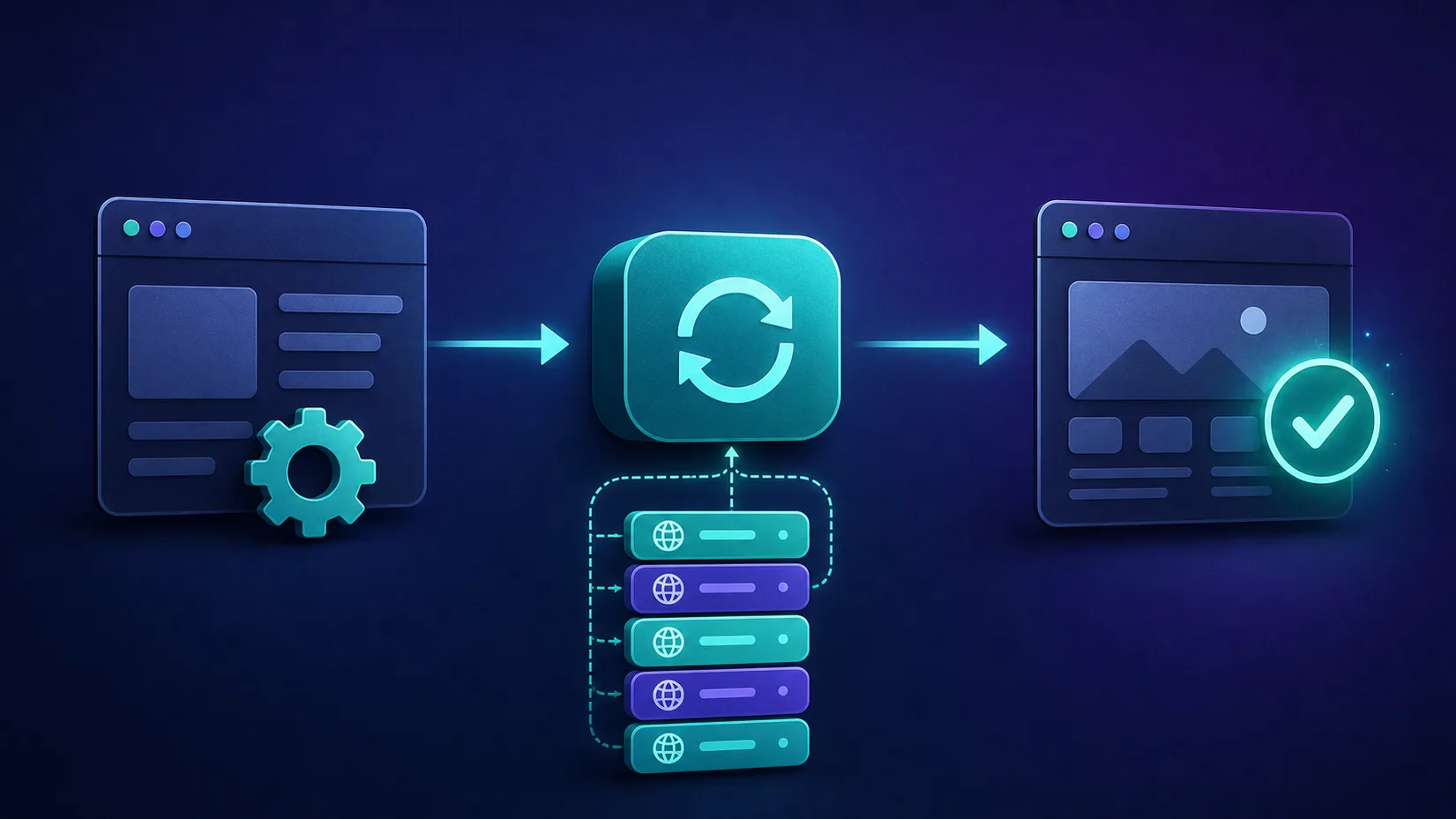
Routing Playwright through rotating proxies spreads requests across many IPs so your automation looks like ordinary users. (New to scraping? Start with how web scraping works.)
How to use a proxy with Playwright
Playwright accepts proxy settings either at browser launch or per browser context. Launch-level applies the proxy to everything:
const { chromium } = require('playwright');

const browser = await chromium.launch({
  proxy: {
    server: 'http://gate.provider.com:7000',
    username: 'your-username',
    password: 'your-password',
  },
});
const page = await browser.newPage();
await page.goto('https://example.com');
For multiple identities in one run, set a different proxy per context — each context can use its own exit IP:
const context = await browser.newContext({
  proxy: { server: 'http://gate.provider.com:7000',
           username: 'session-2', password: 'your-password' },
});
Sticky vs rotating
Use a rotating endpoint for stateless crawls (a fresh IP per request), and a sticky session when a flow must stay on one IP — logins, carts, multi-step journeys. Most providers expose both via the username or port.
What to look for in a Playwright proxy
Browser automation is heavier than plain HTTP scraping, so the proxy choice matters more:
- Residential or mobile IPs for protected targets — datacenter IPs get flagged by anti-bot systems.
- Rotation control — both per-request rotation and sticky sessions, ideally mapped cleanly to Playwright contexts.
- High concurrency — Playwright opens many parallel browser sessions; the proxy must allow enough concurrent connections.
- Geo-targeting — country, and ideally city/ASN level.
- Unblocking / remote-browser support — some providers offer a hosted browser (Playwright-compatible over CDP) that handles CAPTCHAs and fingerprinting for you.
- Success rate & price — residential is billed per GB and browser traffic is bandwidth-hungry, so efficiency matters.

The best proxies for Playwright in 2026
We weighted IP-pool quality and trust, rotation and concurrency control, geo-targeting, remote-browser/unblocking support, and value for bandwidth-heavy automation. Each card below links to our full review with live pricing and any current coupon.
Bright Data — best overall, with a Playwright-ready Scraping Browser
Beyond the largest residential network, Bright Data offers a hosted Scraping Browser you connect to over CDP — so Playwright drives a remote browser with proxy rotation, CAPTCHA solving, and fingerprinting handled for you. The most capable option for tough targets at scale.
Bright Data
Bright Data remains the most complete data-collection platform money can buy. No competitor matches its combination of network scale, targeting granularity, and compliance tooling — and for enterprise teams whose revenue depends on reliable data, that completeness justifies the premium. The trade-offs are real: it is one of the priciest providers per gigabyte, the interface overwhelms newcomers, and KYC verification adds friction before you can route a single request. Smaller projects will get better value from Decodo or IPRoyal. But if you need city-level residential targeting at scale, a managed unblocker for the hardest targets, and audit-ready compliance, Bright Data is the default — and our highest-rated proxy provider overall.
Oxylabs — best for large-scale residential automation
A premium residential pool with high concurrency and a Web Unlocker that pairs well with Playwright on heavily defended sites. Enterprise-grade support and reliability for serious pipelines.

Oxylabs
Oxylabs is the enterprise provider that gets the fundamentals right. The network is huge and well-maintained, the scraper APIs are genuinely best-in-class, and the documentation and SDKs make integration faster than almost any competitor. What sets it apart from Bright Data is service: dedicated account managers, responsive support, and cleaner tooling mean less time fighting the platform and more time shipping. The cost is higher entry pricing, and the deepest discounts favor high-volume commitments. For serious commercial data operations that can justify the spend, Oxylabs is a top-two choice and frequently the one teams stay with long-term.
For high-volume Playwright work, the two enterprise leaders are worth comparing head to head:
Bright Data
Proxy
Oxylabs
Proxy
Editor score
User rating
Starting price
Founded
Decodo — best value residential for Playwright
A large, reliable residential pool with a friendly dashboard, generous concurrency, and approachable per-GB pricing. The easiest "just works" proxy to drop into a Playwright script without enterprise overhead.

Decodo
Decodo offers the best price-to-performance ratio in the industry. It delivers roughly 90% of what the enterprise leaders provide — high success rates, a large clean pool, sticky sessions, an unblocker — at a fraction of their cost. The dashboard is the friendliest of any major provider, the 14-day money-back guarantee removes the risk of trying it, and support actually responds. The main gaps are enterprise-grade compliance tooling and the very deepest targeting, neither of which most teams need. For startups, solo developers, and any team that wants professional results without enterprise pricing, Decodo is our top value pick and an easy recommendation.
SOAX — best for precise geo-targeting
Clean residential and mobile pools with fine-grained country, city, and ASN targeting plus flexible rotation — ideal when your Playwright jobs must run from specific locations.

SOAX
SOAX is the targeting specialist. City- and ISP-level selection on every plan — not locked behind premium tiers — is genuinely rare, and the continuously cleaned pool keeps success rates high where it matters. It is not the fastest network, the interface could use a refresh, and SOCKS5 coverage is uneven. Those are real but minor gripes against a provider that nails the fundamentals of precision and reliability. For ad verification, localized market research, and social-media work that depends on appearing in an exact location, SOAX is one of the best mid-market options available.
ScraperAPI — best managed option (proxy mode for Playwright)
A managed scraping API with a proxy-port mode you can plug straight into Playwright; it handles rotation, retries, and CAPTCHAs behind one endpoint, so you skip building anti-block infrastructure.

ScraperAPI
ScraperAPI nails the "I just want the data" use case. You send a URL, it handles proxies, anti-bot, CAPTCHAs, and rendering, and you get the page back — no infrastructure to maintain. Billing per successful request is genuinely fair, the free tier is generous, and the structured endpoints for Google and Amazon save real work. The trade-off is flexibility: you give up direct IP control, and at very high volumes buying bandwidth directly can be cheaper. For developers who value time over fine-grained control, ScraperAPI is one of the easiest and most reliable ways to scrape at scale.
Webshare — best budget pick and free tier for testing
Cheap rotating proxies and a free tier that's perfect for developing and testing Playwright scripts before you scale. Lean on its residential plans for protected targets; datacenter for easy ones.

Webshare
Webshare is the developer's self-service favorite. Instant activation, a free tier that is actually free, and the cheapest fast datacenter proxies in the market make it the easiest provider to just start using. The custom plan builder — pick your IP count, bandwidth, and threads — is a genuinely good model that lets you avoid paying for capacity you do not need. The residential pool is newer and less battle-tested than specialists, and support is thin on the lower tiers. For datacenter proxies, API-driven workflows, and anyone who wants to try before paying, Webshare is one of the best-value options around.

Best practices for Playwright + proxies
- One identity per context: give each Playwright context its own proxy session so cookies and IP stay consistent together.
- Add stealth and realistic headers: a residential IP with an obvious automation fingerprint still gets caught — randomize viewport, user agent, and locale.
- Throttle and retry: add randomized delays and retry failed requests on a fresh IP rather than hammering one.
- Match geo to target: set the exit country to the site's audience to avoid skewed or blocked content.
- Watch your bandwidth: block images/fonts you don't need — browser traffic burns per-GB residential quota fast.
The bottom line
For most Playwright projects, start with an affordable residential provider like Decodo (or Webshare's free tier while you build), and graduate to Bright Data's Scraping Browser or Oxylabs when you're automating the toughest targets at scale. Wire the proxy in per context, rotate sensibly, and pair it with good fingerprints — that combination is what keeps Playwright unblocked.
Frequently asked questions
Pass a proxy object with server, username, and password either to chromium.launch() for all traffic, or to browser.newContext() to give each context its own exit IP. The server is your provider's gateway host and port.
Rotating residential proxies are best for most Playwright work because anti-bot systems trust real ISP IPs far more than datacenter ones. Use datacenter proxies only for easy, low-defense targets where speed and cost matter more than trust.
Yes. Set a different proxy (or a different sticky-session username) on each browser.newContext() call, so every context uses its own IP while keeping cookies and session consistent within that context.
A trusted IP isn't enough if your browser fingerprint screams automation. Combine a residential proxy with realistic headers, randomized viewport and user agent, human-like delays, and stealth techniques to avoid detection.
Datacenter proxies are fine for unprotected sites and internal testing, but for search engines, e-commerce, and sites behind Cloudflare or DataDome you'll need residential or mobile IPs to keep a usable success rate.