Table of contents
Price monitoring on large retail catalogs is a reliability problem first and a scraping problem second. Teams that track Walmart and similar marketplaces need consistent product pages, stable price fields, and enough geographic coverage to reflect what shoppers actually see — without burning through IP reputation in an afternoon. Proxies sit in the middle of that stack: they spread request load, align exit geography with the market you care about, and give you room to retry when a page is slow or temporarily blocked.
This guide is for operators building legitimate competitive intelligence and assortment monitoring — brand teams, agencies, and analytics vendors who already have permission or a compliant use case. It covers why retail monitoring leans on proxies, how rotating residential compares with datacenter and ISP exits for this workload, session and retry patterns that keep pipelines healthy, and a curated roundup of providers that fit retail monitoring stacks in 2026. We stay high-level on detection and rate limits: no bypass payloads, no exploit steps — just architecture and provider fit.
What this article is (and is not)
Use this as a stack-design and provider-selection guide for retail price monitoring. It does not teach how to evade protections, forge sessions, or violate a site’s terms. If your program depends on aggressive circumvention, you need legal and compliance review — not another proxy SKU.
Why Walmart-style retail monitoring needs proxies
Public product pages look simple: a title, a price, availability, and maybe a fulfillment badge. At monitoring scale those pages become a distributed systems problem. You may refresh thousands of SKUs on a cadence, compare regional offers, and alert when a competitor undercuts you. Doing that from a handful of office or cloud IPs usually fails for mundane reasons: shared hosting ranges get rate-limited, pages vary by location, and intermittent errors look identical to “hard” blocks until you have exit diversity and retries.
Proxies help in three practical ways:
- Exit diversity — spread requests across many addresses so one noisy IP does not stall the whole queue.
- Geo alignment — fetch the offer and shipping context that matches a target market (city or region), not whatever your VPC happens to advertise.
- Operational isolation — keep monitoring traffic off corporate VPN ranges and developer laptops so production jobs do not collide with human browsing.
Retail catalogs also change shape often: promotional badges, dynamic fulfillment copy, and A/B layouts. Your parsers need repeatable HTML or structured API responses. Proxies do not fix brittle selectors by themselves, but they reduce the chaos of “works on my machine” when every engineer hits the same edge node. For a related marketplace-focused walkthrough, see our guide on best proxies for eBay scraping — many of the same residential-versus-datacenter trade-offs apply, with different session expectations.
Finally, monitoring is rarely a single HTTP GET. Mature stacks mix lightweight price checks, deeper product detail pulls, and occasional browser-rendered jobs for heavily dynamic fragments. Different stages tolerate different proxy types. Treating “Walmart monitoring” as one proxy pool is how teams overspend on residential bandwidth for jobs that could run on cheaper exits — or under-provision residential where datacenter noise creates endless retries.
Detection and rate limits at a high level
Large retailers protect storefronts with layers that look familiar across e-commerce: volume controls per IP or ASN, bot scoring on request patterns, challenge pages for suspicious clients, and occasional soft failures that return incomplete content instead of a clear error. From an operator’s seat you mostly experience this as 429s, timeouts, empty shells, or region-mismatched pages — not as a puzzle to reverse-engineer.
What actually improves success rates for monitoring programs is almost always operational hygiene:
- Cap concurrency per exit and per target path.
- Backoff and re-queue instead of hammering the same SKU.
- Separate “fast poll” jobs from “full detail” jobs.
- Prefer official partner feeds or licensed data where they exist for core SKUs.
- Keep user-agent and client stacks consistent within a job class (not randomized chaos).
Proxies amplify good hygiene; they cannot replace it. If your worker opens hundreds of parallel connections from one sticky IP, rotating residential will still look abusive. If you ignore robots and contractual terms, a better proxy bill does not make the program compliant. Treat rate limits as a capacity-planning signal: when error budgets spike, reduce fan-out, lengthen cadence, or segment the catalog — then tune the proxy pool.
Stay on the right side of ToS and law
Price monitoring sits in a gray zone depending on jurisdiction, contract, and method. Prefer public pages you are allowed to access, respect rate expectations, and involve counsel for commercial programs. This article covers infrastructure choices for legitimate monitoring — not circumvention tactics.
Rotating residential vs datacenter vs ISP for retail monitoring
Not every SKU check needs the same exit class. Mapping job types to proxy types is the highest-leverage decision in a retail monitoring stack. For a deeper taxonomy, read residential vs ISP vs datacenter proxies.
Rotating residential
Best default for public product-page monitoring at scale. Residential exits draw from consumer ISP address space, which generally aligns with how shoppers appear. Rotation (new exit per request or short window) spreads load and reduces the blast radius of a single bad IP. For Walmart-style catalogs where you poll many URLs and can tolerate occasional retries, rotating residential is usually the workhorse pool.
Trade-offs: bandwidth cost is higher than datacenter; sticky quality varies by provider; very short TTLs can break multi-step flows if you accidentally design a flow that needs continuity. Most pure price checks are single-request friendly, so rotation wins.
Datacenter
Useful for non-sensitive stages and internal tooling — health checks against your own mirrors, parsing experiments on cached HTML, or high-volume jobs against APIs that explicitly allow datacenter clients. Against consumer retail storefronts, datacenter ranges are more often rate-limited. Use them where the target is amicable or where you are not hitting the live storefront at all.
ISP (static residential / hosted ISP)
Strong when you need longer-lived sessions or fewer exits with cleaner reputation. ISP proxies combine datacenter-like stability with ISP-allocated ranges. For retail monitoring they shine on account-gated research tools, slower deep-dive crawls, or when a small set of high-trust exits is easier to operate than a huge rotating pool. They are usually the wrong primary pool for “refresh 50k prices hourly,” where rotation and concurrency matter more than stickiness.
Practical split many teams land on:
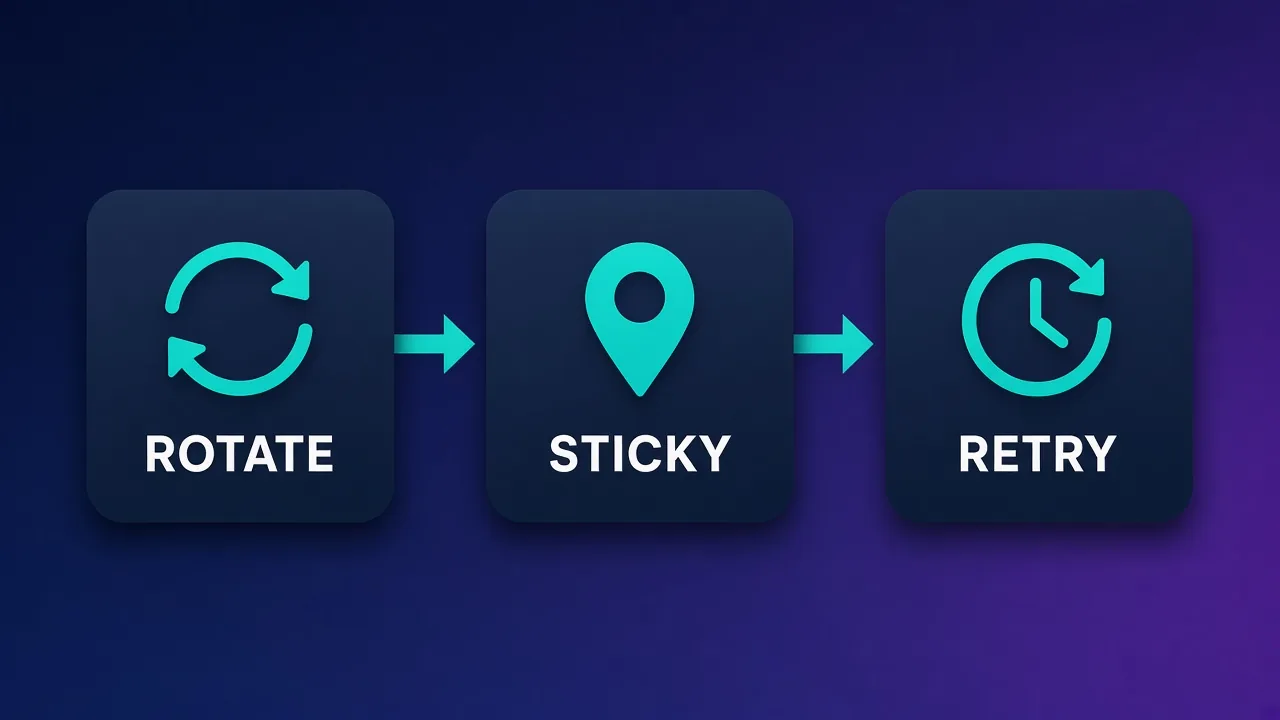
- Rotating residential for bulk price and availability polls.
- Short sticky residential or ISP for multi-step detail pages when required.
- Datacenter for scrapers hitting your own cache, QA fixtures, and non-retail endpoints.
Session strategy, retries, and backoff
Retail monitoring fails more often from bad session design than from picking the “wrong” brand of proxy. Decide explicitly whether each job is stateless (one request, any exit) or sticky (same exit for a short window).
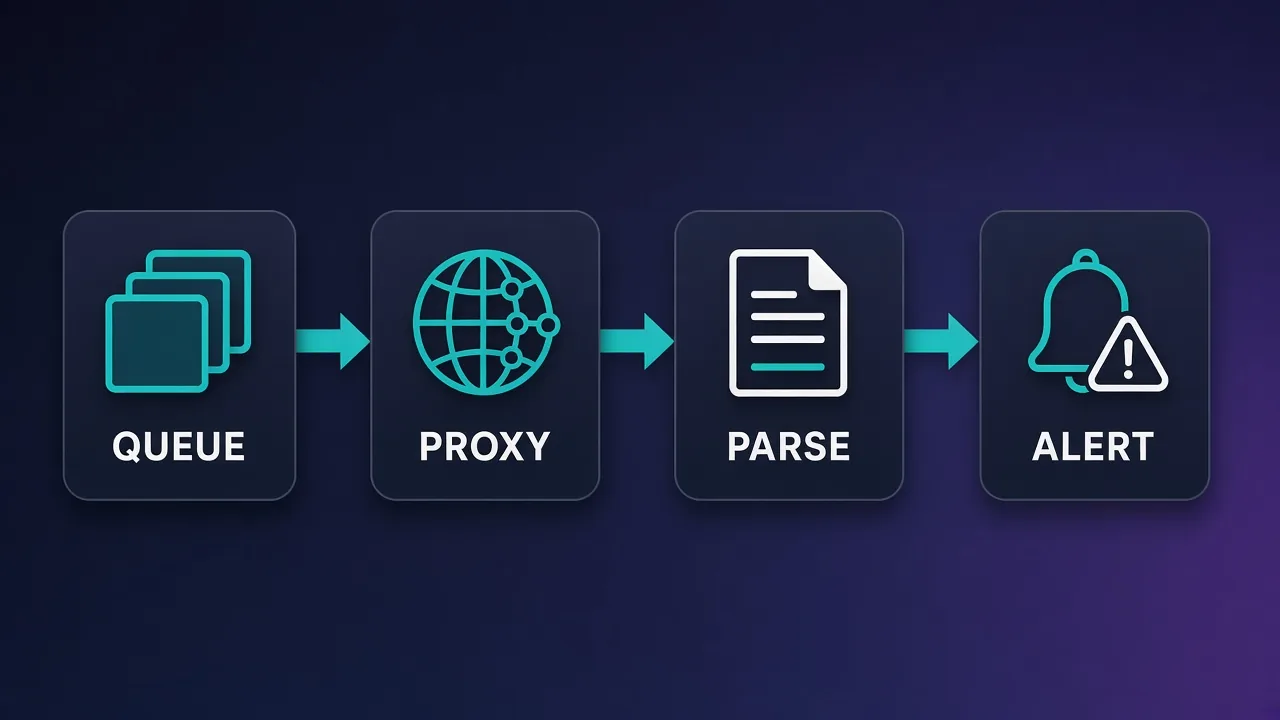
Stateless rotation is ideal for SKU price polls: enqueue URL → pull residential exit → fetch → parse → ack or retry. Sticky sessions help when a detail view spans redirects, cart fragments, or locale cookies that should stay coherent for a few minutes. Overusing sticky sessions concentrates risk on fewer IPs; underusing them breaks flows that truly need continuity. For session mechanics in general, see sticky sessions explained.
Retries should be boring and measurable:
- Classify errors — network timeout, HTTP 429/503, soft challenge, parse miss. Only some deserve a proxy swap.
- Backoff with jitter — exponential delays beat immediate stampedes when a region soft-limits.
- Budget retries — cap attempts per SKU per window; dead-letter chronic failures for human review.
- Rotate on reputation failure, not on every blip — swapping exits for transient timeouts wastes good IPs.
- Idempotent writes — upsert prices with timestamps so duplicate successes do not corrupt history.
A healthy monitoring worker looks less like a scraper race and more like a queue consumer with SLOs: freshness targets per category, error budgets, and clear ownership when a selector breaks after a site redesign. Proxies are capacity; queues and parsers are correctness.
# Illustrative pattern only — tune limits to your ToS and capacity plan
import random, time

def fetch_with_backoff(job, proxy_pool, max_attempts=4):
    delay = 1.0
    for attempt in range(max_attempts):
        proxy = proxy_pool.acquire(sticky=job.needs_sticky)
        try:
            resp = http_get(job.url, proxy=proxy, timeout=20)
            if resp.ok and parse_price(resp):
                return resp
            if resp.status in (429, 503):
                proxy_pool.mark_soft_limit(proxy)
            else:
                proxy_pool.release(proxy)
        except Timeout:
            proxy_pool.release(proxy)
        time.sleep(delay + random.random())
        delay = min(delay * 2, 60)
    job.dead_letter("exhausted_retries")
For Python-centric rotation wiring patterns (clients, env config, pool wrappers), see how to rotate proxies in Python. Keep credentials in a secret store; never bake provider passwords into images.
Geo targeting for retail offers
Retail prices and availability are location-sensitive. Shipping promises, store inventory badges, and sometimes the price itself vary by ZIP or city. If your monitoring claims to represent a market, your exits should too. That usually means:
- Pinning residential or ISP exits to the country — and when the provider supports it, state or city — that matches the shopper persona.
- Keeping locale headers and currency context consistent with that geo (without fabricating identities).
- Segmenting queues by region so a US East pool does not silently answer for a West Coast assortment.
- Documenting which geo each price row represents in your warehouse.
Geo targeting is also where cheap “unlimited” pools disappoint: advertised country coverage may be thin at city granularity, or peak-hour quality may dip. Trial the exact cities you care about with a small canary set of SKUs before you commit a monthly allocation. Measure success rate and parse completeness per geo, not global averages that hide a weak region.
Best proxies for Walmart price monitoring in 2026
These picks emphasize rotating residential quality, workable sticky options, geo coverage, and APIs that fit automated monitoring — not “unlimited hype.” Live cards below show current plans and ratings; we keep commentary qualitative. Provider order reflects fit for retail monitoring stacks, not a paid ranking.
Bright Data — enterprise residential depth
Bright Data remains a default shortlist item when you need broad residential coverage, mature targeting, and operational tooling for large catalogs. For Walmart-style monitoring, teams typically lean on rotating residential for bulk polls and reserve longer sessions for stubborn detail paths. Expect enterprise-style onboarding and stronger governance features than boutique pools — useful when multiple brands share one proxy estate. See the live card for products and positioning.
Bright Data
Bright Data remains the most complete data-collection platform money can buy. No competitor matches its combination of network scale, targeting granularity, and compliance tooling — and for enterprise teams whose revenue depends on reliable data, that completeness justifies the premium. The trade-offs are real: it is one of the priciest providers per gigabyte, the interface overwhelms newcomers, and KYC verification adds friction before you can route a single request. Smaller projects will get better value from Decodo or IPRoyal. But if you need city-level residential targeting at scale, a managed unblocker for the hardest targets, and audit-ready compliance, Bright Data is the default — and our highest-rated proxy provider overall.
Oxylabs — retail-oriented residential and tooling
Oxylabs is frequently chosen for e-commerce collection programs that want residential performance plus scraping-oriented documentation and support. Monitoring teams like predictable pool behavior and clear session controls when mixing price polls with deeper product extraction. If you are comparing top-tier residential vendors side by side, start with the live comparison against Bright Data rather than spreadsheet folklore.

Oxylabs
Oxylabs is the enterprise provider that gets the fundamentals right. The network is huge and well-maintained, the scraper APIs are genuinely best-in-class, and the documentation and SDKs make integration faster than almost any competitor. What sets it apart from Bright Data is service: dedicated account managers, responsive support, and cleaner tooling mean less time fighting the platform and more time shipping. The cost is higher entry pricing, and the deepest discounts favor high-volume commitments. For serious commercial data operations that can justify the spend, Oxylabs is a top-two choice and frequently the one teams stay with long-term.
Bright Data
Proxy
Oxylabs
Proxy
Editor score
User rating
Starting price
Founded
Decodo — balanced residential for growing stacks
Decodo (formerly associated with the Smartproxy line in many buyer conversations) sits in the “serious mid-market” band: enough residential capacity for meaningful retail monitoring without forcing every team into a full enterprise procurement cycle. Good fit when you already have parsers and queues and mainly need dependable rotation plus city targeting trials.

Decodo
Decodo offers the best price-to-performance ratio in the industry. It delivers roughly 90% of what the enterprise leaders provide — high success rates, a large clean pool, sticky sessions, an unblocker — at a fraction of their cost. The dashboard is the friendliest of any major provider, the 14-day money-back guarantee removes the risk of trying it, and support actually responds. The main gaps are enterprise-grade compliance tooling and the very deepest targeting, neither of which most teams need. For startups, solo developers, and any team that wants professional results without enterprise pricing, Decodo is our top value pick and an easy recommendation.
SOAX — flexible residential rotation
SOAX appeals to teams that want granular targeting and hands-on pool control for retail jobs. Rotating residential works well for SKU sweeps; sticky options help when a minority of URLs need continuity. Evaluate real success rates on your SKU sample — marketing page maps are not a substitute for a week of canary metrics.

SOAX
SOAX is the targeting specialist. City- and ISP-level selection on every plan — not locked behind premium tiers — is genuinely rare, and the continuously cleaned pool keeps success rates high where it matters. It is not the fastest network, the interface could use a refresh, and SOCKS5 coverage is uneven. Those are real but minor gripes against a provider that nails the fundamentals of precision and reliability. For ad verification, localized market research, and social-media work that depends on appearing in an exact location, SOAX is one of the best mid-market options available.
NetNut — ISP-leaning options for steadier exits
NetNut is worth a look when part of your Walmart monitoring mix benefits from ISP or static-like exits — for example, slower research crawls or tools that hate aggressive rotation. Pair ISP capacity with a separate rotating residential pool for high-fan-out price polls instead of forcing one product to do every job.

NetNut
NetNut's direct-ISP architecture is more than marketing — it genuinely delivers steadier, faster sessions than peer-to-peer networks, because it does not depend on consumer devices staying online. That makes it a standout for uptime-critical workloads like brand protection and ad verification, where a dropped session means lost data. The trade-offs are business-oriented pricing, higher minimum commitments, and a dashboard that takes some learning. If session stability is your priority and you operate at business scale, NetNut is one of the most reliable residential networks available and well worth the 7-day trial.
IPRoyal — cost-conscious residential
IPRoyal is a common shortlist pick for teams that need residential exits on a tighter budget while they prove monitoring ROI. Use it for controlled catalogs and strict concurrency caps; graduate critical geo segments to a premium pool if canary quality plateaus. Budget residential still needs the same retry and backlog discipline as premium.

IPRoyal
IPRoyal is the best pure pay-as-you-go deal in proxies. Non-expiring traffic is a genuinely customer-friendly policy that no major rival matches — buy what you need, use it whenever, lose nothing. The pool is smaller than the premium networks and success rates can soften on the most heavily defended targets, so high-volume enterprise scraping is not its strength. The dashboard is also fairly basic. For intermittent scraping, account work, and sneaker copping on a predictable budget, IPRoyal is an easy recommendation and one of the best value picks for occasional users.
NodeMaven — sticky-friendly residential workflows
NodeMaven shows up in stacks that care about session continuity and clean residential presentation. For price monitoring, that maps to the minority of flows that are not pure one-shot GETs. Keep bulk polling on a rotating pool; use sticky-oriented capacity where your architecture truly needs it.

NodeMaven
NodeMaven's quality-filtered pool is a genuinely different pitch in a market obsessed with pool size, and it works: the IPs you get are noticeably cleaner, and holding one for a day makes account workflows far more stable than typical 10–30 minute sticky windows. You pay more per gigabyte than at budget providers, and raw-volume scrapers should look elsewhere — this is a precision tool. For multi-accounting through anti-detect browsers and any workflow where one flagged IP costs you an account, NodeMaven justifies its premium.
ScraperAPI — managed fetching when you want less proxy ops
If your team would rather call an API than operate proxy credentials, rotation logic, and retry matrices in-house, a managed fetching layer like ScraperAPI can simplify the middle tier. You still own parsing, compliance, and freshness SLOs — you just outsource more of the exit and challenge handling. Compare total cost against raw residential bandwidth once volume is predictable.

ScraperAPI
ScraperAPI nails the "I just want the data" use case. You send a URL, it handles proxies, anti-bot, CAPTCHAs, and rendering, and you get the page back — no infrastructure to maintain. Billing per successful request is genuinely fair, the free tier is generous, and the structured endpoints for Google and Amazon save real work. The trade-off is flexibility: you give up direct IP control, and at very high volumes buying bandwidth directly can be cheaper. For developers who value time over fine-grained control, ScraperAPI is one of the easiest and most reliable ways to scrape at scale.
Honorable mentions depending on stack shape: Webshare for straightforward proxy shopping and experimentation, DataImpulse and LunaProxy for additional residential capacity options, and Zyte when you want a more platform-style extraction approach. Always verify the live card and run your own canaries.

Webshare
Webshare is the developer's self-service favorite. Instant activation, a free tier that is actually free, and the cheapest fast datacenter proxies in the market make it the easiest provider to just start using. The custom plan builder — pick your IP count, bandwidth, and threads — is a genuinely good model that lets you avoid paying for capacity you do not need. The residential pool is newer and less battle-tested than specialists, and support is thin on the lower tiers. For datacenter proxies, API-driven workflows, and anyone who wants to try before paying, Webshare is one of the best-value options around.

DataImpulse
DataImpulse delivers the most convincing $1/GB offer we have seen: real pay-as-you-go pricing with country and city targeting, SOCKS5, and sticky sessions included rather than upsold. For budget scraping it resets expectations of what cheap should include. As a young network its long-term consistency is still being proven, and heavy-duty targets expose the gap to premium pools. For light-to-moderate scraping, testing, and cost-sensitive production work, it is arguably the best value in the market right now.
Qualitative comparison for retail monitoring
Columns below are qualitative fit notes — not scores, uptime percentages, or prices. Use live provider cards and your own trials for numbers.
| Provider | Bulk price polls | Sticky / detail flows | Geo targeting depth | Best when you… |
|---|---|---|---|---|
| Bright Data | Strong rotating residential fit | Mature session controls | Broad, enterprise-oriented | Run large multi-brand catalogs |
| Oxylabs | Strong e-commerce oriented pools | Solid session options | Strong country/city tooling | Want retail-focused support culture |
| Decodo | Good mid-market rotation | Adequate for mixed jobs | Practical city trials | Need balance of price and control |
| SOAX | Flexible rotation | Configurable sticky windows | Hands-on targeting | Tune pools actively |
| NetNut | Pair with a rotating pool | ISP-leaning strength | Depends on product mix | Need steadier exits for some jobs |
| IPRoyal | Viable with strict caps | Use selectively | Validate per market | Prove ROI on a budget |
| NodeMaven | Secondary to rotation | Sticky-oriented appeal | Check canary geos | Care about session continuity |
| ScraperAPI | Managed path, less DIY | Abstracted | Provider-mediated | Prefer API over proxy ops |
Choosing among premium residential vendors is often about procurement, support, and measured success on your SKUs — not a universal winner. If you are still framing the buy, how to choose a proxy provider walks through evaluation criteria that apply beyond retail.
Architecture tips: queues, parsing, and observability
Proxies fail loudly when the surrounding architecture is vague. A durable Walmart price-monitoring design usually includes:
- SKU queue with priorities — hero assortment and volatile categories refresh faster than long-tail.
- Proxy policy layer — map job class → pool (rotating residential / sticky / ISP / datacenter) in config, not hardcoded in workers.
- Deterministic parsers — version selectors; store raw snapshots when parse confidence is low.
- Schema for geo + timestamp — every price row should say where and when it was observed.
- Alerting on freshness and error budget — page the on-call when SLO burn rises, not on every single 429.
- Canary SKUs per geo — detect site markup changes before the full catalog goes dark.
Separate collection from analytics. Let workers focus on fetch success and raw fidelity; let a downstream job normalize currency, detect promo badges, and compute deltas. That split keeps retry logic simple and prevents business rules from multiplying HTTP attempts.
Also plan for partial content: retail pages sometimes return 200 with missing price nodes under load. Treat “parse miss” as a first-class outcome with its own retry policy — often a single delayed re-fetch on a fresh rotating exit — instead of inventing prices or carrying forward stale values silently.
Operational checklist
Canary geos weekly, cap concurrency per pool, budget retries, version parsers, and document which proxy policy each job class uses. Most “proxy quality” incidents are really missing SLOs or a selector change.
Compliance, ethics, and contract boundaries
Infrastructure advice does not override contracts. Before you scale a Walmart-focused monitor:
- Review the retailer’s terms and any partner or API programs that already cover your use case.
- Prefer licensed data feeds for mission-critical pricing where available.
- Limit personal data collection; price monitoring rarely needs shopper identity.
- Keep access logs and retention policies boring and auditable.
- Train vendors and freelancers on approved methods — shadow scrapers create legal risk.
Ethically, competitive price visibility is normal in retail; abusive load and account fraud are not. Design for the former. If a stakeholder asks for credential stuffing, captcha farms, or inventory hoarding automation, that is a different (and often prohibited) project — decline and escalate.
Who this is for — and who should look elsewhere
Good fit: brand and retailer analytics teams, agencies running compliant competitive dashboards, SaaS vendors with clear customer contracts, and internal ops teams that already own parsers, queues, and on-call. You want rotating residential as the backbone, measured retries, and geo-aware price rows.
Weak fit: one-off manual checks (a browser is enough), programs that require violating terms to function, or teams hoping a proxy subscription will replace engineering for parsers and data quality. Also weak fit: ultra-low-latency trading fantasies against storefront HTML — public pages are not market-data feeds.
If you only need occasional spot checks in one city, start tiny: a small residential allotment, a short SKU list, and honest logging. Expand pools after you can show freshness SLOs and stable parse rates — not before.
Conclusion
Best-in-class Walmart price monitoring in 2026 is a retail monitoring stack: rotating residential for bulk polls, selective sticky or ISP exits for continuity-heavy paths, disciplined retries, geo-accurate labeling, and parsers you can version. Providers like Bright Data, Oxylabs, Decodo, SOAX, NetNut, IPRoyal, NodeMaven, and managed options such as ScraperAPI cover different points on that spectrum — validate with canaries and live cards rather than memorizing vanity benchmarks.
Invest first in queue design, error classification, and compliance clarity. Then choose proxy capacity that matches each job class. That order keeps costs predictable and makes provider switches boring — which is exactly what a monitoring system should feel like when prices move and your alerts still fire on time.
Frequently asked questions
For public product-page monitoring at meaningful scale, rotating residential is usually the safest default because exits resemble consumer traffic and spread load. Datacenter exits can work for internal caches or friendly APIs but are more often limited on live storefronts. Many teams mix pools by job type rather than using one proxy class for everything.
Most single-request price polls work best with rotating residential exits. Use short sticky sessions only when a detail flow truly needs continuity across redirects or locale cookies. Overusing sticky sessions concentrates risk on fewer IPs and is usually unnecessary for bulk SKU refreshes.
Classify failures first—timeouts, rate limits, soft empty pages, and parse misses deserve different handling. Back off with jitter, cap attempts per SKU, rotate exits when reputation or soft limits are involved, and dead-letter chronic failures. Retries without budgets and queues create stampedes that look abusive.
Offers, availability, and shipping context can vary by location. If your dataset claims to represent a market, exits and locale context should match that market, and each stored price should record where and when it was observed. Validate city-level coverage with canary SKUs before you trust a provider map.
Datacenter proxies are fine for non-storefront stages such as parsing cached HTML, hitting your own services, or APIs that allow them. Against consumer retail pages they tend to hit rate limits sooner. Use them as a complementary pool, not as the sole exit strategy for live catalog polling.
Enterprise residential platforms such as Bright Data and Oxylabs are common shortlist picks for large catalogs. Decodo and SOAX suit mid-market rotating residential needs; NetNut and NodeMaven help when ISP or sticky behavior matters; IPRoyal can fit budget canaries; ScraperAPI helps teams that want managed fetching. Always confirm with live cards and your own success-rate trials.
It depends on how you collect data, what contracts apply, and where you operate. Prefer permitted public access or licensed feeds, respect rate expectations, avoid personal data you do not need, and involve counsel for commercial programs. Proxies do not make a prohibited method compliant.
Use a prioritized SKU queue, a policy layer that maps job classes to proxy pools, versioned parsers, geo-aware schemas, and alerts on freshness and error budgets. Canary SKUs per region catch markup changes early. Proxies supply capacity; queues and parsers supply correctness.