Table of contents
Oxylabs sits in the enterprise tier of the proxy market: broad residential and ISP inventory, mature scraping APIs, and packaging that assumes serious volume. That is exactly why buyers eventually ask about Oxylabs alternatives—not always because quality failed, but because budget, product mix, support model, or “we only need sticky ISP for social” no longer matches an enterprise-shaped contract.
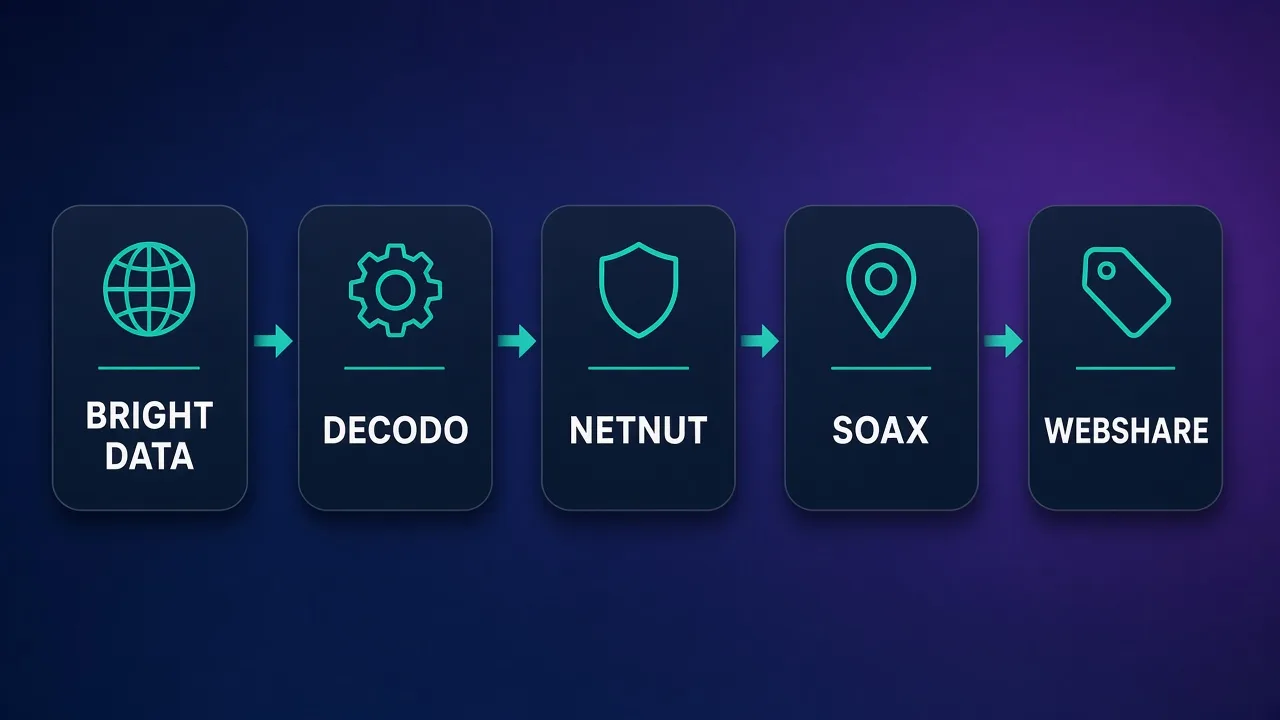
This comparison walks through when leaving Oxylabs makes sense, what to evaluate next, and how Decodo, Bright Data, NetNut, SOAX, and Webshare differ in positioning. We keep commercials on live Proxyaxis cards—no invented list prices, success rates, or pool sizes.
How to use this guide
Treat it as a decision framework. Shortlist two or three alternatives, run the same sticky and throughput tests you used on Oxylabs, then compare live plans on Proxyaxis before you migrate production traffic.
Why teams look for Oxylabs alternatives
Common triggers we hear from operators (qualitative, not a survey claim):
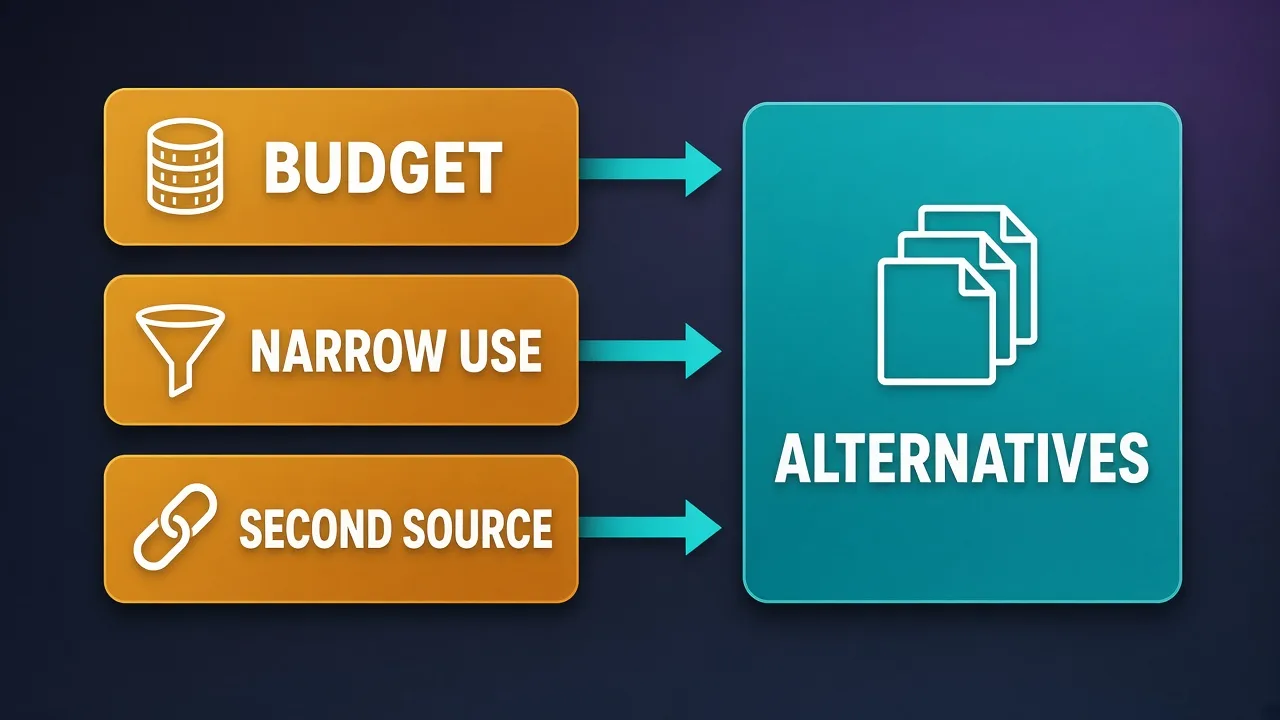
- Budget recalibration — enterprise minimums or unused SKUs outweigh the value of a full platform.
- Narrower use case — you mainly need ISP sticky for accounts, not Web Scraper API + everything else.
- Mid-market preference — faster self-serve onboarding and simpler dashboards.
- Second-source strategy — redundancy if one vendor has regional capacity or quality variance.
- Product-fit mismatch — another vendor’s ISP, mobile, or geo mix simply fits your target sites better.
Leaving a working provider has switching costs: session configs, allowlists, runbooks, and tribal knowledge. Alternatives only win if they beat Oxylabs on the dimension you actually care about—not on a generic “cheaper” headline.
What Oxylabs is optimized for (so you know what you are replacing)
Oxylabs typically shines when you need:
- Large-scale residential or ISP access with enterprise support expectations.
- Scraping-oriented APIs alongside raw proxies.
- Procurement-friendly packaging for larger organizations.
If that still describes you, an “alternative” might really mean a complement—Bright Data for a second enterprise source, or Decodo/SOAX for a cheaper side channel—rather than a full rip-and-replace. Keep the Oxylabs card open while you evaluate:

Oxylabs
Oxylabs is the enterprise provider that gets the fundamentals right. The network is huge and well-maintained, the scraper APIs are genuinely best-in-class, and the documentation and SDKs make integration faster than almost any competitor. What sets it apart from Bright Data is service: dedicated account managers, responsive support, and cleaner tooling mean less time fighting the platform and more time shipping. The cost is higher entry pricing, and the deepest discounts favor high-volume commitments. For serious commercial data operations that can justify the spend, Oxylabs is a top-two choice and frequently the one teams stay with long-term.
Evaluation checklist before you switch
- Workload map — % sticky social vs rotating SERP vs API unlocker-style traffic.
- Must-have geos — countries and cities that blocked your last migration attempt.
- Protocol needs — HTTP vs SOCKS5, sticky TTL length, session syntax your code already uses.
- Compliance posture — KYC, acceptable-use, and whether your vertical is welcome.
- Support path — chat vs ticket vs dedicated manager for production incidents.
- Exit plan — can you dual-run for two weeks with mirrored traffic?
Do not migrate on price alone
A lower sticker can erase itself with higher retry rates, weaker sticky semantics, or support delays. Benchmark success rate and IP stability on your real targets before you cancel Oxylabs.
Bright Data — the enterprise peer alternative
Bright Data is the most common peer when teams want Oxylabs-class breadth with a different product mix or commercial structure. Strengths for switchers: deep proxy lines, unlocking/scraping products, and ecosystem tooling. Trade-offs: still enterprise-shaped; you may recreate the same “platform sprawl” if you only needed a narrow sticky ISP slice.
Choose Bright Data over Oxylabs when you want a true dual-enterprise strategy, need specific Bright Data product lines, or your team already knows that ecosystem. Stay or dual-run if your Oxylabs scraping API workflows are deeply embedded and switching cost dwarfs any gain.
Bright Data
Bright Data remains the most complete data-collection platform money can buy. No competitor matches its combination of network scale, targeting granularity, and compliance tooling — and for enterprise teams whose revenue depends on reliable data, that completeness justifies the premium. The trade-offs are real: it is one of the priciest providers per gigabyte, the interface overwhelms newcomers, and KYC verification adds friction before you can route a single request. Smaller projects will get better value from Decodo or IPRoyal. But if you need city-level residential targeting at scale, a managed unblocker for the hardest targets, and audit-ready compliance, Bright Data is the default — and our highest-rated proxy provider overall.
Bright Data
Proxy
Oxylabs
Proxy
Editor score
User rating
Starting price
Founded
Decodo — mid-market path when you do not need the full enterprise bundle
Decodo is frequently shortlisted by teams who like “serious residential/ISP” without living inside enterprise procurement. Positioning leans mid-market: practical dashboards, proxy types that cover social and scraping, and a lighter feel than the largest platforms.
Choose Decodo when your workload is mostly proxies (not a constellation of data APIs), you want faster self-serve iteration, or Oxylabs feels oversized for your seat count. Pause if you rely on Oxylabs-specific API features that Decodo does not mirror one-for-one—map features before you cut over.

Decodo
Decodo offers the best price-to-performance ratio in the industry. It delivers roughly 90% of what the enterprise leaders provide — high success rates, a large clean pool, sticky sessions, an unblocker — at a fraction of their cost. The dashboard is the friendliest of any major provider, the 14-day money-back guarantee removes the risk of trying it, and support actually responds. The main gaps are enterprise-grade compliance tooling and the very deepest targeting, neither of which most teams need. For startups, solo developers, and any team that wants professional results without enterprise pricing, Decodo is our top value pick and an easy recommendation.
Decodo
Proxy
Oxylabs
Proxy
Editor score
User rating
Starting price
Founded
NetNut — ISP-leaning alternative for stable exits
NetNut often enters the conversation when the pain is less “I need a bigger rotating pool” and more “I need dependable ISP-style exits.” That maps well to account, ad, and monitoring workloads where stickiness and ASN character matter more than country-count marketing.
Choose NetNut when ISP stability is the job-to-be-done and you are willing to evaluate a specialist-leaning stack. Keep Oxylabs (or dual-run) if you still depend on large rotating residential diversity for many targets in parallel.

NetNut
NetNut's direct-ISP architecture is more than marketing — it genuinely delivers steadier, faster sessions than peer-to-peer networks, because it does not depend on consumer devices staying online. That makes it a standout for uptime-critical workloads like brand protection and ad verification, where a dropped session means lost data. The trade-offs are business-oriented pricing, higher minimum commitments, and a dashboard that takes some learning. If session stability is your priority and you operate at business scale, NetNut is one of the most reliable residential networks available and well worth the 7-day trial.
NetNut
Proxy
Oxylabs
Proxy
Editor score
User rating
Starting price
Founded
SOAX — flexible targeting for geo-sensitive workloads
SOAX appeals to operators who care about fine location control and flexible proxy configuration. For teams leaving Oxylabs because geo precision or mid-market packaging matters more than the biggest enterprise brand, SOAX is a natural trial.
Choose SOAX when city-level or flexible targeting is central, and you want a vendor that feels adaptable for mixed social + data tasks. Validate first if your Oxylabs setup leans heavily on a particular API product—raw proxy alternatives are not automatic API replacements.

SOAX
SOAX is the targeting specialist. City- and ISP-level selection on every plan — not locked behind premium tiers — is genuinely rare, and the continuously cleaned pool keeps success rates high where it matters. It is not the fastest network, the interface could use a refresh, and SOCKS5 coverage is uneven. Those are real but minor gripes against a provider that nails the fundamentals of precision and reliability. For ad verification, localized market research, and social-media work that depends on appearing in an exact location, SOAX is one of the best mid-market options available.
SOAX
Proxy
Oxylabs
Proxy
Editor score
User rating
Starting price
Founded
Webshare — budget and self-serve alternative (with clear limits)
Webshare is not an Oxylabs clone. It is a self-serve, often budget-friendly provider that can replace parts of a stack—datacenter pools, lighter residential experiments, or internal tools—especially when Oxylabs was never the right size for that traffic.
Choose Webshare when you are carving out low-risk or cost-sensitive workloads and can accept a different quality envelope. Do not assume it is a drop-in for Oxylabs enterprise residential/ISP on hard targets without a rigorous bake-off.

Webshare
Webshare is the developer's self-service favorite. Instant activation, a free tier that is actually free, and the cheapest fast datacenter proxies in the market make it the easiest provider to just start using. The custom plan builder — pick your IP count, bandwidth, and threads — is a genuinely good model that lets you avoid paying for capacity you do not need. The residential pool is newer and less battle-tested than specialists, and support is thin on the lower tiers. For datacenter proxies, API-driven workflows, and anyone who wants to try before paying, Webshare is one of the best-value options around.
Webshare
Proxy
Oxylabs
Proxy
Editor score
User rating
Starting price
Founded
Other names worth a glance
Depending on your vertical, you may also trial IPRoyal for approachable sticky/residential testing, or Proxy-Seller when static catalogs dominate. Neither is a full enterprise twin of Oxylabs; both can cover niches in a multi-vendor design.

IPRoyal
IPRoyal is the best pure pay-as-you-go deal in proxies. Non-expiring traffic is a genuinely customer-friendly policy that no major rival matches — buy what you need, use it whenever, lose nothing. The pool is smaller than the premium networks and success rates can soften on the most heavily defended targets, so high-volume enterprise scraping is not its strength. The dashboard is also fairly basic. For intermittent scraping, account work, and sneaker copping on a predictable budget, IPRoyal is an easy recommendation and one of the best value picks for occasional users.

Proxy-Seller
Proxy-Seller is excellent value if you want fixed, dedicated IPs instead of metered bandwidth. Per-IP pricing from $1.30 with unlimited bandwidth, flexible rental terms, and unusually cheap IPv6 make it a smart choice for account management and SEO. It is not the place for large rotating-residential workloads — the per-IP model does not scale to mass scraping that needs thousands of fresh addresses. The dashboard is also plain and functional rather than polished. But for stable, dedicated identities at a low cost, backed by 24/7 support, Proxy-Seller is one of the better dedicated-proxy specialists around.
Comparison table: which alternative fits which exit reason
| Exit reason | First alternative to trial | Also consider | Keep Oxylabs if… |
|---|---|---|---|
| Need enterprise peer / dual source | Bright Data | Stay multi-homed with Oxylabs | Single-vendor simplicity matters more |
| Mid-market pricing & UX | Decodo | SOAX | Procurement already standardized on Oxylabs |
| ISP / stable exits focus | NetNut | Proxy-Seller static lines | Rotating residential diversity is still core |
| Fine geo control | SOAX | Bright Data targeting | Your geos already perform well |
| Budget carve-out | Webshare | IPRoyal | Hard targets need premium pools |
Migration playbook (minimize downtime)
- Inventory configs — list every Oxylabs endpoint, sticky syntax, geo, and consuming service.
- Pick a pilot workload — one geo + one traffic class (e.g., sticky ISP for social only).
- Dual-run — send mirrored or canary traffic to the alternative for several days.
- Compare — success rate, latency, sticky integrity, support responsiveness (your metrics, not marketing slides).
- Cut over in stages — never flip every production job on the same afternoon.
- Keep a rollback path — Oxylabs credentials stay warm until the alternative is boringly stable.
Sticky syntax tip
Session ID formats differ by vendor. Abstract “create sticky session / bind geo” behind a small internal helper so application code does not hard-code Oxylabs username patterns forever.
Pricing posture without fabricated numbers
Oxylabs and Bright Data generally present as premium/enterprise. Decodo and SOAX often compete as more approachable mid-market platforms. NetNut is frequently evaluated on ISP value. Webshare competes on self-serve affordability. Exact dollars change—use live cards:
Bright Data
Proxy
Decodo
Proxy
Editor score
User rating
Starting price
Founded
SOAX
Proxy
NetNut
Proxy
Editor score
User rating
Starting price
Founded
Ask every vendor how they bill sticky ISP versus rotating residential, what happens on idle IP time, and whether unused commitments roll. Those mechanics matter more than a single GB sticker.
For a deeper Bright Data commercial breakdown (still without invented prices), see Bright Data pricing explained. For the head-to-head with Oxylabs, read Bright Data vs Oxylabs.
Feature gaps to watch when leaving Oxylabs
- Web Scraper / Unlocker-style APIs — raw proxies are not the same product; you may need Bright Data or another API vendor if that was your Oxylabs centerpiece.
- Compliance documentation — enterprise security questionnaires may be thinner at mid-market vendors; start early if your legal team is involved.
- Subnet reputation variance — a “cheaper” residential GB can cost more in captchas; measure on your targets.
- Support hours and language — match them to when your on-call engineers actually page people.
- Sub-account and team RBAC — agencies need this; hobby plans often do not.
Who should not leave Oxylabs yet
Stay put (or only add a small complement) if:
- Your success rates on hard targets are already good enough that migration risk exceeds savings.
- You are deep into Oxylabs APIs with custom parsing pipelines.
- Your procurement cycle just finished and switching would restart security review for little gain.
- You lack engineering time to dual-run and measure properly.
Alternatives are tools, not trophies. The winning architecture is often Oxylabs + one specialist, not a dramatic breakup announcement.
Practical shortlists by team type
| Team type | Shortlist | Why |
|---|---|---|
| Enterprise data org | Bright Data (+ keep Oxylabs) | Peer capability, dual-source resilience |
| Growth / anti-detect agency | Decodo, SOAX, NetNut | Sticky/ISP focus, mid-market UX |
| Startup scraping SERPs | Decodo, Webshare (careful), SOAX | Iterate fast; upgrade when targets harden |
| Static social accounts | NetNut, Proxy-Seller, Decodo | Stable exits over giant rotating pools |
Related reading for social sticky patterns: best proxies for TikTok automation and best proxies for Discord.
API-centric vs proxy-centric stacks
One of the easiest ways to pick the wrong Oxylabs alternative is to ignore whether your production path is API-centric or proxy-centric.
- API-centric teams call a scraping or unlocking API, receive parsed or browser-rendered results, and rarely touch raw proxy strings. For them, Bright Data’s comparable product lines (or staying on Oxylabs) usually beat a pure residential reseller.
- Proxy-centric teams inject host:port:user:pass into browsers, scrapers, or anti-detect profiles. For them, Decodo, SOAX, NetNut, IPRoyal, and Proxy-Seller are more natural comparison sets—evaluate sticky syntax and subnet quality first.
Hybrid orgs should split the bill intentionally: keep an enterprise API where it earns its keep, and move sticky social or simple fetch jobs to a mid-market proxy vendor. That split is how you avoid paying enterprise rates for traffic that never needed enterprise APIs.
Quality signals to measure in every bake-off
Run the same scripted checks against Oxylabs and each alternative for at least a few business days:
- Sticky integrity — same session key, same IP across reconnects for your required TTL.
- Target success — HTTP 200 / challenge rate on your real domains (not only ipinfo-style checkers).
- Latency distribution — p50 and p95, not just a single ping.
- Subnet diversity — are you stuck on one ASN that a target already rate-limits?
- Replacement speed — how fast can support or self-serve swap a burned IP?
- Dashboard honesty — do usage meters match your client-side counters?
Write the results in a shared sheet. Vendors will happily provide demo numbers; your bake-off is the only dataset that matters for a migration decision.
Challenge pages are data
A rise in captchas after switching is not “bad luck”—it is a quality signal. Budget time to tune geos and session lengths before you declare the alternative a failure or a win.
Contract and ops questions procurement should ask
- What is the minimum commitment, and can unused traffic roll over?
- Are ISP and residential billed with different unit economics?
- Is there a sandbox or trial large enough to simulate production concurrency?
- Who is on-call for regional outages, and in which hours?
- Can you create isolated sub-accounts per customer or brand?
- What acceptable-use rules apply to social platforms and authenticated sessions?
If a vendor cannot answer these clearly, treat that as a risk score—especially when you are leaving Oxylabs partly for better operational clarity.
Finally, document your decision: which workloads stayed on Oxylabs, which moved, and what metrics justified the split. Future you—and your finance team—will want that paper trail when renewals come around.
Conclusion
The best Oxylabs alternative is the one that matches why you are leaving. Bright Data is the enterprise peer; Decodo and SOAX cover mid-market flexibility; NetNut leans ISP stability; Webshare (and similar) carve out budget workloads. Verify every slug’s live plan on Proxyaxis, dual-run before cutover, and do not confuse a lower invoice with a higher success rate. Keep Oxylabs in the mix when it still earns its seat—multi-vendor is a strategy, not a failure.
Frequently asked questions
It depends on why you are switching. Bright Data is the usual enterprise peer. Decodo and SOAX suit mid-market teams. NetNut is often tried for ISP-focused stability, and Webshare for budget or self-serve carve-outs. Compare live plans on Proxyaxis after a real traffic bake-off.
Consider leaving or dual-sourcing when enterprise packaging exceeds your needs, you only require a narrow sticky ISP slice, you want a second vendor for resilience, or another provider clearly wins on your geos. Do not switch on sticker price alone without measuring success rates.
Neither is universally better. Bright Data and Oxylabs are peer enterprise platforms with different product mixes and commercials. Choose based on the lines you will actually use, support expectations, and measured performance on your targets—not brand preference.
Decodo is a strong mid-market alternative when you want serious residential or ISP proxies without a full enterprise bundle. Map any Oxylabs API features you rely on before cutover, because raw proxy platforms are not automatic API replacements.
Sometimes for lighter or cost-sensitive workloads, but it is not a drop-in enterprise replacement. Treat Webshare as a carve-out or experiment lane unless bake-offs show it meets your hard-target success and sticky requirements.
Inventory every endpoint and sticky syntax, pilot one workload, dual-run canary traffic, compare your own success and latency metrics, then cut over in stages. Keep Oxylabs credentials ready until the alternative is stable.
SOAX is often evaluated when flexible or fine-grained geo control matters and mid-market packaging is preferred. Validate your critical cities and sticky behavior in a trial rather than assuming parity with Oxylabs’ full enterprise footprint.
Often yes. Many teams keep Oxylabs for proven hard targets and add Decodo, SOAX, NetNut, or Bright Data for other lanes. Multi-vendor designs reduce single-provider risk if you abstract session configuration in your code.