Table of contents
Multilogin has been the reference antidetect browser for years, and for a long time it was also the expensive one. That reputation is why "Multilogin alternatives" is such a common search. But the 2026 picture is more nuanced than "Multilogin is pricey, so switch." Its current plans are much cheaper than many people remember, its Firefox-based engine has been retired to legacy status, and it now bundles cloud phones, proxy traffic and mobile minutes into every paid tier. So the right alternative depends less on price alone and more on why you want to leave.
This guide maps the most credible alternatives (GoLogin, AdsPower, Dolphin Anty, Octo Browser, Kameleo, MoreLogin and Incogniton) to the five reasons people actually give for switching: price per profile, the automation API, team seats, a maintained Firefox engine, and no-code RPA. All plan and price facts below were checked on each vendor's official pricing page on November 1, 2026. Antidetect pricing changes often and promotions come and go, so treat every figure as a snapshot and confirm on the vendor's site before you buy.
How we compared these tools
We read each vendor's live pricing and documentation on November 1, 2026 and compared what you get at a similar profile count: browser engines, API access and rate limits, included team seats, automation tooling and free tiers. We don't quote detection-test scores, because results depend on your proxy, your target sites and your behaviour. A great fingerprint paired with a poor IP will still get flagged.
Why people look for Multilogin alternatives in 2026
Multilogin's product is mature: isolated browser profiles, hardened automation for Selenium, Puppeteer and Playwright, a CLI, team permissions, and now Android cloud phones in the same dashboard. People rarely leave because it doesn't work. They leave because of fit. The common reasons we see:
- Price per profile at their scale. Someone who needs 300 or 1,000 profiles compares the total monthly bill against tools priced with a profile slider.
- Paying for bundles they don't use. Every paid Multilogin tier now includes premium proxy traffic and cloud-phone minutes. That's useful if you need them and just overhead if you bring your own proxies and only work in the browser.
- Automation limits. API access starts on Pro, with published request limits of 50 to 100 requests per minute on Pro tiers. Scraping and QA teams running many headless sessions often want higher limits or SDK-first tooling.
- Team seats. Pro tiers include one or two seats, and unlimited seats begin on Business. Small agencies with four or five operators feel that jump.
- Firefox. Multilogin's Firefox-based core, Stealthfox, became legacy in January 2026 and is frozen at core version 146, per Multilogin's own help center and release notes. If your workflow depends on Firefox fingerprints or add-ons, you need a maintained Firefox engine elsewhere.
- No-code automation. Some teams want a visual RPA builder rather than writing scripts against an API.
Keep your own reason in mind as you read. A tool that's "cheaper" on paper can cost more once you add seats, API headroom or a second subscription to cover a missing feature.
Multilogin's current pricing: the baseline to beat
Before comparing alternatives, it helps to know what you're comparing against. On November 1, 2026, Multilogin's pricing page listed:
- Free: 5 cloud-only profiles, a one-time 200 MB of proxy traffic and 30 cloud-phone minutes. No API access.
- Pro 10 / 20 / 50: $11, $19 and $29 per month billed monthly, or $7.08, $12.42 and $19.17 per month billed annually (Multilogin advertises 35% off for yearly billing). Pro includes API access, with 1, 2 and 2 team seats respectively, plus monthly proxy traffic and mobile minutes.
- Business: from $40 per month billed monthly for 100 profiles ($26.67 per month annually), rising through tiers such as 300 profiles at $89, 500 at $115 and 1,000 at $185 per month on monthly billing. Business adds unlimited team seats, advanced team management and custom API rate limits.
That is a big change from the days when Multilogin's entry plan cost far more than most rivals. At 10 to 100 profiles it is now competitive with, and sometimes cheaper than, the tools usually pitched as "cheaper alternatives." The honest takeaway: switch for a specific capability or pricing shape that suits you better, not because of an outdated assumption that Multilogin is always the expensive option. For a head-to-head breakdown, see our GoLogin vs Multilogin comparison and Multilogin vs AdsPower.
Multilogin alternatives compared side by side
The table summarises entry pricing and the features that usually decide a switch. "From" prices are the lowest paid tier shown on monthly billing unless noted. Most vendors discount longer billing periods.
| Browser | Free tier (Nov 1, 2026) | Paid entry point | Engines | API / automation | Best reason to switch |
|---|---|---|---|---|---|
| Multilogin (baseline) | 5 cloud profiles | $11/mo (10 profiles) | Mimic (Chrome); Stealthfox legacy | API from Pro, 50–100 RPM; CLI | n/a |
| GoLogin | 3 profiles | $9/mo (10 profiles); 50% off shown for annual | Chromium-based | REST API, 300–1,200 RPM by plan | Large profile counts, cloud launches |
| AdsPower | 2 profiles + 7-day trial | Profile-slider pricing; check site | Chrome and Firefox | Local API 300–1,500 RPM; RPA robot | No-code RPA, Firefox |
| Dolphin Anty | Up to 3 profiles | $10/mo Starter (from 20 profiles) | Chrome or Firefox | Remote API 1,500 RPM on paid; scenario builder | Affiliate/ads teams, flat API limit |
| Octo Browser | No free plan; 2-day trial code | €10/mo Lite (3 profiles); €29 Starter | Chromium-based | API from Base, 50–200 RPM | Fingerprint-focused teams |
| Kameleo | 2 concurrent browsers, unlimited local profiles | €59/mo Startup | Chroma (Chromium) and Junglefox (Firefox) | Local API, Python/JS/C# SDKs, Docker, headless | Automation, scraping, Firefox |
| MoreLogin | 2 profiles, 2 users | $9/mo Pro (10 profiles); 40% off yearly | Chromium and Firefox | Local API, Selenium/Puppeteer | Low entry cost, cloud phones |
| Incogniton | 10 profiles for 2 months, then 3 | $19.99/mo Starter Plus (10 profiles) | Chromium-based | REST API + Selenium/Puppeteer from Entrepreneur | Generous trial, simple tiers |
The cheapest-looking column rarely tells the full story. Octo's Lite plan, for example, is cheap but small and has no API. Dolphin's Starter is inexpensive, but its fixed-profile Base plan jumps to $89 for 100 profiles. Read across the whole row before deciding.

Multilogin
Browser

GoLogin
Browser
Editor score
User rating
Starting price
Founded
Match the alternative to your reason for leaving
Use this quick decision map, then read the detailed picks below:
- "I pay too much per profile at scale": compare GoLogin's large tiers, AdsPower's profile slider and Dolphin's Team and Enterprise plans against Multilogin Business at your exact count.
- "I need a better automation API": Kameleo (SDKs, Docker, headless with the same fingerprint) or GoLogin (high REST rate limits).
- "I need more team seats without jumping tiers": Octo Browser's Team plan (3 members, expandable to 6), Incogniton Professional (3 seats) or Dolphin's paid add-on users.
- "I need Firefox": Kameleo's Junglefox, AdsPower, Dolphin Anty or MoreLogin, all of which list Firefox-based browsers.
- "I want automation without code": AdsPower's RPA robot or Dolphin's scenario builder. Synchronizers in Incogniton and MoreLogin cover simpler "mirror my clicks" needs.
The best Multilogin alternatives, one by one
Each pick below explains who it suits and where it falls short. The live cards show current listings from our database.
GoLogin: best for scaling to hundreds or thousands of profiles
GoLogin's pricing is built around profile volume. On November 1, 2026 its page showed a Professional plan from $9 per month for 10 profiles (with a slider up to 100), Business at $99 for 300 profiles, Enterprise at $179 for 1,000 and Custom from $279 for 2,000 or more. Annual billing was shown at a 50% discount. A free plan with 3 profiles is also available. REST API limits scale from 300 to 1,200 requests per minute across plans, well above Multilogin's published Pro limits. GoLogin also offers cloud launches and an Android app for checking profiles on the go.
The trade-off: GoLogin's per-profile cost is excellent at high counts, but Multilogin's Business 1,000 tier ($185 per month on monthly billing) is now in the same range as GoLogin Enterprise at list price. Compare at your exact count and billing period. Our GoLogin vs Multilogin guide covers fingerprint and workflow differences in depth.
GoLogin
GoLogin is the best-value anti-detect browser going, pairing a genuinely useful forever-free tier with entry plans that include 100+ profiles for $24/month. It cedes a little ground to Multilogin on granular team permissions and to Octo on outright stealth, and its free bundled proxies are low quality — but as an accessible, cross-platform, cloud-or-desktop workhorse it is hard to fault.
AdsPower: best for no-code RPA and Chrome plus Firefox
AdsPower is the go-to for teams that want automation without writing scripts. Its pricing page lists an RPA robot with customizable workflows, a Synchronizer for mirroring actions across profiles, and a Local API whose limits rise from 300 to 900 to 1,500 requests per minute by tier. It offers both Chrome- and Firefox-based stealth browsers, which matters now that Multilogin's Firefox core is frozen.
Pricing is configured with a profile slider (Professional at 10, 20, 50 or 100 profiles, then Business, then Enterprise from 5,000 profiles on request), plus 2 free profiles and a 7-day trial. The live price depends on your slider settings and billing period, so check adspower.com rather than relying on a quoted figure. See Multilogin vs AdsPower for a detailed comparison.

AdsPower
AdsPower delivers remarkable feature-per-dollar: dual Chromium/Firefox engines, a genuine no-code RPA robot, team roles, a free 5-profile tier, and plans from around $5.40/mo. The trade-offs are a cluttered, learning-curve interface and support that leans to Asian time zones, but for cost-conscious e-commerce and ad teams it's hard to beat.
Dolphin Anty: best for affiliate and ads teams who want a flat API limit
Dolphin Anty grew up in the affiliate-marketing world, and it shows in features like bulk proxy assignment, a scenario builder, a Synchronizer and proxy spam-database checks. On November 1, 2026 its plans were: Free (up to 3 profiles, no API), Starter at $10 per month for 20 profiles (adjustable up to 60), Base at $89 for 100 profiles, Team at $159 for 300 and Enterprise at $299 starting at 1,000 profiles. Extra users cost $10, $20 or $25 each depending on the tier, and 12-month billing is shown at 40% off.
A notable detail: every paid tier lists the same 1,500 requests-per-minute remote API limit, so you don't have to upgrade just for API headroom. The weakness is the gap between Starter and Base. If you need 61 to 100 profiles, the bill jumps sharply.
Dolphin Anty
Dolphin Anty is one of the most polished choices for affiliate and paid-social teams, pairing a genuinely useful 10-profile free tier with warming automation and bulk proxy tools that were clearly built by people who run ad accounts. Just weigh its Russian origins against your vendor policy, and know that its strengths are wasted if your work isn't media buying.
Octo Browser: best for teams that prioritise fingerprint quality
Octo Browser focuses on fingerprint consistency and offers a built-in proxy shop. Its November 1, 2026 tiers: Lite at €10 per month (3 profiles), Starter from €29 (10 profiles), Base from €79 (100 profiles), Team from €169 (350 profiles, 3 team members, expandable to 6) and Advanced from €329 (1,200 profiles, 8 members, expandable without limit). API access starts at Base with 50 requests per minute, rising to 200 on Advanced and up to 1,000 with add-ons. Discounts are 10%, 20% and 30% for 3, 6 and 12 months. There's no permanent free plan, but the promo code TRIAL gives new users a 2-day Starter trial.
Octo is rarely the cheapest option. Teams choose it because they've had good results with its fingerprints and want clean team roles at mid-scale. Prices are in euros and exclude VAT.

Octo Browser
Octo is one of the most stealth-focused and stable anti-detect browsers on the market, with real-device fingerprints and an update cadence measured in days rather than weeks. The trade-offs are a higher entry price with no free plan and lighter built-in automation than AdsPower — but if undetectability and a clean, sharable app are your priorities, it's hard to beat.
Kameleo: best for developers, scraping and a maintained Firefox engine
Kameleo is the most developer-oriented alternative here. It ships two custom browser kernels: Chroma (Chromium-based, with new builds promised within 5 days of each stable Chrome release) and Junglefox (Firefox-based, updated every two months). It provides a Local API with official SDKs for Python, JavaScript and C#, headless mode with the same masking as headed mode, and official Docker images for Linux and Windows. Your existing Selenium, Puppeteer and Playwright scripts can connect through its WebSocket endpoint.
Its pricing model is different. Kameleo limits concurrent browsers, not stored profiles. Local profiles are unlimited on every plan. The Free plan allows 2 concurrent browsers, 100 cloud profiles and 300 minutes of browser time. Startup is €59 per month (unlimited usage time and team members, 5,000 cloud profiles), Business €299 and Enterprise €1,499, with lower prices shown for annual billing. If you store thousands of profiles but only run a few at a time, this model can work out much cheaper. If you run many sessions in parallel, it may not.

Kameleo
Kameleo is the go-to when you genuinely need to look like a phone: its real Android and iOS profiles and four-engine coverage are unmatched, and its Selenium/Puppeteer/Playwright automation suits serious pipelines. The catches are that the desktop app is Windows-only and there's no free plan, so you commit before you can trial it fully.
MoreLogin: best low-cost entry with Chromium and Firefox
MoreLogin's Free plan includes 2 profiles and 2 users, with both Chrome and Firefox kernels, a local API and Selenium/Puppeteer automation. Its Pro plan was listed at $9 per month for 10 profiles on November 1, 2026, or $5.40 per month with the 40% yearly discount. Profile and user counts are customisable, and the price updates as you add them. MoreLogin also sells Android cloud phones billed at $0.006 per minute (capped at $1.50 per day) or $23 to $25 per 30 days, a rough counterpart to Multilogin's bundled cloud phones.
It's a sensible pick for solo operators and small teams who want Firefox and an API without a big commitment. As with any lower-cost tool, test it against your own target sites before migrating important accounts.

MoreLogin
MoreLogin is the value pick: a permanent 2-profile free tier, plans from $9/mo, dual Chromium/Firefox engines, and a surprising cloud-phone feature make it one of the cheapest ways to run a lot of profiles. Its automation and mobile authenticity are lighter than premium rivals, so heavy technical users may outgrow it, but budget-focused multi-accounters get remarkable mileage.
Incogniton: best for a long free trial and simple tiers
Incogniton has one of the most generous trials: 10 browser profiles free for the first 2 months, after which the free plan drops to 3. Paid tiers on November 1, 2026: Starter Plus at $19.99 per month (10 profiles), Entrepreneur at $29.99 (50 profiles, REST API, Selenium/Puppeteer, Cookie Collector, Synchronizer), Professional at $79.99 (150 profiles, 3 team seats) and Custom from $149.99 (500+ profiles, 10 seats). Six-month billing saves 30% and yearly billing 40%. All plans list free built-in proxies.
The catch: automation and profile transfer start on Entrepreneur, and team management on Professional. Starter Plus suits manual work only. Incogniton is Chromium-based and doesn't advertise a Firefox engine, so it won't solve a Firefox requirement.

Incogniton
Incogniton is the easy-to-learn option: a gentle interface, a generous 10-profile free plan, cloud sync, cookie collection, and handy touches like OCR paste-as-typing make everyday multi-accounting painless. Its core updates land more slowly than faster rivals and it sticks to desktop Chromium, so power users chasing the latest fingerprinting or mobile profiles may want more.
Promotions distort comparisons
Several vendors showed discounted or "billed annually" figures next to monthly list prices on November 1, 2026. Always compare the same billing period across tools, and check whether a headline price assumes a 6- or 12-month prepayment you may not want.
If you need a Firefox engine
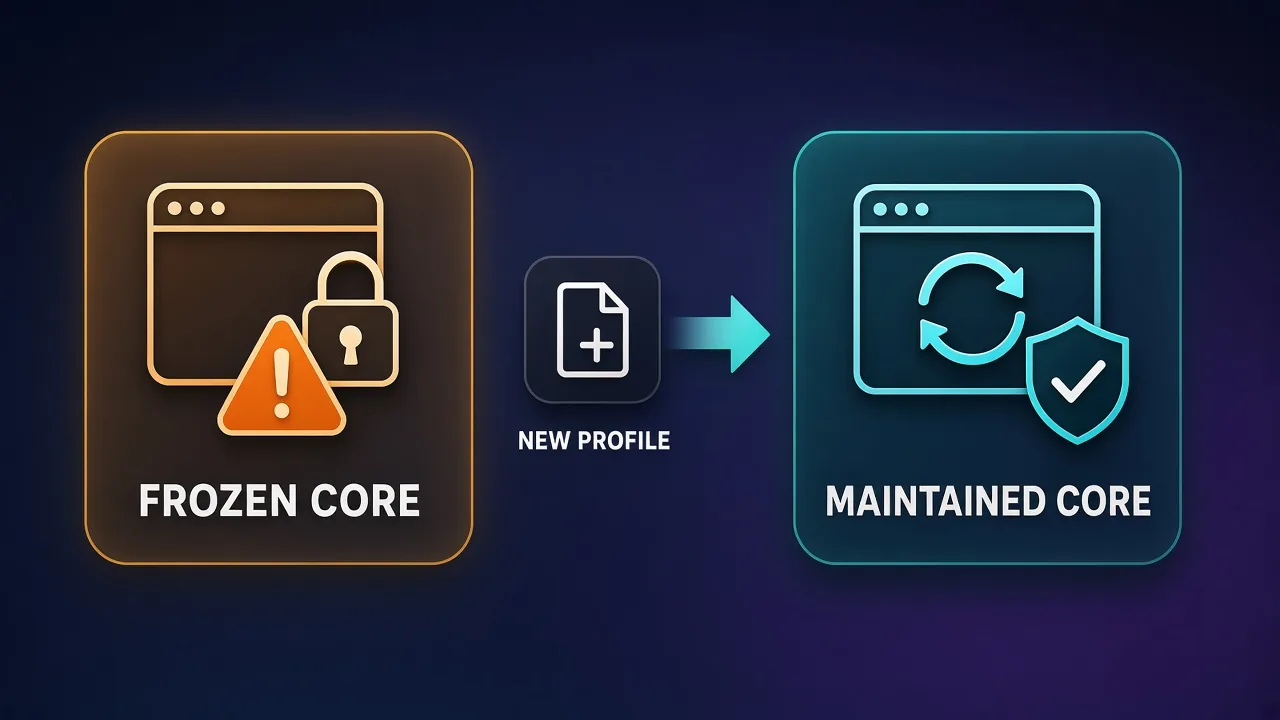
This is the most concrete reason to leave Multilogin in 2026. According to Multilogin's release notes, Stealthfox became legacy on January 27, 2026, and its help center says it stays on its final core version 146 with no further core updates or fixes. Existing Stealthfox profiles still launch, but you can't convert a profile between Mimic and Stealthfox. Switching cores means creating a new profile.
A frozen browser core gets riskier over time. Real Firefox users keep updating, so a profile stuck on an old version increasingly stands out, and sites gradually drop support for older browser versions. If your accounts were built on Firefox fingerprints, or you rely on Firefox add-ons, you have three practical options:
- Kameleo Junglefox: a dedicated Firefox-based kernel with a published update cadence and Playwright support for Firefox-based work.
- AdsPower or Dolphin Anty: both list Chrome and Firefox engines inside a more marketing-oriented profile manager.
- MoreLogin: lists Chromium and Firefox kernels from the free plan up.
Whichever you choose, check the vendor's changelog for how recently its Firefox core was updated. A Firefox option is only useful if someone maintains it.
If the automation API is the reason
For scraping, QA and account-farming at scale, what matters is how well the tool fits into your code. Three things to compare:
- Rate limits. Multilogin publishes 50, 75 and 100 requests per minute on Pro 10, 20 and 50, with custom limits on Business. GoLogin lists 300 to 1,200 RPM, Dolphin 1,500 RPM on every paid tier, AdsPower 300 to 1,500 RPM, and Octo 50 to 200 RPM before add-ons. Kameleo publishes 60 to 1,200 RPM, but those limits apply only to fingerprint search, profile creation and profile start. Its other local endpoints are unlimited.
- Driver support. Most tools support Selenium and Puppeteer. Playwright support varies, so check each vendor's docs for your framework and engine. Multilogin's own docs note that Stealthfox supports Selenium and Puppeteer only.
- Deployment. If you run on servers, Kameleo's official Docker images and headless mode are a real advantage. GUI-first tools can be automated but often expect a desktop session.
If you write code, Kameleo or GoLogin are the strongest fits. If you prefer recorded flows, skip ahead to RPA.
Test with your real workload
Before you switch, run your actual script against 10 to 20 profiles on the free or trial tier for a few days. Measure launch time, memory per browser, error rates and how often your target sites challenge you. That tells you more than any feature table, including this one.
If team seats are the reason
Seat pricing is easy to overlook until the invoice arrives. Multilogin includes 1 seat on Pro 10 and 2 on Pro 20 and Pro 50, then unlimited seats from Business (from $40 per month for 100 profiles on monthly billing). For many small agencies, Multilogin Business is actually a strong deal on seats. Alternatives are worth a look when your seat needs and profile needs don't line up:
- Octo Browser Team includes 3 members (expandable to 6) and 350 profiles. Advanced includes 8 members with unlimited expansion.
- Incogniton Professional includes 3 seats with 150 profiles. Custom plans start with 10 seats.
- Dolphin Anty lets you add users to Base, Team and Enterprise for $10 to $25 each.
- Kameleo includes 3 team members on Free and unlimited team members from Startup, with role-based access and a session lock that stops two people from opening the same cloud profile at once.
- MoreLogin includes 2 users on Free and lets you add users on Pro.
Also check permission granularity: per-profile sharing, folder access, audit logs, and whether passwords and proxies stay hidden from operators. Those controls matter more than the raw seat count when contractors handle client accounts.
If you want no-code RPA
Multilogin is strongest when driven through its API. If your team doesn't code, look at tools with built-in visual automation:
- AdsPower has the most developed RPA here, with a robot and customizable workflows that cover routine tasks like logging in, scrolling feeds or posting.
- Dolphin Anty includes a scenario builder on paid plans, plus a Synchronizer for mirroring actions across profiles.
- Incogniton (Entrepreneur and up) and MoreLogin include synchronizers, which repeat your manual actions across many profiles. That's simpler than full RPA but often enough.
Be careful with automation intensity. RPA makes it easy to repeat identical actions across many accounts at once, and that pattern is exactly what platform anti-abuse systems look for, whatever your fingerprint. Add randomness and pacing, and respect each platform's terms of service.
How to migrate off Multilogin without losing accounts
Switching browsers is where accounts get lost. An established account suddenly appearing with a new device fingerprint and new cookies can trigger re-verification. A careful migration looks like this:
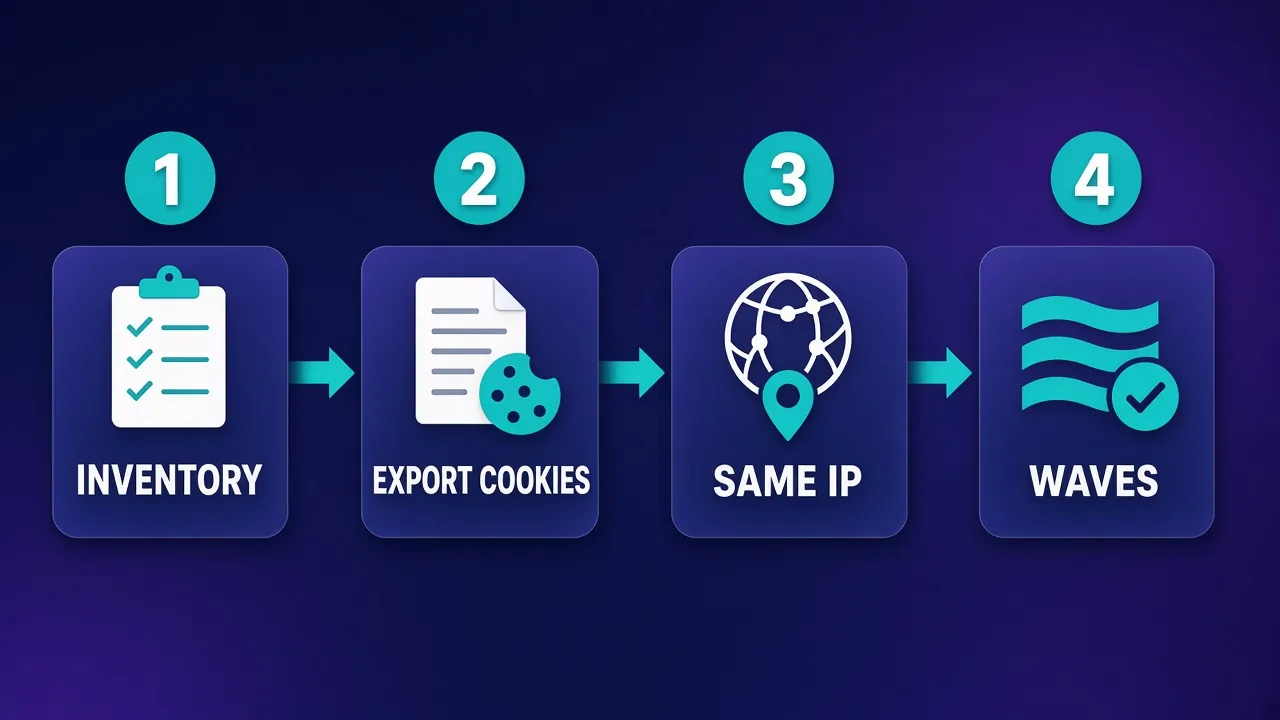
- Inventory first. Export a list of profiles with their proxy, OS, engine, time zone and the accounts each one holds.
- Export cookies and data where Multilogin and the destination tool support it. Multilogin lists profile export/import, and several alternatives (Kameleo, Dolphin Anty, Incogniton) support cookie import. Dolphin lists direct "one-to-one profile import from other antidetects" as coming soon, so don't count on it yet.
- Keep the same IP per account. The proxy is the strongest identity signal. Move each account with its existing static or sticky IP rather than assigning a new one at the same time.
- Match the fingerprint family. Recreate the profile with the same OS and browser family. A Windows/Chrome account shouldn't suddenly become macOS/Firefox. For Stealthfox accounts, move to a maintained Firefox engine.
- Migrate in waves. Start with low-value accounts, watch for a week, then move the rest.
- Run both tools briefly. Overlap subscriptions for one billing cycle so you can roll back if a batch has problems.
For proxies, choose a provider that documents how it sources residential IPs and has a clear abuse policy. Our guide to the best antidetect browsers covers proxy pairing in more detail.
Pitfalls: what "cheaper" doesn't buy you
Low sticker prices can hide real costs. Watch for these:
- Fixed profile caps. Some plans can't buy extra profiles (Dolphin's Base and Team say so explicitly), so growth forces a tier jump.
- Features gated by tier. API access, profile transfer and team roles often start one or two tiers above the entry plan. Price the tier you'll actually need.
- Concurrency vs storage. Kameleo charges for concurrent browsers, while most others charge for stored profiles. Make sure you compare the same thing.
- Bundled extras you'd buy anyway. Multilogin includes proxy traffic and cloud-phone minutes in paid plans. If you'd otherwise pay for those separately, its effective price is lower than it looks.
- Update cadence. An antidetect browser that lags browser releases becomes easier to detect over time. Check release notes, not just marketing pages.
- Proxy sourcing risk. A browser can't protect accounts sitting on flagged or unethically sourced IPs. Avoid networks with documented legal or abuse problems.
Bottom line: which Multilogin alternative should you choose?
In 2026, Multilogin is no longer the obvious "expensive" choice. Its Pro and Business tiers are competitive, especially once you count bundled proxy traffic, cloud phones and unlimited Business seats. The best reasons to switch are specific:
- Volume pricing at hundreds or thousands of profiles: compare GoLogin, AdsPower and Dolphin Anty at your exact count.
- Code-first automation and servers: Kameleo, with GoLogin as a high-rate-limit REST option.
- Team structure at mid-scale: Octo Browser or Incogniton Professional.
- A maintained Firefox engine: Kameleo Junglefox, or the Firefox options in AdsPower, Dolphin Anty and MoreLogin.
- No-code RPA: AdsPower, then Dolphin Anty.
- Lowest-commitment start: MoreLogin or Incogniton's two-month trial.
Shortlist two tools that match your reason for leaving, run your real workflow on their free or trial tiers, and migrate in waves. For the full field, including options not covered here, see our roundup of the best antidetect browsers.
Frequently asked questions
It depends on why you are leaving. GoLogin and AdsPower suit high profile counts, Kameleo suits developers and scraping, AdsPower suits no-code RPA, and Octo Browser suits mid-sized teams. Shortlist two tools that match your reason and test them on free or trial tiers.
Sometimes, but not always. On November 1, 2026 Multilogin Pro started at $11 per month for 10 profiles on monthly billing, which is competitive. Alternatives like MoreLogin ($9 for 10 profiles) or GoLogin's large tiers can be cheaper at specific profile counts, so compare at your exact count and billing period.
Only as a legacy option. Multilogin's Firefox-based Stealthfox core became legacy in January 2026 and is frozen at core version 146, so new profiles should use the Chrome-based Mimic. If you need a maintained Firefox engine, look at Kameleo Junglefox, AdsPower, Dolphin Anty or MoreLogin.
Kameleo is the most developer-focused, with official Python, JavaScript and C# SDKs, Docker images and headless mode. GoLogin offers high REST API limits of 300 to 1,200 requests per minute by plan, and Dolphin Anty lists 1,500 requests per minute on every paid tier.
Several alternatives have free plans: GoLogin and Dolphin Anty offer 3 profiles, AdsPower and MoreLogin offer 2, and Kameleo's free plan allows unlimited local profiles with 2 concurrent browsers. Incogniton gives 10 profiles free for the first two months, then 3. Multilogin itself also has a free plan with 5 cloud profiles.
Not as a one-click transfer in most cases. Export cookies and profile details, recreate each profile with the same OS, browser family and proxy in the new tool, then import cookies. Migrate low-value accounts first and keep both subscriptions for a short overlap in case you need to roll back.
Octo Browser's Team plan includes 3 members (expandable to 6), Incogniton Professional includes 3 seats, and Kameleo includes unlimited team members from its Startup plan. Note that Multilogin Business also includes unlimited seats from 100 profiles, so compare total cost, not just seat count.
Yes. An antidetect browser isolates fingerprints and cookies, but every profile still needs its own clean IP that matches the profile's location. Choose a proxy provider that documents how it sources residential IPs, and keep each account on a consistent IP.