Table of contents
Amazon changes prices constantly — millions of times a day across its catalogue — which is exactly why sellers, brands and deal sites need to watch them automatically. But Amazon is also one of the hardest sites on the internet to scrape: it aggressively blocks repeated requests, serves different prices by region, and throws CAPTCHAs the moment it smells a bot. The tool that makes reliable Amazon price monitoring possible is a good proxy. This guide explains why Amazon blocks scrapers, how proxies solve it, what type to use, and the best proxies for Amazon price monitoring in 2026.
Why monitor Amazon prices?
Automated price monitoring turns Amazon's chaos into actionable data. The common reasons to do it:
- Dynamic repricing — sellers adjust their own prices in near-real-time to stay competitive and win the Buy Box.
- Competitor tracking — watching rival listings' prices, stock and offers across the catalogue.
- MAP monitoring — brands enforcing Minimum Advertised Price by catching resellers who undercut it.
- Deal and coupon sites — surfacing price drops for shoppers.
- Market research — tracking pricing trends, demand and assortment over time.
All of these need the same thing: the ability to pull current prices from many product pages, repeatedly, without getting blocked.
What Amazon data can you monitor?
Price is the headline, but a good monitoring setup captures the full commercial picture of a listing:
- Current price and price history — the number itself, tracked over time to spot trends and drops.
- The Buy Box winner — which seller currently holds the Buy Box, the single biggest driver of sales on a listing.
- Availability and stock — in-stock status, delivery estimates and low-stock signals.
- Offer count and sellers — how many sellers compete on a listing and at what prices.
- Ratings and review counts — social-proof signals that shift alongside price.
- Coupons and deals — promotional discounts, lightning deals and clipped coupons that change the effective price.
Tracking these together tells you not just what a price is, but why it moved — whether a competitor undercut you, lost the Buy Box, or ran a coupon. That context is what turns raw numbers into decisions.
Why Amazon blocks scrapers (and why you need proxies)
Amazon invests heavily in stopping automated access, because its pricing data is commercially valuable. Hit it from a single IP and you'll run into its defences fast:
- Rate limiting and IP bans — too many requests from one address and it's throttled or blocked.
- CAPTCHAs and bot checks — Amazon serves its "robot check" page or dog-error pages to suspicious traffic.
- Fingerprinting — it scores IP reputation, headers and behaviour; datacenter IPs are flagged far more often than residential.
- Geo-specific pricing — prices, availability and the Buy Box differ by marketplace (amazon.com vs .co.uk vs .de) and even by delivery location, so you need to appear to be in the right place.
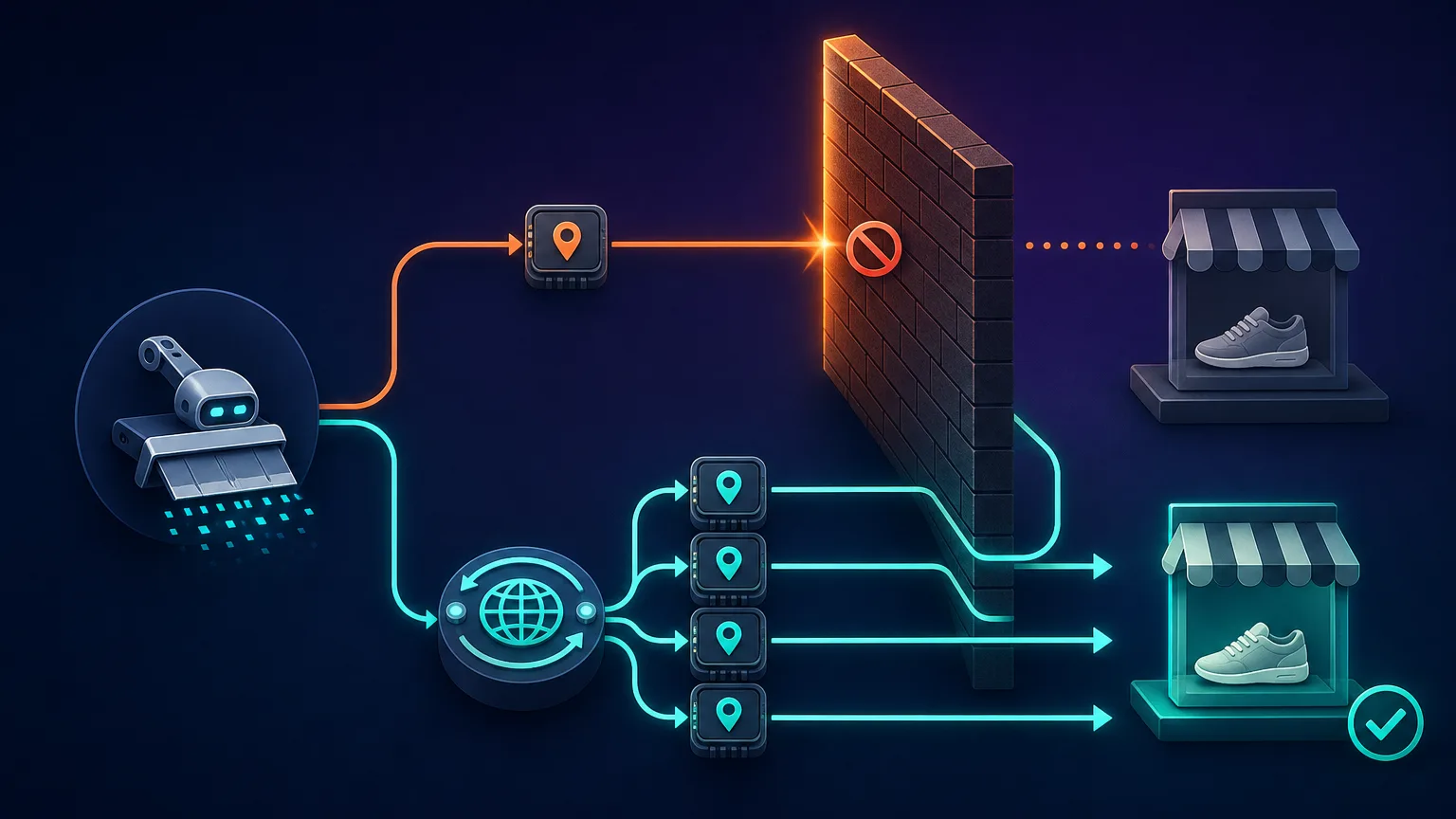
Proxies solve all of this by routing each request through a different IP — ideally a residential one that looks like a real shopper — in the location you care about. Without them, serious Amazon monitoring simply isn't viable.
How proxies enable Amazon price monitoring
The mechanism is straightforward. You send your requests through a rotating proxy gateway; it assigns a fresh IP from a large pool to each request, so your traffic looks like many different shoppers rather than one relentless bot. Pair that with geo-targeting to view the correct marketplace, and you can collect prices at scale.
In code, pointing a request at a rotating residential proxy looks like this:
import requests

# Route each request through a rotating residential proxy endpoint
proxy = "http://USERNAME:PASSWORD@gate.provider.com:7000"
proxies = {"http": proxy, "https": proxy}
headers = {"User-Agent": "Mozilla/5.0 (Windows NT 10.0; Win64; x64)"}

# Fetch an Amazon product page by its ASIN
url = "https://www.amazon.com/dp/B0EXAMPLE1"
resp = requests.get(url, proxies=proxies, headers=headers, timeout=20)
print(resp.status_code)
# Then parse the price and Buy Box from resp.text with your HTML parser
Each run exits from a different IP, and you'd parse the price, availability and Buy Box seller from the returned HTML. Scale that across your target ASINs on a schedule and you have a monitoring pipeline.
At scale, two things matter beyond simply rotating IPs: concurrency and geo-coverage. Monitoring thousands of ASINs means running many requests in parallel, so your provider needs to allow enough simultaneous connections without throttling you. And because Amazon runs a separate marketplace per country, a provider with fresh IPs in each target region lets you read the true local price rather than a geo-redirected guess. A pipeline that gets both right can track a large catalogue across several marketplaces without its success rate quietly collapsing.
What type of proxy is best for Amazon?
Not all proxies are equal against Amazon's defences:
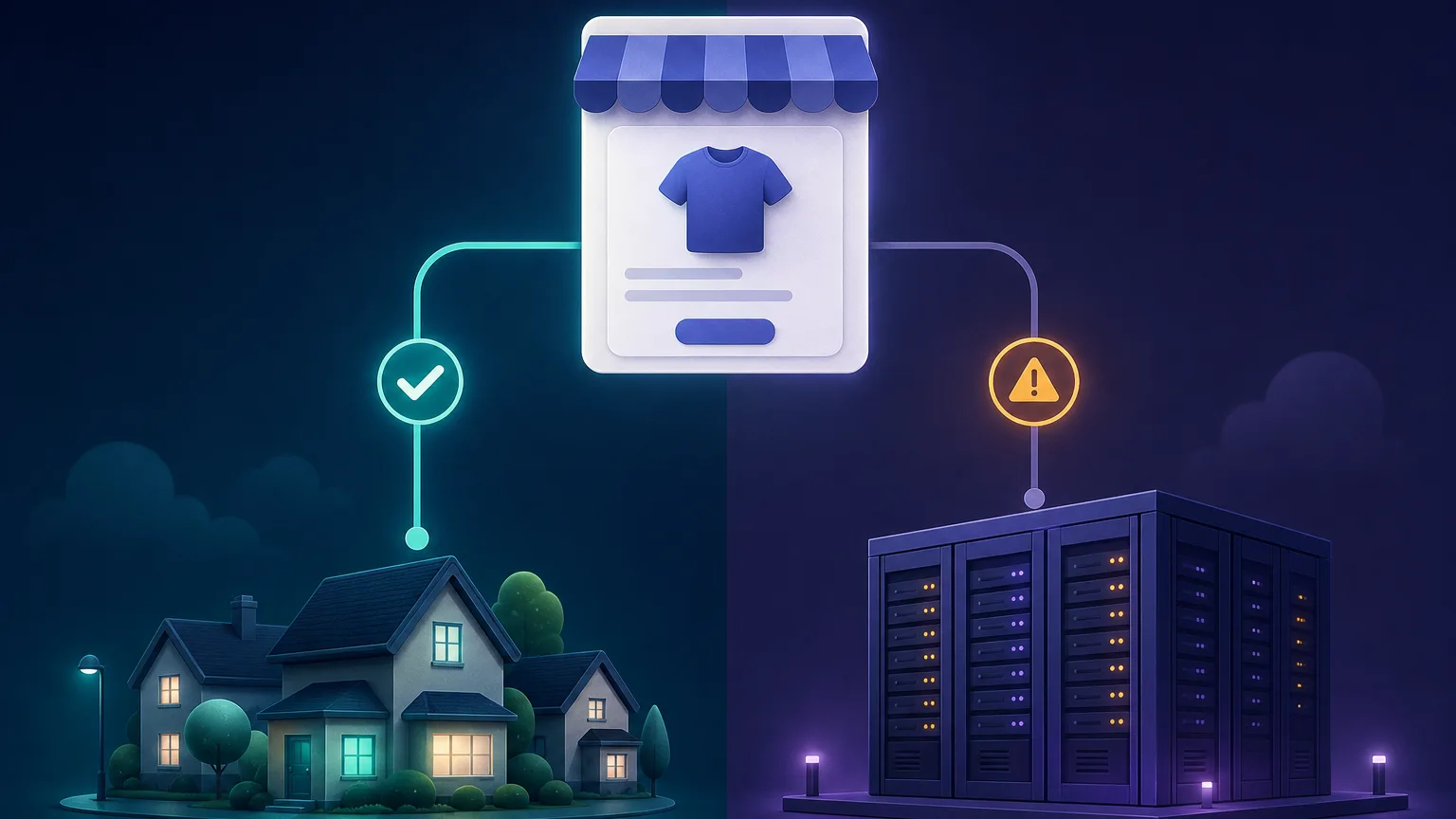
- Residential proxies — real home-ISP IPs that look like ordinary shoppers. The most reliable choice for Amazon and the default recommendation, with the best success rates on product and search pages.
- Datacenter proxies — fast and cheap, but Amazon flags them far more readily. Usable for light, budget monitoring of easy pages, but expect higher block rates.
- Mobile proxies — the most trusted of all, but usually overkill and too expensive for price monitoring; save them for the very hardest targets.
- Scraping APIs — managed services that handle proxies, CAPTCHAs and even parsing for you, returning structured price data. The hands-off option when you'd rather not build anti-block infrastructure.
Raw proxies vs a scraping API: which should you use?
This is the key architecture decision, so weigh it honestly:
| Approach | You handle | Best for |
|---|---|---|
| Raw residential proxies | Rotation, retries, CAPTCHAs, parsing | Teams with engineering resources; lower cost at scale; full control |
| Datacenter proxies | Everything, on cheaper but riskier IPs | Budget, light monitoring of low-defence pages |
| Amazon scraping API | Almost nothing — it returns parsed data | Hands-off setups; unblocking + parsing handled for you; higher per-request cost |
The rule of thumb: if you have developers and volume, raw residential proxies give you the most control and the best economics. If you want structured Amazon data with minimal engineering, a scraping API is worth the premium.
What to look for in an Amazon monitoring proxy
Beyond the network type, these are the factors that decide whether a provider performs on Amazon:
- Clean, fresh residential pool — IPs that aren't already burned on Amazon.
- Geo-targeting by country and city — to view each marketplace's true local pricing and Buy Box.
- High success rate on Amazon specifically — the only metric that matters; test before committing.
- Rotation and sticky sessions — per-request rotation for product pages, sticky for anything stateful.
- A scraping-API option — useful to fall back on for the hardest pages.
- Sensible pricing and concurrency — per-GB rates and enough parallel connections for your catalogue size.
- Ethical sourcing — consent-based IPs from a trustworthy provider.
The best proxies for Amazon price monitoring in 2026
We weighted Amazon success rates, residential-pool quality and freshness, geo-targeting granularity, whether a dedicated e-commerce scraping API is available, rotation control, and value. Each card links to our full review with live pricing and any current coupon.
Bright Data — best for enterprise scale
The largest residential network plus purpose-built tools — a Web Unlocker, a Scraping Browser, and ready-made e-commerce datasets — make it the most powerful option for monitoring huge Amazon catalogues. Premium-priced and complex, but unmatched at scale.
Bright Data
Bright Data remains the most complete data-collection platform money can buy. No competitor matches its combination of network scale, targeting granularity, and compliance tooling — and for enterprise teams whose revenue depends on reliable data, that completeness justifies the premium. The trade-offs are real: it is one of the priciest providers per gigabyte, the interface overwhelms newcomers, and KYC verification adds friction before you can route a single request. Smaller projects will get better value from Decodo or IPRoyal. But if you need city-level residential targeting at scale, a managed unblocker for the hardest targets, and audit-ready compliance, Bright Data is the default — and our highest-rated proxy provider overall.
Oxylabs — best for structured Amazon data
Its E-Commerce Scraper API is designed for marketplaces like Amazon, returning parsed product and pricing data rather than raw HTML, on top of an excellent residential pool. Ideal when you want clean data without building parsers.

Oxylabs
Oxylabs is the enterprise provider that gets the fundamentals right. The network is huge and well-maintained, the scraper APIs are genuinely best-in-class, and the documentation and SDKs make integration faster than almost any competitor. What sets it apart from Bright Data is service: dedicated account managers, responsive support, and cleaner tooling mean less time fighting the platform and more time shipping. The cost is higher entry pricing, and the deepest discounts favor high-volume commitments. For serious commercial data operations that can justify the spend, Oxylabs is a top-two choice and frequently the one teams stay with long-term.
The two enterprise data leaders, head to head:
Bright Data
Proxy
Oxylabs
Proxy
Editor score
User rating
Starting price
Founded
Decodo — best value all-rounder
A large, reliable residential pool with a friendly dashboard, a site-unblocking tool, and approachable per-GB pricing. The easiest balance of performance and cost for small-to-mid Amazon monitoring.

Decodo
Decodo offers the best price-to-performance ratio in the industry. It delivers roughly 90% of what the enterprise leaders provide — high success rates, a large clean pool, sticky sessions, an unblocker — at a fraction of their cost. The dashboard is the friendliest of any major provider, the 14-day money-back guarantee removes the risk of trying it, and support actually responds. The main gaps are enterprise-grade compliance tooling and the very deepest targeting, neither of which most teams need. For startups, solo developers, and any team that wants professional results without enterprise pricing, Decodo is our top value pick and an easy recommendation.
ScraperAPI — best managed scraping option
A scraping API that handles proxy rotation, CAPTCHAs and structured Amazon endpoints behind one request, so you skip building anti-block infrastructure entirely. The fastest path from zero to reliable Amazon data.

ScraperAPI
ScraperAPI nails the "I just want the data" use case. You send a URL, it handles proxies, anti-bot, CAPTCHAs, and rendering, and you get the page back — no infrastructure to maintain. Billing per successful request is genuinely fair, the free tier is generous, and the structured endpoints for Google and Amazon save real work. The trade-off is flexibility: you give up direct IP control, and at very high volumes buying bandwidth directly can be cheaper. For developers who value time over fine-grained control, ScraperAPI is one of the easiest and most reliable ways to scrape at scale.
IPRoyal — best budget residential
Competitively priced pay-as-you-go residential proxies with no aggressive minimums and non-expiring traffic — a practical pick for smaller or intermittent Amazon monitoring on a tight budget.

IPRoyal
IPRoyal is the best pure pay-as-you-go deal in proxies. Non-expiring traffic is a genuinely customer-friendly policy that no major rival matches — buy what you need, use it whenever, lose nothing. The pool is smaller than the premium networks and success rates can soften on the most heavily defended targets, so high-volume enterprise scraping is not its strength. The dashboard is also fairly basic. For intermittent scraping, account work, and sneaker copping on a predictable budget, IPRoyal is an easy recommendation and one of the best value picks for occasional users.
SOAX — best for marketplace geo-targeting
Clean residential and mobile pools with fine-grained country and city targeting, perfect for pulling accurate local pricing from specific Amazon marketplaces around the world.

SOAX
SOAX is the targeting specialist. City- and ISP-level selection on every plan — not locked behind premium tiers — is genuinely rare, and the continuously cleaned pool keeps success rates high where it matters. It is not the fastest network, the interface could use a refresh, and SOCKS5 coverage is uneven. Those are real but minor gripes against a provider that nails the fundamentals of precision and reliability. For ad verification, localized market research, and social-media work that depends on appearing in an exact location, SOAX is one of the best mid-market options available.
How to monitor Amazon prices step by step
- Choose your proxies — rotating residential for reliability, or a scraping API for hands-off structured data.
- Build your target list — the ASINs or product URLs you want to track, per marketplace.
- Set geo-targeting — point the proxy at the country of each marketplace so you see local prices and the correct Buy Box.
- Fetch and parse — request each page through a rotating IP and extract price, availability and seller from the HTML.
- Schedule and store — run on a cadence that matches your needs, save results to a database, and track changes over time.
- Alert on changes — trigger notifications or repricing when a price crosses a threshold.
Match the proxy location to the marketplace
Amazon shows different prices, currencies and Buy Box winners per region. To monitor amazon.de accurately, use German IPs; for amazon.co.uk, UK IPs. Mismatched geo gives you misleading data.
How often should you check Amazon prices?
There is no single correct cadence — it depends on your goal, and over-checking only raises your block rate and bandwidth bill:
- Active repricing — sellers fighting for the Buy Box may check key listings every few minutes to a few hours.
- Competitor and MAP monitoring — once or a few times a day is usually enough to catch meaningful changes.
- Deal and trend tracking — hourly to daily, weighted toward the products that move fastest.
The honest trade-off is frequency versus cost and risk: every check consumes proxy bandwidth and adds a small chance of a block or CAPTCHA. Prioritise your highest-value ASINs for frequent checks and monitor the long tail less often, rather than hammering your entire catalogue on the same tight schedule. Matching cadence to how fast a product's price actually moves is both cheaper and more reliable than blanket high-frequency polling.
Best practices and common mistakes
- Throttle and randomise. Even with rotation, hammering Amazon invites blocks. Add randomised delays between requests.
- Rotate per request for product pages. Each product fetch is stateless, so a fresh IP each time spreads the load.
- Send realistic headers. A clean IP with a bot-like user agent still gets flagged — rotate headers alongside IPs.
- Parse defensively. Amazon's HTML changes often and varies by page layout; build parsers that tolerate missing elements.
- Handle CAPTCHAs gracefully. Detect the robot-check page and retry on a fresh IP rather than pushing through.
- Don't over-fetch. Pulling the same page every few seconds wastes bandwidth and raises your block rate — match frequency to how often prices actually change.
Scrape responsibly
Collect only public pricing data, respect Amazon's terms of service and robots rules, avoid gathering personal data, and don't overload their servers. A VPN or proxy reduces your footprint but doesn't grant permission — stay within legitimate, public-data monitoring.
The bottom line
Amazon price monitoring lives or dies on your proxies, because Amazon blocks everything that looks automated. Rotating residential proxies are the reliable default; datacenter proxies work only for light, budget monitoring; and a scraping API is the hands-off route when you'd rather not build anti-block infrastructure. For scale and tooling, Bright Data and Oxylabs lead; Decodo and IPRoyal offer the best value; ScraperAPI is the quickest managed start; and SOAX shines for marketplace geo-targeting. Pick the right network for your scale, match the proxy location to each marketplace, throttle politely, and you'll have accurate Amazon price data flowing without the blocks.
Frequently asked questions
Scraping publicly available data like prices is generally legal in most jurisdictions, but it does violate Amazon's terms of service, and the realistic consequence is being blocked rather than sued. Collect only public data, avoid personal information, and don't overload Amazon's servers.
Amazon aggressively blocks repeated requests from a single IP with rate limits, CAPTCHAs and bans. Rotating proxies spread your requests across many IPs so your traffic looks like many real shoppers, which is the only reliable way to collect prices at scale.
Rotating residential proxies are best because Amazon trusts real home-ISP IPs far more than datacenter ones. Datacenter proxies are cheaper but get flagged more often, so they suit only light, budget monitoring. Mobile proxies work but are usually overkill for price monitoring.
Raw residential proxies give you the most control and the best economics at scale, but you handle rotation, CAPTCHAs and parsing yourself. A scraping API costs more per request but returns structured price data with the unblocking and parsing done for you - better if you want minimal engineering.
Use geo-targeted proxies in each marketplace's country - German IPs for amazon.de, UK IPs for amazon.co.uk - so you see the correct local prices, currency and Buy Box. Amazon varies pricing by region, so mismatched geo returns misleading data.
You can for light or budget monitoring of low-defence pages, but expect a higher block and CAPTCHA rate because Amazon flags datacenter IP ranges. For consistent success across product and search pages, residential proxies are far more reliable.
Amazon's official APIs (like the Product Advertising API and Selling Partner API) exist but are gated, limited in scope, and not designed for broad competitive price monitoring. That's why most price-tracking relies on scraping public product pages through proxies.
Residential proxies are usually billed per gigabyte, so efficient scraping keeps costs down, while scraping APIs charge per request or a monthly plan. Costs scale with how many products you track and how often, so start with a small plan and test success rates on your ASINs first.